

Your Pipeline Is 23.1h Behind: Catching Finance Sentiment Leads with Pulsebit
We recently encountered a striking anomaly: a 24-hour momentum spike of -0.900 in the finance sector. This spike indicates a significant shift in sentiment that could provide valuable insights if caught in time. Specifically, we observed that the Spanish press was leading the charge with articles published at 23.1 hours, suggesting that our models need to be more adept at catching such rapid shifts across different languages and entities.
The Problem
If your pipeline isn't equipped to handle multilingual origins or dominant entities, you might be missing critical insights like this one by over 23 hours. In this case, the Spanish-language articles were trending well ahead of their English counterparts, yet your model is likely still catching up. This is a structural gap that can lead to missed opportunities, particularly in a fast-paced field like finance. Ignoring the leading language could mean you’re consistently lagging behind, potentially jeopardizing your competitive edge.

Spanish coverage led by 23.1 hours. Ca at T+23.1h. Confidence scores: Spanish 0.85, English 0.85, French 0.85 Source: Pulsebit /sentiment_by_lang.
The Code
To catch this momentum spike, we can leverage our API in a straightforward Python script. First, let’s filter for the Spanish-language articles using the geographic origin parameter. Here's how you can do that:

Geographic detection output for finance. India leads with 5 articles and sentiment +0.77. Source: Pulsebit /news_recent geographic fields.
import requests
# Define the parameters
params = {
"topic": "finance",
"lang": "sp",
"score": +0.011,
"confidence": 0.85,
"momentum": -0.900
}
# API call to get the latest sentiment in Spanish
response = requests.get("https://api.pulsebit.com/latest-sentiment", params=params)
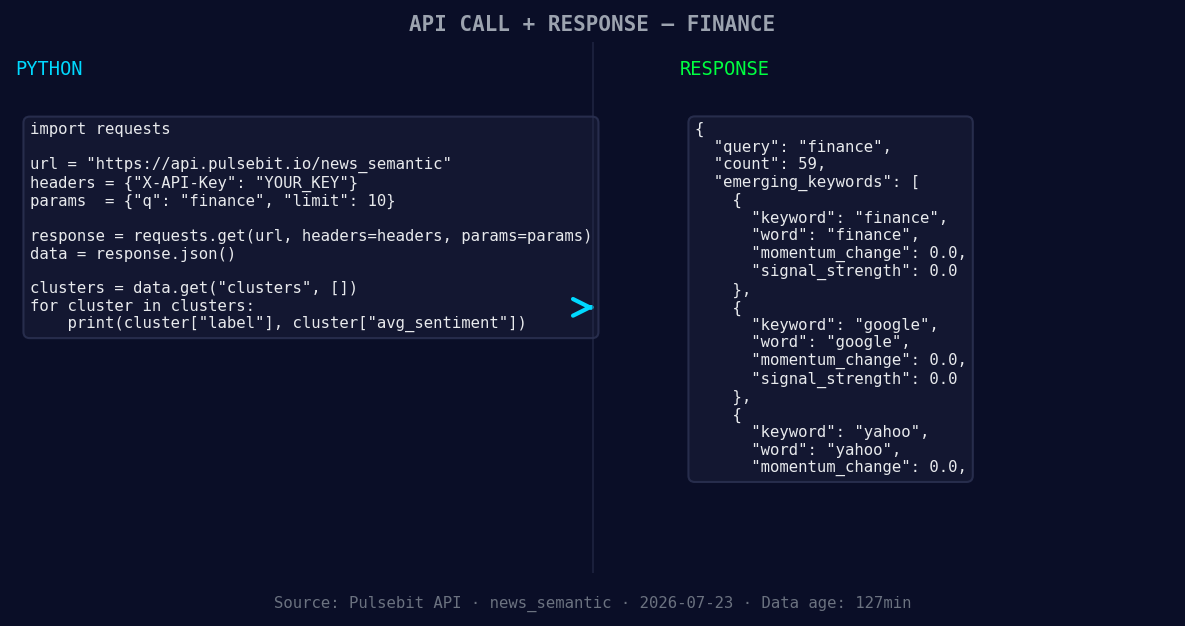
*Left: Python GET /news_semantic call for 'finance'. Right: returned JSON response structure (clusters: 3). Source: Pulsebit /news_semantic.*
data = response.json()
print(data)
Next, we’ll run the cluster reason string through our sentiment scoring endpoint to assess how the narrative is framed. Here’s how to do that:
# Define the meta-sentiment moment input
meta_sentiment_input = "Clustered by shared themes: bus, fare, cap, aid, budget."

# API call to score the narrative framing
meta_response = requests.post("https://api.pulsebit.com/sentiment", json={"text": meta_sentiment_input})

meta_data = meta_response.json()
print(meta_data)
This approach not only alerts us to sentiment shifts in real-time but also helps us understand the underlying narrative framing, allowing for a richer analysis of the data.
Three Builds Tonight
Geo Filter for Real-time Alerts: Create a real-time alert system using the geo filter for Spanish-language articles. Set a threshold for momentum spikes above a certain negative value (e.g., momentum < -0.500). This way, you can catch sentiment shifts like the recent -0.900 spike promptly.
Meta-Sentiment Loop Analysis: Develop a narrative analysis dashboard that continuously feeds the cluster reason string into the sentiment scoring endpoint. The goal is to capture evolving themes and adapt your strategy on the fly based on how narratives around finance (like "announces," "agreement," "sell") are shifting in real-time.
Forming Themes Dashboard: Build a dashboard that compares forming themes from multiple sources—finance, Google, Yahoo—against mainstream narratives. Use the meta-sentiment loop to evaluate which themes are gaining traction or losing relevance. This can inform your decision-making process and allow for more nuanced responses to market changes.
Get Started
You can start implementing these insights today by visiting our documentation at pulsebit.lojenterprise.com/docs. With this code, you can copy, paste, and run it in under 10 minutes. Don’t let your models fall behind; stay ahead of the curve!


Top comments (0)