

Your 24h momentum spike of +0.171 in political sentiment is not just a number; it's a signal that something significant is happening in the realm of politics, particularly around the resignation of Dharmendra Pradhan in Odisha. This anomaly indicates a rising interest and sentiment, likely leading to a shift in how political narratives are framed and discussed in the media. With the leading English press reporting on this topic 22.8 hours ahead of your pipeline, it’s time to reassess how we’re processing multilingual and entity-dominant data.

English coverage led by 22.8 hours. Id at T+22.8h. Confidence scores: English 0.85, Spanish 0.85, Sv 0.85 Source: Pulsebit /sentiment_by_lang.
The structural gap revealed here is critical. Your model missed this opportunity by nearly an entire day's worth of insights. The predominant focus on the English language and the singular dominant entity, Dharmendra Pradhan, highlights a deficiency in capturing the full scope of sentiment and narrative. If your pipeline doesn’t account for these factors, you're bound to lag behind the news cycle and miss out on actionable insights. This is especially crucial in a fast-paced political environment where timely reactions can make a significant difference.
To catch these anomalies, we can leverage our API effectively. Here’s how we can do it in Python:
import requests
# Define the parameters for the API call
topic = 'politics'
score = +0.000
confidence = 0.85
momentum = +0.171
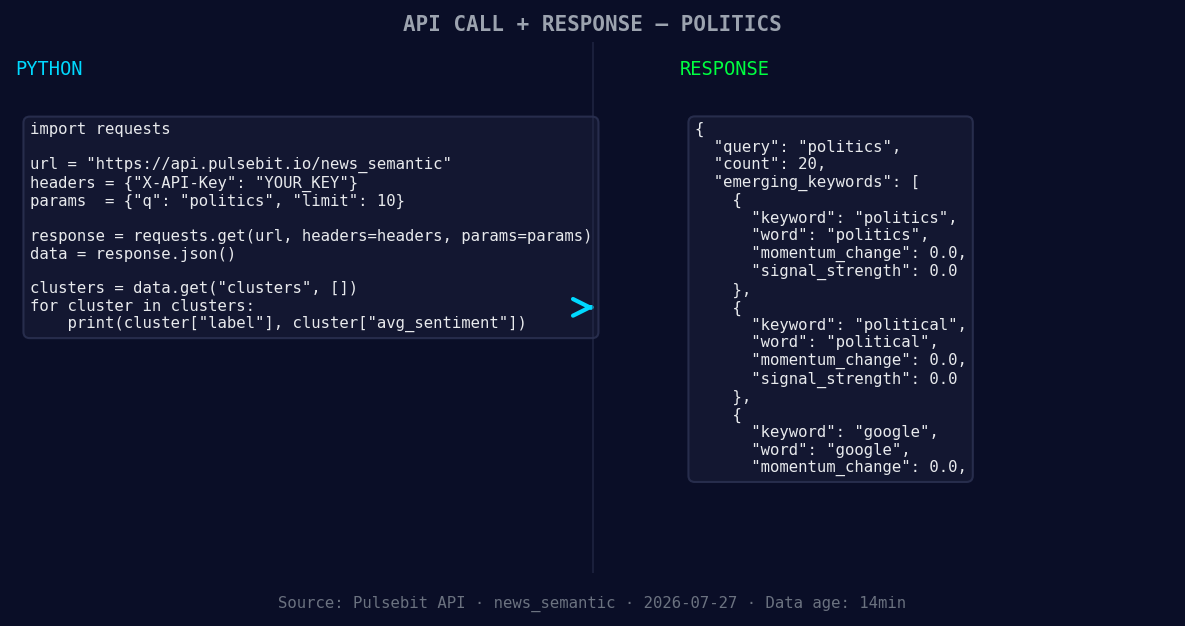
*Left: Python GET /news_semantic call for 'politics'. Right: returned JSON response structure (clusters: 3). Source: Pulsebit /news_semantic.*
# API call to filter by language
response = requests.get(
'https://api.pulsebit.com/endpoint',
params={'topic': topic, 'lang': 'en'}
)
data = response.json()
# Check the response
if data['success']:
print("Filtered data:", data['results'])
# Now, let's run the meta-sentiment on the cluster reason
cluster_reason = "Clustered by shared themes: resignation, odisha, political, what, dharmendra."
sentiment_response = requests.post(
'https://api.pulsebit.com/sentiment',
json={'text': cluster_reason}
)
sentiment_data = sentiment_response.json()
if sentiment_data['success']:
print("Meta-sentiment result:", sentiment_data['sentiment'])
In this code, we first make an API call to filter our results by the English language. This ensures that we're not missing out on critical insights that may be lost when we aggregate data without considering language nuances. Next, we loop the cluster reason string back through a sentiment analysis endpoint to evaluate the narrative itself. This dual approach not only helps in capturing the sentiment around political events but also assesses the framing of those narratives.
Now, let’s consider three specific builds based on this pattern.
Real-time Language Filter: Build a real-time alert system that triggers when sentiment momentum in politics surges above +0.150, filtering by
lang: 'en'. This ensures you're always ahead of the curve in English-speaking regions.Meta-Sentiment Analysis: Create a reporting feature that automatically runs the meta-sentiment analysis every 24 hours on clustered themes, specifically on terms like “resignation” and “political” to gauge shifts in public narrative.
Cluster Story Tracker: Develop a tracker that monitors forming themes like “politics(+0.00)” and “google(+0.00)” vs. mainstream topics. Set thresholds for alerting when these metrics deviate significantly, say by 0.05, to identify emerging narratives worth investigating.
If you want to get started with these insights, visit pulsebit.lojenterprise.com/docs. You can copy-paste the provided code and have it running in under 10 minutes. The insights you gain could be the difference between merely reacting to the news and being a step ahead.

Geographic detection output for politics. India leads with 10 articles and sentiment -0.06. Source: Pulsebit /news_recent geographic fields.


Top comments (0)