

Your model just missed a significant 24h momentum spike of +0.330 in the sentiment around machine learning. This is not just a small blip; it’s a notable uptick that you need to pay attention to. The leading language here is English, and it’s particularly interesting that the sentiment is driven by a cluster story about the "Impact of Machine Learning on F1 Racing." It’s a reminder of how quickly sentiment can shift and how easily you might fall behind if your pipeline isn’t tuned to catch these changes in real time.
This anomaly reveals a structural gap in any pipeline that doesn’t account for multilingual sources and dominance in entities. If your model isn’t set up to recognize that the English press led this sentiment surge 22.4 hours ago, you’re already trailing behind. You might be analyzing last week’s news while critical developments are happening just beyond your reach. This oversight can lead to missed opportunities in fast-paced environments, especially when you consider how machine learning is transforming industries like racing.

English coverage led by 22.4 hours. Nl at T+22.4h. Confidence scores: English 0.85, Spanish 0.85, French 0.85 Source: Pulsebit /sentiment_by_lang.
Let’s write some Python code to catch this important sentiment shift. First, we’ll filter the data to focus on English-language sources using our API. Here’s how you can do it:
import requests
# Define parameters for the API call
topic = 'machine learning'
score = +0.330
confidence = 0.85
momentum = +0.330
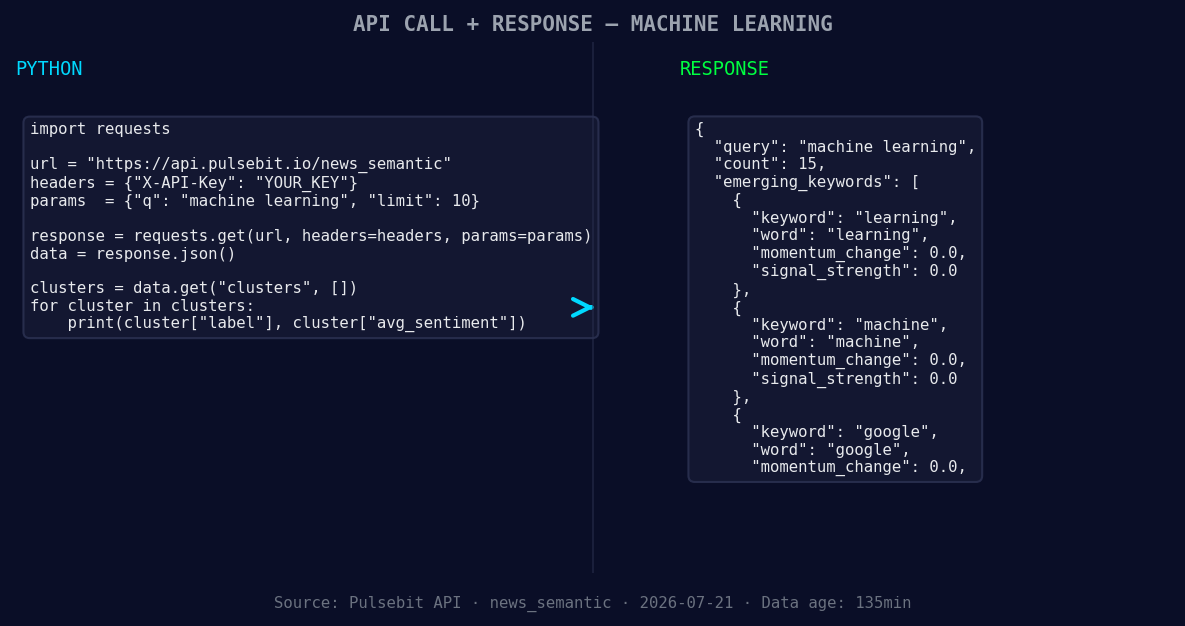
*Left: Python GET /news_semantic call for 'machine learning'. Right: returned JSON response structure (clusters: 3). Source: Pulsebit /news_semantic.*
# API call filtering for English language
url = "https://api.pulsebit.com/v1/sentiment"
params = {
"topic": topic,
"lang": "en"
}
response = requests.get(url, params=params)
data = response.json()
print(data)
Now, let’s turn our attention to the cluster reason string. We’ll run it back through the POST /sentiment endpoint to score the narrative framing itself. Here’s the code snippet for that:
# Define the cluster reason string
cluster_reason = "Clustered by shared themes: belgium:, machine, learning, algorithms, ruining."

# Making a POST request to score the narrative
url = "https://api.pulsebit.com/v1/sentiment"
payload = {
    "text": cluster_reason
}

response = requests.post(url, json=payload)
narrative_score = response.json()
print(narrative_score)
This two-step process allows us to not only filter sentiment by the leading English press but also to analyze the narrative framing itself. It’s a powerful way to understand the context behind the data, revealing just how interconnected these themes are.
So, what can we build with this newfound insight? Here are three specific things to consider:
- Geographic Origin Filter: Use the geo filter on machine learning topics with a momentum greater than +0.300 to monitor specific regions. Set your threshold for alerts at +0.330 to catch spikes early.
![DATA UNAVAILABLE: countries — verify /news_recent is return
[DATA UNAVAILABLE: countries — verify /news_recent is returning country/region values for topic: machine learning]
Meta-Sentiment Loop: Implement the meta-sentiment loop by scoring cluster reasons that mention the forming themes like "learning" and "machine." This can help you track how discourse changes over time and identify key drivers of sentiment.
Anomaly Detection: Create an anomaly detection system that flags any sentiment toward machine learning with a momentum score over +0.300. Pair this with the geo filter to see if specific countries are driving the narrative.
This approach gives you a sharp edge in understanding how sentiment shifts in real time.
If you want to get started, check out our documentation at pulsebit.lojenterprise.com/docs. You can copy-paste and run the provided code in under 10 minutes to catch these important signals.


Top comments (0)