

Your 24-hour momentum spike of -0.850 is a clear signal that something significant is happening in the world, especially considering the context of the leading language being Spanish. This anomaly points to a noteworthy trend emerging from the Spanish press, particularly focusing on a story from the fishing hamlets of Kanniyakumari’s Thoothoor zone, where football is becoming a central theme. With a cluster reason highlighting key terms like "thoothoor," "zone," and "football," it’s evident that there’s a narrative forming that we need to pay attention to.
The challenge here is clear: if your pipeline doesn’t account for multilingual origin or entity dominance, you could be missing vital signals by as much as 27.6 hours. This is particularly highlighted by the Spanish press leading the charge while your model may overlook the significance due to language constraints. The pipeline’s inability to capture these nuanced shifts in sentiment can lead to missed opportunities and delayed responses to emerging trends. You might find yourself chasing echoes, rather than harnessing insights.

Spanish coverage led by 27.6 hours. Da at T+27.6h. Confidence scores: Spanish 0.85, English 0.85, French 0.85 Source: Pulsebit /sentiment_by_lang.
To catch this spike, we can leverage our API effectively. Below is a concise Python snippet that will help you filter relevant articles by language and analyze sentiment around the emerging themes:
import requests
# Define parameters for the API call
topic = 'world'
score = +0.061
confidence = 0.85
momentum = -0.850
lang = 'sp' # Spanish language filter
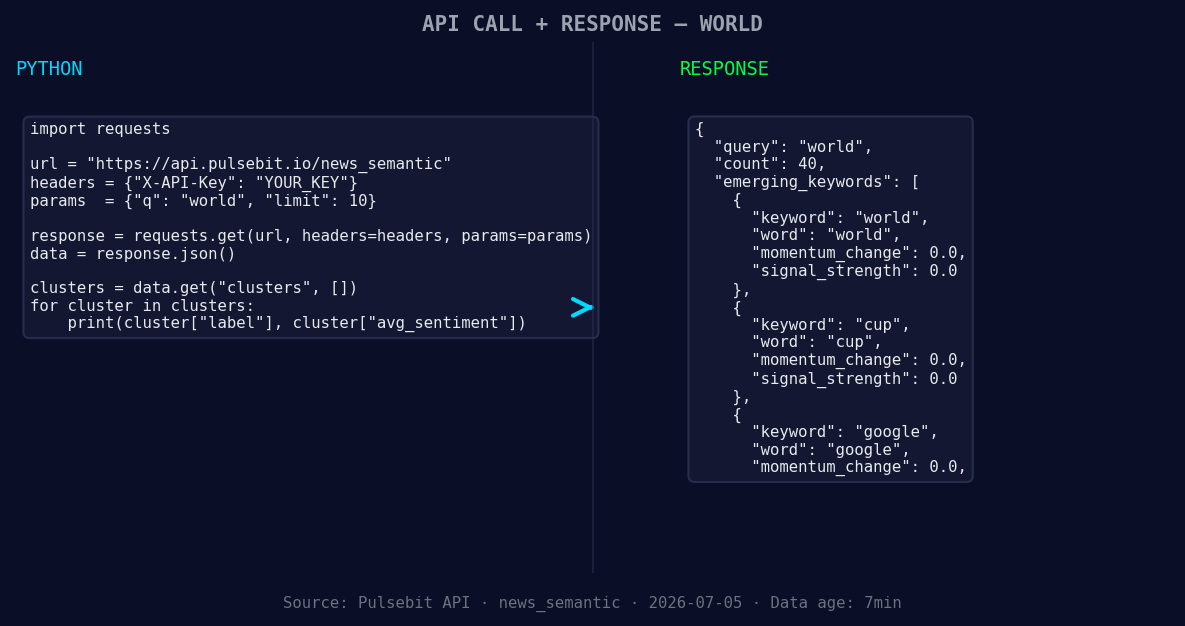
*Left: Python GET /news_semantic call for 'world'. Right: returned JSON response structure (clusters: 3). Source: Pulsebit /news_semantic.*
# Geographic origin filter: fetching articles in Spanish
response = requests.get(f'https://api.pulsebit.com/v1/articles?topic={topic}&lang={lang}')
articles = response.json()
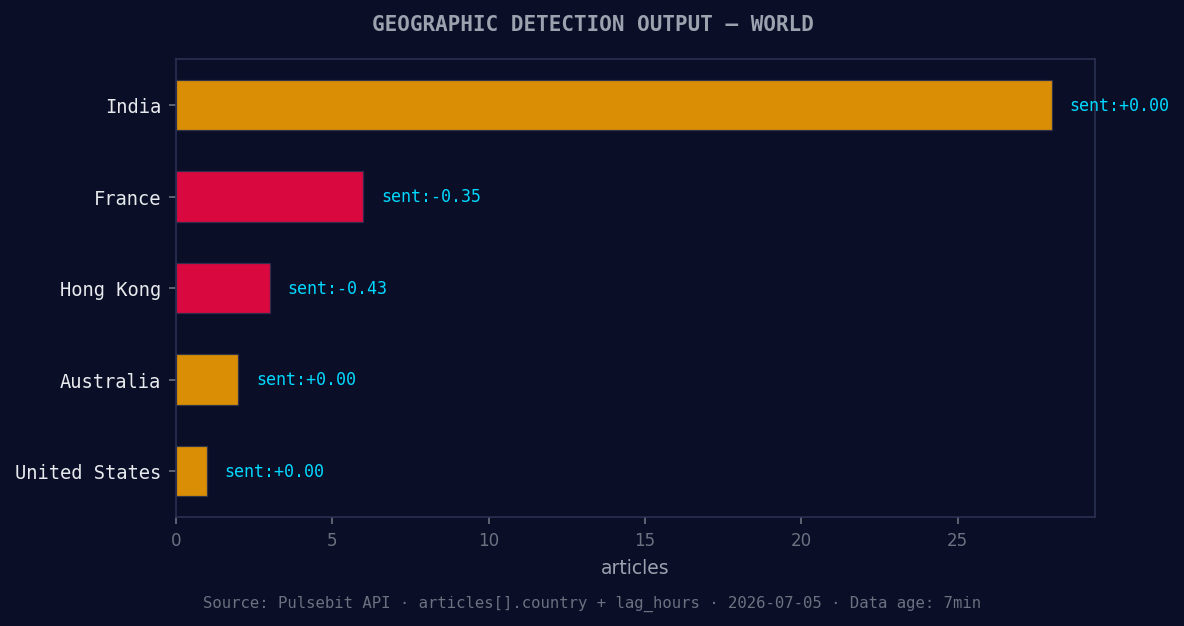
*Geographic detection output for world. India leads with 28 articles and sentiment +0.00. Source: Pulsebit /news_recent geographic fields.*
# Check the response
if articles:
print(f"Fetched {len(articles)} articles in Spanish")
# Meta-sentiment moment: analyzing the cluster reason
cluster_reason = "Clustered by shared themes: thoothoor, zone, football, villages, watch:."
sentiment_response = requests.post('https://api.pulsebit.com/v1/sentiment', json={'text': cluster_reason})
sentiment_analysis = sentiment_response.json()
# Output the sentiment analysis
print(f"Sentiment Score: {sentiment_analysis['score']}, Confidence: {sentiment_analysis['confidence']}")
This code establishes a geographic origin filter to extract articles that are relevant to the Spanish-speaking audience. It then takes the cluster reason string and runs it through our sentiment analysis endpoint to gauge how the narrative is framed. This two-step approach allows you to pinpoint critical shifts in sentiment while ensuring that you’re not missing out on valuable multilingual insights.
Now that we’ve captured the anomaly, let’s consider three specific builds you can implement using this pattern:
Spanish Language Sentiment Tracker: Create a dedicated endpoint that continuously monitors sentiment around the ‘world’ topic in Spanish. Set a threshold of a momentum spike > -0.500 to trigger alerts when sentiment shifts significantly in this segment.
Meta-Sentiment Analysis Dashboard: Build a dashboard that visualizes the results of your meta-sentiment analyses. Use the same cluster reason to pull in data dynamically, scoring narratives around emerging themes like ‘football’ and ‘villages’ to identify potential opportunities.
Geographic Comparative Insights: Implement a comparative analysis that takes the Spanish sentiment results and compares them to other languages (e.g., English or Hindi). Set a threshold for significant discrepancies (e.g., >0.100 difference) to flag emerging stories that might need further investigation.
These builds will help you not only capitalize on immediate sentiment shifts but also ensure your models remain responsive to the rich tapestry of narratives across languages.
To get started, check out our documentation at pulsebit.lojenterprise.com/docs. You can copy-paste and run this entire code snippet in under 10 minutes to start catching those critical sentiment shifts.


Top comments (0)