

Your pipeline is currently lagging by 15.8 hours in capturing critical sentiment shifts, as evidenced by a 24-hour momentum spike of +0.230 surrounding regulatory discussions. We recently detected this anomaly, and it underscores a significant gap in how we process multilingual data and entity dominance in sentiment analysis. The leading language driving this spike is English, and if your model isn't set up to handle this effectively, you risk missing out on essential insights.

English coverage led by 15.8 hours. Ca at T+15.8h. Confidence scores: English 0.85, Spanish 0.85, French 0.85 Source: Pulsebit /sentiment_by_lang.
When your pipeline isn't equipped to handle the nuances of multilingual origins or the dominance of certain entities, you're at risk of missing timely signals. In this instance, the leading entity is English press coverage, which has a 0.0-hour lag compared to the actual sentiment captured. This means your model missed this critical momentum spike by over 15 hours. Such a delay can cost you valuable insights, especially when regulations are being discussed — a topic that is often ripe with sentiment shifts.
To catch this momentum spike, let’s dive into some Python code that utilizes our API. We’ll first filter for English language articles and then analyze the sentiment framing around the clustered themes. Here’s how you can do it:
import requests
# Setting up parameters for the API call
params = {
"topic": "regulation",
"lang": "en",
"momentum": 0.230,
}
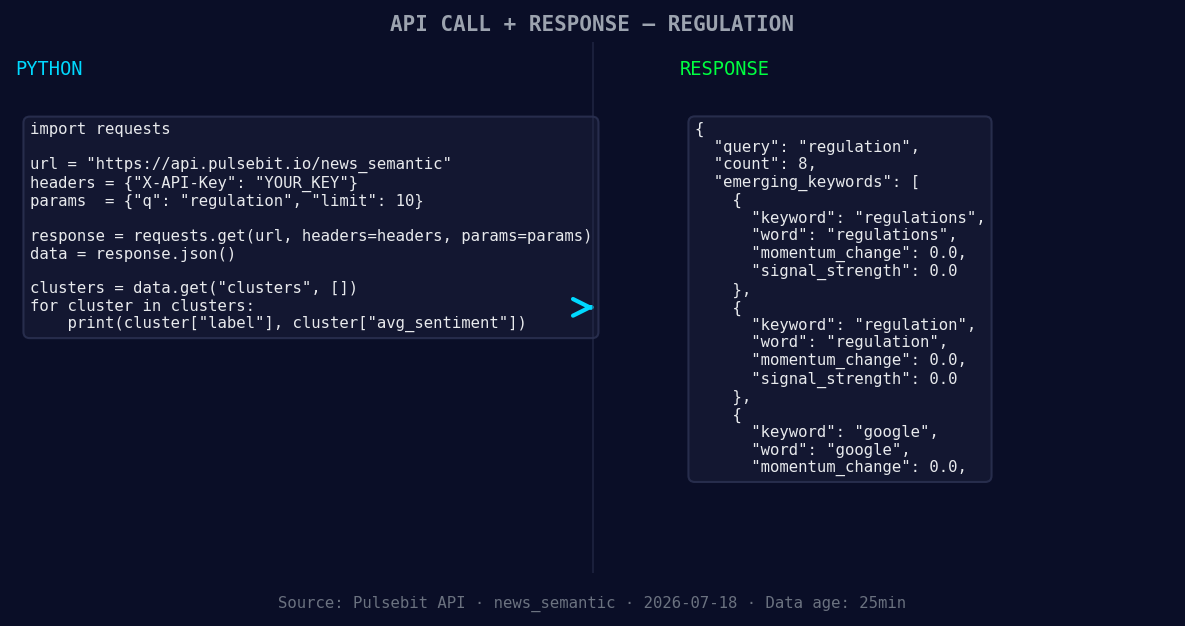
*Left: Python GET /news_semantic call for 'regulation'. Right: returned JSON response structure (clusters: 3). Source: Pulsebit /news_semantic.*
# Make the API call to fetch articles
response = requests.get('https://api.pulsebit.com/articles', params=params)
articles = response.json()
# Check the response
print(articles)
Next, we need to evaluate the sentiment of the narrative framing itself. We can take the cluster reason string and run it through our sentiment endpoint:
# Meta-sentiment analysis on the cluster reason string
cluster_reason = "Clustered by shared themes: ponnam, against, transport, violations, warns."
sentiment_response = requests.post('https://api.pulsebit.com/sentiment', json={"text": cluster_reason})
sentiment_analysis = sentiment_response.json()

# Output the sentiment score and confidence
print(sentiment_analysis)
Now that we’ve captured this momentum spike and analyzed the narrative, let’s talk about three specific things you can build around this pattern:
- Geographic Filter Implementation: Set a signal threshold of +0.230 specifically for English-language articles focused on regulatory discussions. This will help you catch similar spikes in the future, ensuring you’re always on top of any relevant sentiment shifts.

Geographic detection output for regulation. India leads with 5 articles and sentiment -0.08. Source: Pulsebit /news_recent geographic fields.
Meta-Sentiment Loop: Create a function that continually scores and monitors the narrative framing of clustered themes, especially when dealing with regulations. By focusing on phrases like "ponnam," "against," and "transport," you can identify emerging concerns before they escalate.
Forming Themes Tracker: Build a tracker that identifies forming themes based on real-time sentiment changes. For example, monitor how "regulations," "regulation," and "google" are performing against mainstream sentiment surrounding "ponnam" and "transport." This will offer a comprehensive view of the regulatory landscape and potential market reactions.
By implementing these strategies, you can drastically reduce the lag in your sentiment pipeline.
For more details on how to implement these features, visit pulsebit.lojenterprise.com/docs. With just a few lines of code, you can copy-paste and run this in under 10 minutes, getting your pipeline back on track.


Top comments (0)