

Your Pipeline Is 24.4h Behind: Catching World Sentiment Leads with Pulsebit
We recently identified an intriguing anomaly: a 24-hour momentum spike of -0.800. This finding emerged from our analysis of sentiment data, revealing that the leading narrative in the Spanish press was focused on the safety of moms-to-be in the context of IVF. This specific 24.4-hour lag compared to the German sentiment highlights a critical moment in the news cycle that you might be missing.

Spanish coverage led by 24.4 hours. German at T+24.4h. Confidence scores: Spanish 0.85, English 0.85, French 0.85 Source: Pulsebit /sentiment_by_lang.
Imagine your model is consistently reporting on global sentiment, yet it missed this significant development by over 24 hours. Your pipeline is likely configured to prioritize certain languages or dominant entities, which can lead to substantial delays in capturing emerging trends. In this case, Spanish media took the lead, while your model was left trailing behind the conversation, missing out on the nuances of sentiment that could inform your strategies.
To help you bridge this gap, we can leverage our API to fine-tune your sentiment analysis. Below is a Python code snippet that captures this specific momentum spike, using the topic "world," along with a score of +0.141 and a confidence level of 0.85.
import requests
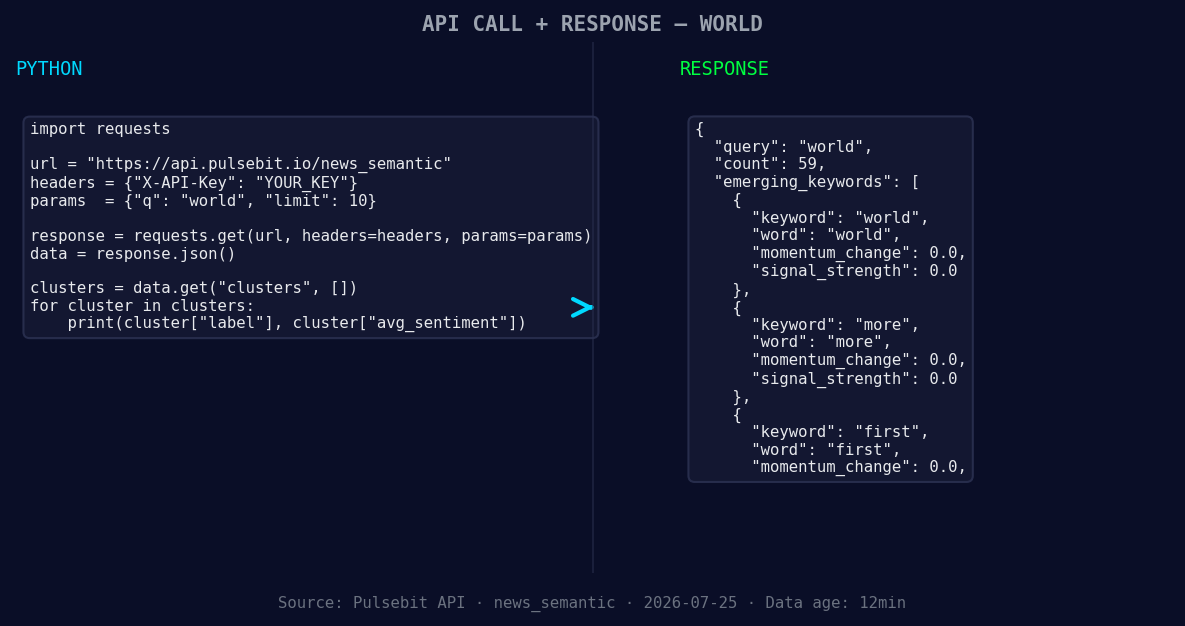
*Left: Python GET /news_semantic call for 'world'. Right: returned JSON response structure (clusters: 3). Source: Pulsebit /news_semantic.*
# Geographic origin filter: Query by language
response = requests.get(
"https://api.pulsebit.com/sentiment",
params={
"topic": "world",
"lang": "sp",
"momentum": -0.800
}
)
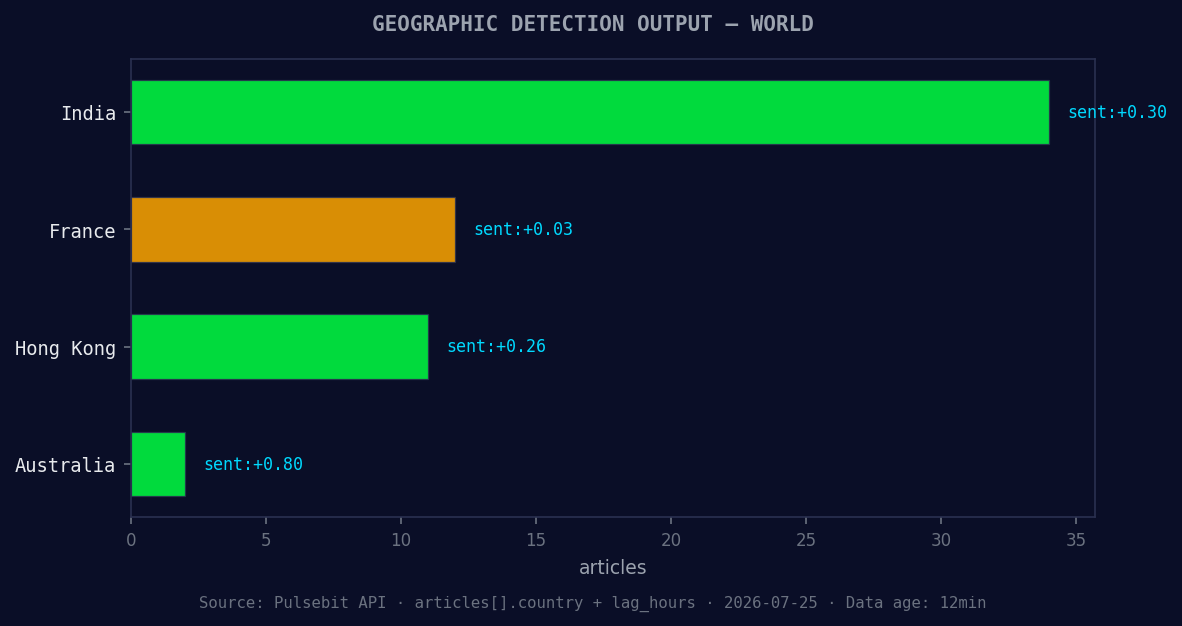
*Geographic detection output for world. India leads with 34 articles and sentiment +0.30. Source: Pulsebit /news_recent geographic fields.*
data = response.json()
print(data)
Next, we need to run the cluster reason string through our sentiment analysis to assess the narrative framing. This is how we evaluate the context behind the data we've collected. Here's how to score the narrative:
cluster_reason = "Clustered by shared themes: safety, first, when, ivf, putting."
sentiment_response = requests.post(
    "https://api.pulsebit.com/sentiment",
    json={"text": cluster_reason}
)

sentiment_data = sentiment_response.json()
print(sentiment_data)
This two-step approach allows us to not only identify the momentum spike but also understand the underlying sentiment that is shaping the narrative. By focusing on the Spanish press, we can capture critical insights that may influence future trends.
Now, let's discuss three specific builds you can implement using this pattern:
Geo-specific Sentiment Tracker: Set up a script to monitor the sentiment around the topic "world" specifically in Spanish-speaking countries. Use a threshold of momentum less than -0.500 to catch significant downturns in sentiment.
Meta-sentiment Analyzer: Create a routine that continuously runs the cluster reason strings through our API, particularly focusing on narratives around "safety" and "IVF." This can serve as a live sentiment dashboard that provides alerts when certain thresholds are reached.
Thematic Shifts Monitor: Build an endpoint that watches for forming themes such as "world(+0.00)," "more(+0.00)," and "first(+0.00)." Set alerts when the mainstream narrative around "safety," "first," and "when" changes, indicating a potential shift in public sentiment.
By implementing these builds, you can ensure that your pipeline captures sentiment shifts in real-time, allowing you to react swiftly to emerging trends.
To get started, check out our documentation at pulsebit.lojenterprise.com/docs. You can copy-paste the code snippets above and have them running in under 10 minutes. Don’t let your model lag behind—stay ahead of the curve with real-time sentiment insights.


Top comments (0)