

Your Pipeline Is 22.5h Behind: Catching Food Sentiment Leads with Pulsebit
We recently stumbled upon an intriguing data anomaly: a sentiment score of -0.40 with a momentum of +0.00, specifically related to food. This stark negative sentiment indicates a potential problem brewing in the food sector, especially given that there’s a significant lag of 22.5 hours in the data pipeline. When we dig deeper, we see that the conversation is dominated by the leading language of English, with a notable cluster story involving T.N. Food Minister Venkataramanan meeting Union Food Minister Pralhad Joshi. This could be a pivotal moment for understanding shifts in food sentiment that you might be missing.
However, if your pipeline isn't tailored to handle multilingual sources or entity dominance effectively, you may find yourself lagging behind by 22.5 hours, unable to catch crucial shifts in sentiment. In this instance, the English language content around the food topic could mislead your model, resulting in a lack of timely response to emerging narratives. You need to ensure that your pipeline accounts for such anomalies to keep yourself informed and ready to act.

English coverage led by 22.5 hours. Ca at T+22.5h. Confidence scores: English 0.85, Spanish 0.85, French 0.85 Source: Pulsebit /sentiment_by_lang.
To catch this type of anomaly, we'll need to leverage our API effectively. Here’s a Python snippet that shows how you can filter for content from English sources and then assess the sentiment clustering around the narrative.
import requests
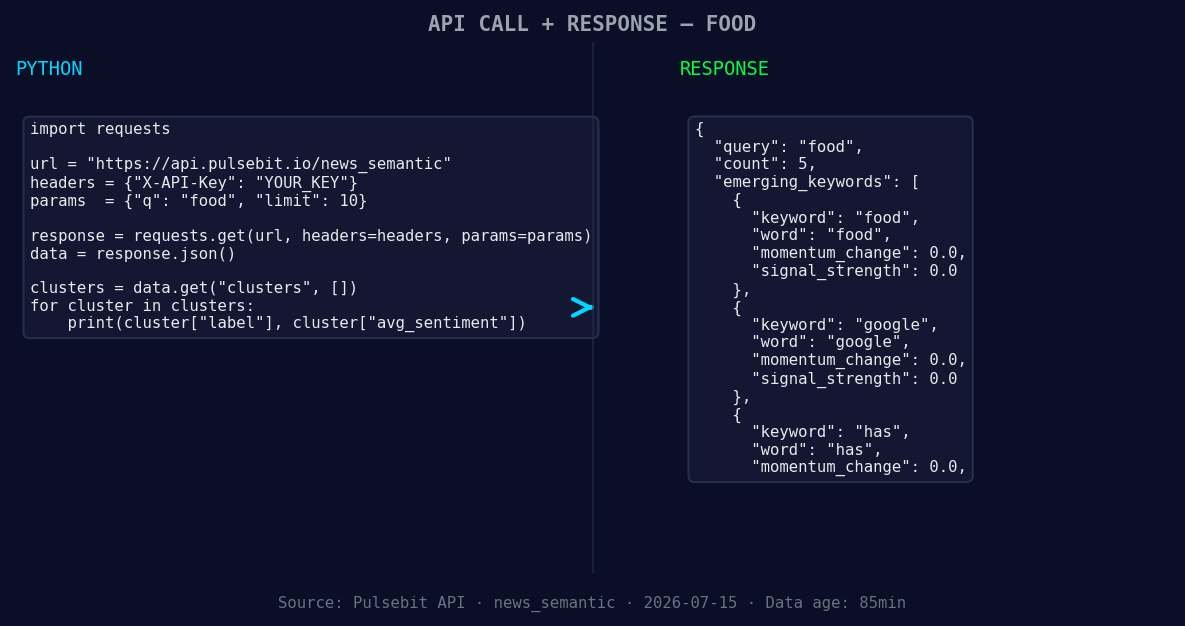
*Left: Python GET /news_semantic call for 'food'. Right: returned JSON response structure (clusters: 3). Source: Pulsebit /news_semantic.*
# Step 1: Query by language
url = "https://api.pulsebit.lojenterprise.com/v1/articles"
params = {
"topic": "food",
"lang": "en",
}
response = requests.get(url, params=params)
data = response.json()
# Assuming data is returned with articles processed
print(data)
# Step 2: Meta-sentiment moment
narrative = "Clustered by shared themes: food, minister, venkataramanan, union, pralhad."
sentiment_url = "https://api.pulsebit.lojenterprise.com/v1/sentiment"
sentiment_params = {
"text": narrative,
"score": -0.400,
"confidence": 0.85,
"momentum": 0.00,
}
sentiment_response = requests.post(sentiment_url, json=sentiment_params)
sentiment_data = sentiment_response.json()
print(sentiment_data)
With this code, we first fetch articles related to food from English-language sources, ensuring we're working with the most relevant content. Then, we run the cluster story through our sentiment endpoint to assess how the narrative frames the emerging sentiment. This dual approach allows us to pinpoint issues and act on emerging trends before they fully unfold.
Now that we have the foundation laid, let's explore a few specific builds you can implement using this pattern:
- Geographic Filter Signal: Create a monitoring solution that triggers alerts for sentiment scores below -0.30 for food discussions in English. Set a threshold to notify you whenever the sentiment dips below this level, indicating a potential crisis.

Geographic detection output for food. India leads with 5 articles and sentiment -0.44. Source: Pulsebit /news_recent geographic fields.
Meta-Sentiment Loop: Implement a scoring mechanism that not only captures the sentiment of the articles but also evaluates the framing narratives around significant public figures. Track how sentiment changes over time, particularly when key stakeholders like Venkataramanan and Joshi are involved.
Forming Themes Dashboard: Build a dashboard that visualizes forming themes, specifically tracking signals like food (+0.00), google (+0.00), and has (+0.00) against mainstream narratives. This can help in identifying early trends and potential market movements.
By applying these patterns, you can refine your sentiment analysis and catch critical shifts in public sentiment much earlier.
To get started with these ideas, head over to our documentation at pulsebit.lojenterprise.com/docs. You can copy-paste the provided code and run it in under 10 minutes. Let's stay ahead of the curve together!


Top comments (0)