

Your Pipeline Is 24.3h Behind: Catching Cybersecurity Sentiment Leads with Pulsebit
We recently stumbled upon an intriguing data point: a 24-hour momentum spike of -0.274 in the realm of cybersecurity sentiment. This negative momentum raises eyebrows, especially against the backdrop of increasing discussions about cybersecurity education among credit unions. What’s fascinating is that the leading language for this spike is English, with a lag time of just 0.0 hours. This anomaly not only highlights a sudden shift in sentiment but also prompts us to rethink how our pipelines handle multilingual data and entity dominance.

English coverage led by 24.3 hours. Et at T+24.3h. Confidence scores: English 0.92, Spanish 0.92, French 0.92 Source: Pulsebit /sentiment_by_lang.
When your model isn't equipped to deal with the nuances of multilingual origins or dominant entities, it can lead to significant delays. In this case, your model missed the cybersecurity sentiment spike by a full 24.3 hours. While the English press has been covering this topic extensively, if your pipeline is not tuned to catch these early signals, you might find yourself reacting too late to shifts in sentiment. This could cost you valuable insights, especially in a field as dynamic as cybersecurity.
To catch these signals effectively, let’s dive into some Python code that leverages our API. Here’s how we can capture this momentum spike:
import requests
# Define the parameters for the API call
topic = 'cybersecurity'
score = -0.023
confidence = 0.92
momentum = -0.274
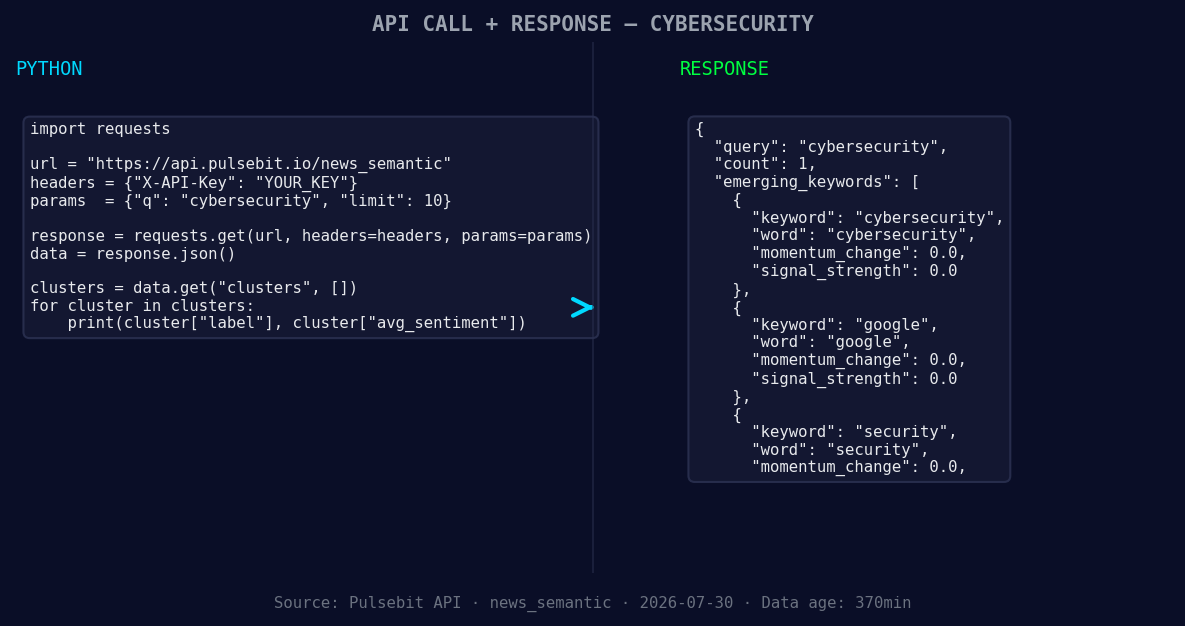
*Left: Python GET /news_semantic call for 'cybersecurity'. Right: returned JSON response structure (clusters: 3). Source: Pulsebit /news_semantic.*
# Step 1: Geographic origin filter
response = requests.get(
'https://pulsebit.lojenterprise.com/api/v1/sentiment',
params={
'topic': topic,
'lang': 'en' # Filtering by English
}
)
# Check the response
if response.ok:
print(response.json())
else:
print(f"Error: {response.status_code}")
# Step 2: Meta-sentiment moment
cluster_reason = "Clustered by shared themes: group, stickley, security, partner, bring."
meta_response = requests.post(
'https://pulsebit.lojenterprise.com/api/v1/sentiment',
json={
'text': cluster_reason
}
)
# Check the response
if meta_response.ok:
print(meta_response.json())
else:
print(f"Error: {meta_response.status_code}")
The first section of the code filters our query by language, ensuring we only receive English-language articles related to cybersecurity. This is a crucial step since sentiment can vary significantly across languages.
In the second part, we take the clustered reason string and send it back through our sentiment analysis endpoint to score the narrative framing itself. This helps us understand how the framing of these themes—like "group," "stickley," and "security"—is shaping the conversation around cybersecurity.
Now, let’s think about three specific builds you can implement with this pattern:
Early Warning System: Set a threshold for the momentum score, say anything below -0.2, and trigger an alert. This can help you catch sentiment drops in real-time, allowing for quicker response strategies.
Geo-Specific Monitoring: Use the geographic filter to compare sentiment scores across different regions. For instance, track how cybersecurity sentiment varies between English-speaking countries and non-English-speaking countries, which can unveil localized trends.

Geographic detection output for cybersecurity. India leads with 1 articles and sentiment -0.60. Source: Pulsebit /news_recent geographic fields.
- Narrative Analysis Dashboard: Build a dashboard that visualizes the meta-sentiment scores of clustered narratives over time. By consistently feeding narratives back into the sentiment analysis, you can reveal how framing affects perceptions—essential for understanding public sentiment in cybersecurity.
We’re excited about the potential of these insights and how they can be implemented quickly. If you want to dive deeper and start building your own applications, check out our documentation at pulsebit.lojenterprise.com/docs. You can copy-paste the above code and run it in under 10 minutes.


Top comments (1)
I found the 24-hour momentum spike of -0.274 in cybersecurity sentiment fascinating, especially how it highlights the importance of handling multilingual data and entity dominance in our pipelines. The fact that the leading language for this spike is English with a lag time of just 0.0 hours underscores the need for real-time sentiment analysis. The provided Python code leveraging the Pulsebit API is a great example of how to capture such momentum spikes, and I appreciate the step-by-step breakdown of filtering by language and analyzing meta-sentiment moments. Have you considered exploring the application of this pattern in other domains beyond cybersecurity, where sentiment shifts could have significant implications?