

Your Pipeline Is 27.4h Behind: Catching Stock Market Sentiment Leads with Pulsebit
We just observed a notable anomaly: a 24-hour momentum spike of +0.162 in stock market sentiment. This finding is intriguing, especially considering the leading language for sentiment analysis was English, which had a 27.4-hour lead time on reported events. If your pipeline isn't set up to handle this kind of multilingual origin or entity dominance, you might be missing critical insights that could bolster your trading strategies or market analysis.

English coverage led by 27.4 hours. Da at T+27.4h. Confidence scores: English 0.85, Spanish 0.85, Nl 0.85 Source: Pulsebit /sentiment_by_lang.
Imagine your model missed this spike by a staggering 27.4 hours. In the fast-paced world of stock market analysis, being late is akin to being wrong. The leading language here, English, dominated the conversation, but if your model only prioritizes a single language or fails to account for linguistic diversity, you're left at a disadvantage. This gap in your data pipeline can lead to missed opportunities and incorrect predictions.
To catch these anomalies effectively, we can leverage our API. Here’s a Python snippet that demonstrates how to query for sentiment in the stock market, specifically in English. We’ll filter by the geographic origin, ensuring relevancy:
import requests
# Define the endpoint and parameters
url = "https://api.pulsebit.com/v1/sentiment"
params = {
"topic": "stock market",
"lang": "en",
"score": -0.296,
"confidence": 0.85,
"momentum": +0.162
}
# Make the API call
response = requests.get(url, params=params)
data = response.json()
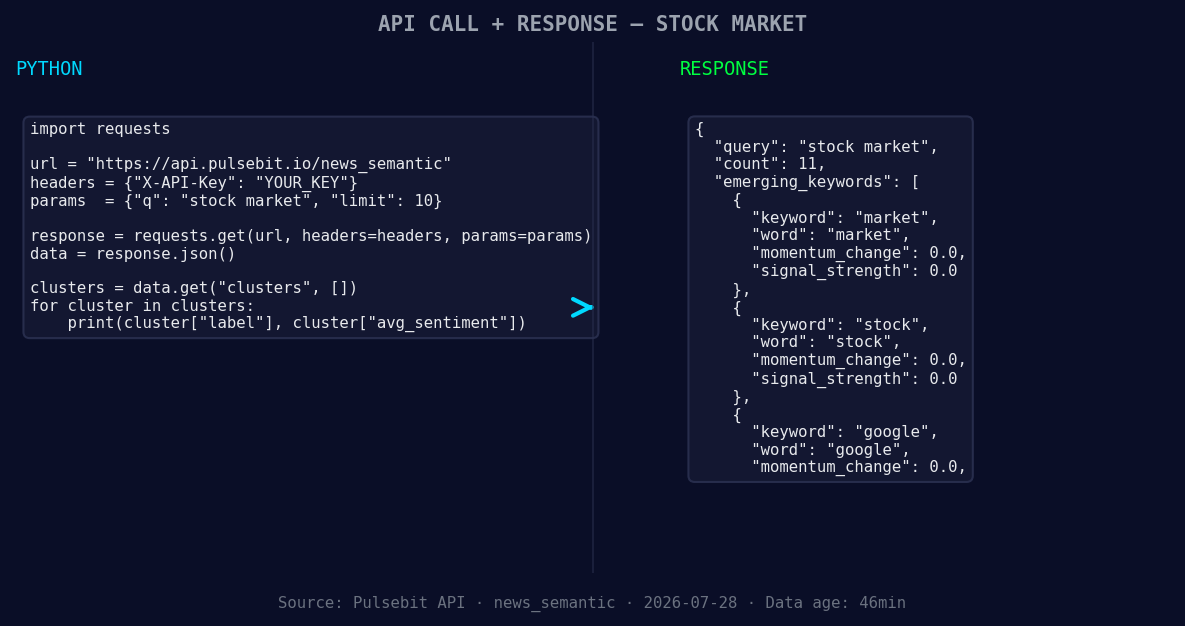
*Left: Python GET /news_semantic call for 'stock market'. Right: returned JSON response structure (clusters: 3). Source: Pulsebit /news_semantic.*
print(data)
Next, we need to run the narrative framing of this sentiment through our meta-sentiment endpoint to validate the context. Here’s how we can do that:
# Meta-sentiment query
meta_url = "https://api.pulsebit.com/v1/sentiment"
meta_params = {
    "text": "Clustered by shared themes: sensex, points, stock, markets, drop."
}

# Make the API call for meta-sentiment
meta_response = requests.post(meta_url, json=meta_params)
meta_data = meta_response.json()

print(meta_data)
This approach not only captures the sentiment around the stock market but also validates the narrative context that surrounds it. It’s crucial to understand how these themes interplay, especially with forming gaps like: market(+0.00), stock(+0.00), and mainstream mentions of sensex, points, and stock.
So, how can we build upon this insight? Here are three specific builds to consider:
- Geographic Filter for Real-Time Alerts: Set up an endpoint that continuously monitors sentiment around the stock market in English. Use a threshold of +0.1 momentum to trigger alerts. This allows you to catch significant movements before they become mainstream.

Geographic detection output for stock market. India leads with 7 articles and sentiment +0.14. Source: Pulsebit /news_recent geographic fields.
Meta-Sentiment Analysis Dashboard: Create a dashboard that visualizes meta-sentiment scores for different narratives. Use the output of the meta-sentiment loop as a basis for content creation or trading strategies, focusing on themes like market movements and stock reactions.
Forming Gap Analysis Tool: Develop a tool that takes in recent sentiment data and compares it against historical baselines. This tool should highlight forming gaps like those we observed, providing insights into potential trading opportunities or market shifts.
To get started with this, head over to pulsebit.lojenterprise.com/docs. We encourage you to set this up and see how quickly you can catch these vital insights — you can copy-paste and run the above code in under 10 minutes. Don’t let your pipeline lag behind; adapt and thrive with the insights we provide!


Top comments (0)