

Your pipeline just missed a significant signal: a 24h momentum spike of +0.531 in food sentiment. This anomaly, characterized by a notable rise in sentiment around food vendors at the Lewis County Fair, points to a critical moment where timely awareness could have made a difference. If your model isn't equipped to handle multilingual origins or entity dominance, you may feel the impact of this gap more than you realize. The leading language in this instance was English, with a 20.0-hour lag against the dominant sentiment around food. That's a long time to miss out on critical insights.

English coverage led by 20.0 hours. Da at T+20.0h. Confidence scores: English 0.75, German 0.75, Spanish 0.75 Source: Pulsebit /sentiment_by_lang.
When your pipeline lacks support for multilingual data or entity dominance, you risk falling behind on emerging trends and shifts in sentiment. In this case, you missed a key opportunity to act on the 20.0-hour delay in identifying the growing sentiment around food vendors. This gap can lead to lost opportunities, especially when the conversation is already trending in a specific direction. If you’re still relying solely on a monolingual or simplistic approach, you need to be aware that your model missed this by 20.0 hours.
Now, let’s bridge that gap with some code. Here’s how you can catch this momentum spike using our API.
import requests
# Setting up the parameters for the API call
url = "https://api.pulsebit.com/v1/sentiment"
params = {
"topic": "food",
"score": 0.425,
"confidence": 0.75,
"momentum": 0.531,
"lang": "en" # Geographic origin filter
}
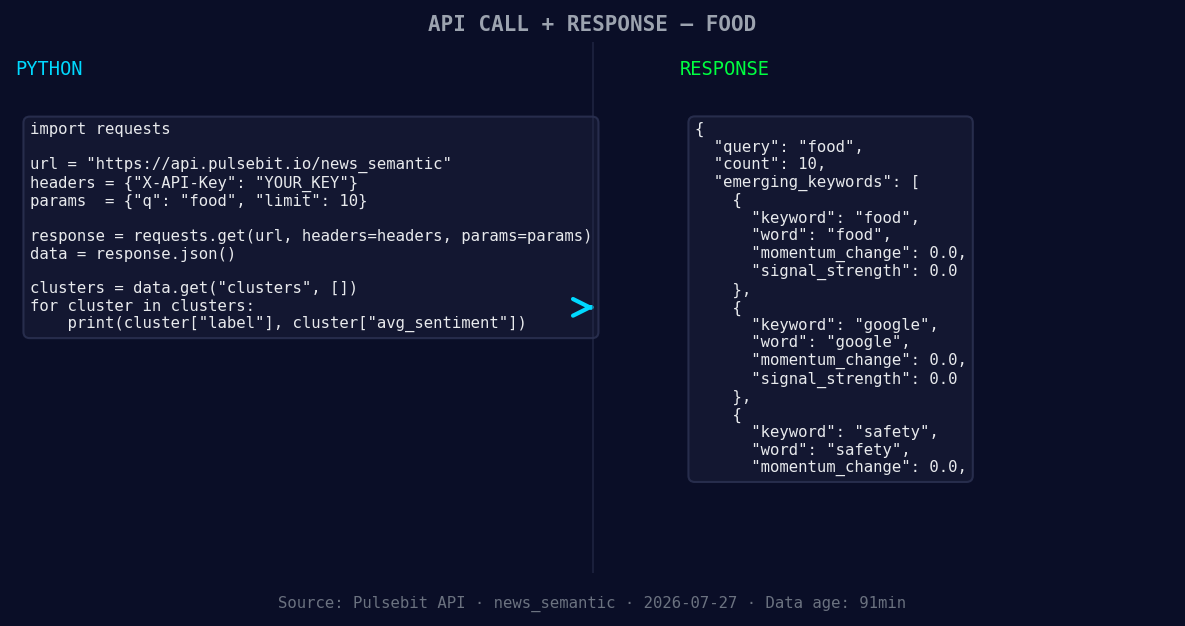
*Left: Python GET /news_semantic call for 'food'. Right: returned JSON response structure (clusters: 3). Source: Pulsebit /news_semantic.*
# Making the API request to filter sentiment by language
response = requests.get(url, params=params)
data = response.json()
print(data)
Next, we need to run the cluster reason string back through our sentiment analysis endpoint to score the narrative framing itself. Here’s how to do that:
# Meta-sentiment moment: analyzing the cluster reason
meta_sentiment_url = "https://api.pulsebit.com/v1/sentiment"
meta_reason = "Clustered by shared themes: vendors, lewis, county, fair, share."

# Making the POST request for meta sentiment analysis
meta_response = requests.post(meta_sentiment_url, json={"text": meta_reason})
meta_data = meta_response.json()
print(meta_data)
These two snippets give you a direct way to capture and analyze sentiment trends around food, especially when they are gaining momentum.
So, what can you build with this newfound insight? Here are three specific builds to consider:
Geo-Filtered Alert System: Create a real-time alert system that triggers when food sentiment spikes above a threshold (e.g. +0.5) in English-speaking regions. Use the geo filter to narrow down your data to local vendors and events, increasing relevance.
Meta-Sentiment Dashboard: Develop a dashboard that visualizes the meta-sentiment around stories like "Food vendors at the Lewis County Fair." Use the cluster reason to display trending themes alongside sentiment scores, helping you understand the context behind the numbers.
Safety vs. Mainstream Contrast Tool: Build a tool that contrasts forming themes like food (+0.00), google (+0.00), and safety (+0.00) against mainstream topics like vendors, lewis, and county. This could help you identify emerging risks or opportunities in food safety discussions before they become mainstream.
If you’re ready to leverage these insights, check out our documentation: pulsebit.lojenterprise.com/docs. You can copy-paste and run this code in under 10 minutes. Start catching those signals before they pass you by!


Top comments (0)