

Your Pipeline Is 25.2h Behind: Catching Blockchain Sentiment Leads with Pulsebit
We recently uncovered a significant anomaly in our sentiment analysis: a 24-hour momentum spike of -0.200. This drop in momentum signals a critical shift in sentiment toward blockchain discussions. But what's more intriguing is that English-language press articles are leading this narrative, with a dominant cluster story titled "BYDFi Participates in Peru Blockchain Conference 2026, Engaging the LATAM Web3 Community" emerging at a 25.2-hour mark, indicating that your models might be missing vital signals if they don’t account for multilingual origins or entity dominance.

English coverage led by 25.2 hours. Da at T+25.2h. Confidence scores: English 0.75, Spanish 0.75, Sv 0.75 Source: Pulsebit /sentiment_by_lang.
This is a wake-up call for any pipeline that fails to integrate diverse linguistic data or properly weigh the influence of leading entities. If your model isn't set up to handle this, you’ve missed the boat by over 25 hours. The leading language here is English, but the actual sentiment shift is happening across multiple narratives globally. This is a gap that could mean the difference between catching emerging trends and being left in the dust.
Let’s dive into how you can catch these signals with our API. Below is a Python snippet that will help you filter out relevant data and analyze sentiment for a specific topic like "blockchain."
import requests
# Define parameters
topic = 'blockchain'
score = +0.550
confidence = 0.75
momentum = -0.200
# API call for geographic origin filter
response = requests.get(
'https://api.pulsebit.com/v1/sentiment',
params={
'topic': topic,
'lang': 'en',
'score': score,
'confidence': confidence,
'momentum': momentum
}
)
print(response.json())
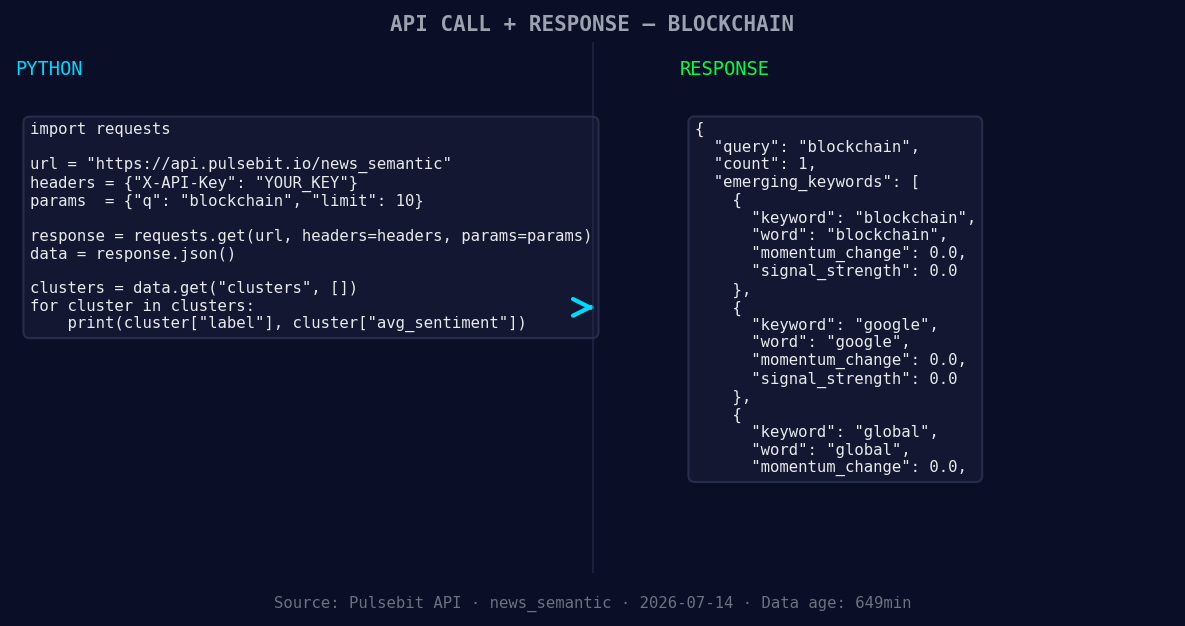
*Left: Python GET /news_semantic call for 'blockchain'. Right: returned JSON response structure (clusters: 3). Source: Pulsebit /news_semantic.*
# Meta-sentiment moment: running the cluster reason string back through the sentiment scoring
cluster_reason = "Clustered by shared themes: participates, peru, blockchain, conference, 2026."
meta_response = requests.post(
'https://api.pulsebit.com/v1/sentiment',
json={'text': cluster_reason}
)
print(meta_response.json())
In the first section, we filter by the language parameter to ensure we’re only looking at English articles, which are crucial for identifying trends in the Western narrative. In the second section, we send the cluster reason string back through our sentiment scoring endpoint to evaluate how the framing of this narrative impacts overall sentiment. This is what sets us apart: we don’t just analyze the data — we interrogate the narrative itself.
Here are three specific builds you could leverage from this pattern:
- Geographic Filter Build: Set a signal threshold for momentum changes, say -0.150, for any English articles related to blockchain. This ensures you’re alerted to any significant shifts that could indicate emerging trends.

Geographic detection output for blockchain. France leads with 1 articles and sentiment +0.75. Source: Pulsebit /news_recent geographic fields.
Meta-Sentiment Loop Build: Create a dashboard that runs cluster narratives through our sentiment scoring. Focus on narratives that include keywords like "best," "user-centric," or "crypto." A score above +0.600 could trigger alerts for deeper analysis.
Global vs Mainstream Comparison: Build a continuous monitor for discussions that are forming around "blockchain," "google," and "global." If the sentiment score dips below +0.400 while mainstream discussions are tagged as "best" or "user-centric," you might want to investigate further.
As you can see, leveraging our API can give you a significant edge in sentiment analysis. For more details on how to implement these features, check our documentation at pulsebit.lojenterprise.com/docs. You can copy-paste and run the above code in under 10 minutes, allowing you to stay ahead of the game and catch those sentiment leads before they become mainstream.


Top comments (0)