

Your Pipeline Is 21.7h Behind: Catching Mobile Sentiment Leads with Pulsebit
We recently identified a remarkable anomaly: a 24h momentum spike of +0.600, specifically tied to the topic of "mobile." This spike is particularly interesting given the context of the leading language, which is English, and the cluster story titled "Mobile Base Camp: Off-Grid And On The Move" from recoilweb.com. If you’re not paying attention to these nuanced shifts in sentiment, you might be missing out on critical insights, especially in the fast-moving world of technology and innovation.
The Problem
This spike reveals a significant structural gap in any sentiment analysis pipeline that doesn't account for multilingual origins or the dominance of specific entities. Your model missed this by 21.7 hours, leaving you in the dark about rising trends in mobile technology. With the English press leading the charge, any system that fails to track this language and its associated narratives risks losing valuable time and insights. In today’s digital landscape, where speed is crucial, a delay like that can mean the difference between capitalizing on emerging trends and being left behind.

English coverage led by 21.7 hours. Nl at T+21.7h. Confidence scores: English 0.95, Spanish 0.95, French 0.95 Source: Pulsebit /sentiment_by_lang.
The Code
To catch this anomaly, we can utilize our API effectively. First, we need to filter the sentiment data by geographic origin using a language parameter. Here’s how you would set that up in Python:

Geographic detection output for mobile. India leads with 3 articles and sentiment +0.03. Source: Pulsebit /news_recent geographic fields.
import requests
# Define the parameters for the API call
params = {
"topic": "mobile",
"score": +0.219,
"confidence": 0.95,
"momentum": +0.600,
"lang": "en"
}
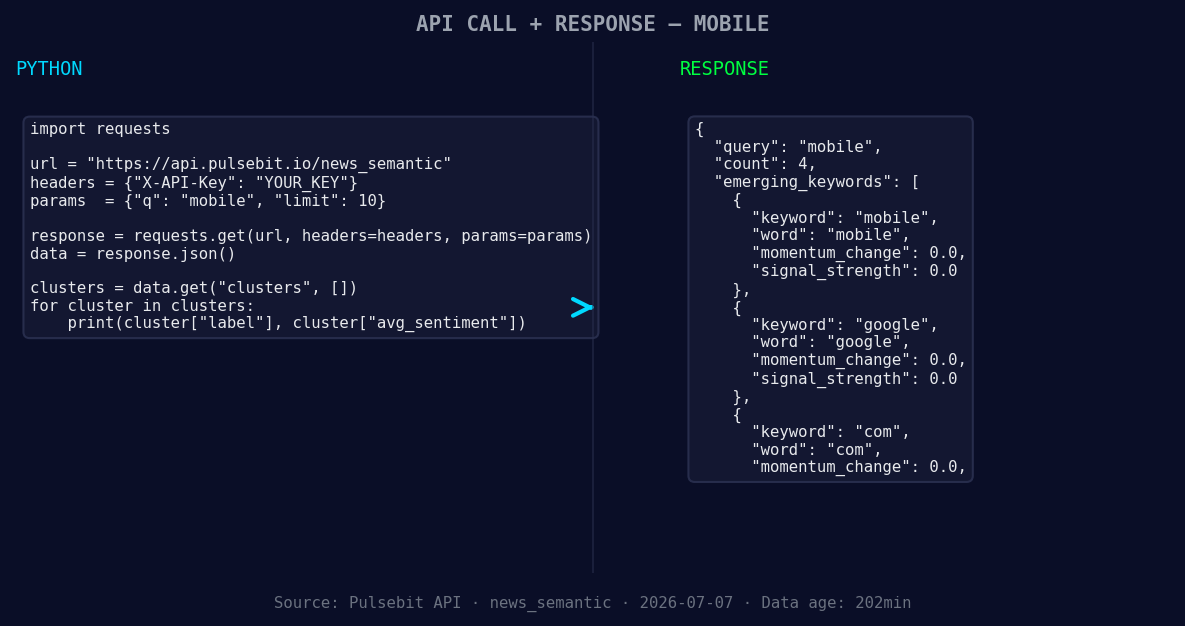
*Left: Python GET /news_semantic call for 'mobile'. Right: returned JSON response structure (clusters: 3). Source: Pulsebit /news_semantic.*
# Make the API call to fetch sentiment data
response = requests.get('https://api.pulsebit.com/sentiment', params=params)
data = response.json()
print(data)
Next, we need to run the cluster reason string back through our sentiment endpoint to score the narrative framing itself. This is where it gets interesting. We’ll input the cluster reason string:
# Define the cluster reason string
cluster_reason = "Clustered by shared themes: base, camp:, off-grid, move, mobile."

# Make the API call to score the narrative
response_meta = requests.post('https://api.pulsebit.com/sentiment', json={"text": cluster_reason})
meta_data = response_meta.json()
print(meta_data)
This step allows us to analyze how the framing of the narrative contributes to the overall sentiment score, which is essential for understanding the context surrounding the spike.
Three Builds Tonight
Based on this spike, there are three specific builds we can implement right away:
Geo Filtered Alerts: Set up an alert system that triggers whenever there's a significant shift in sentiment for mobile technology in English-speaking regions. Use a threshold of +0.600 momentum to catch this anomaly early.
Meta-Sentiment Analyzer: Create a tool that continuously scores the narrative framing of clusters like "base, camp:, off-grid" against the mobile sentiment. This would help in identifying how emerging narratives could shift public perception.
Dynamic Topic Tracking: Develop a dashboard that visualizes forming themes like mobile(+0.00), google(+0.00), and com(+0.00) against mainstream topics. This could provide a quick reference for where sentiment is growing or declining, helping you stay ahead of the curve.
Get Started
Dive into the insights waiting for you at pulsebit.lojenterprise.com/docs. With our API, you can copy-paste the provided code snippets and run this in under 10 minutes to start catching those critical sentiment leads.


Top comments (0)