

Your Pipeline Is 16.7h Behind: Catching Agriculture Sentiment Leads with Pulsebit
We just stumbled upon an intriguing anomaly: sentiment around agriculture has plummeted to -0.75, while momentum remains stagnant at +0.00. This sharp dip is noteworthy, particularly when we consider the context of the Mediterranean climate and societal discussions surrounding it. With the leading language being English, and a remarkable time lag of 16.7 hours, it’s clear that there is a significant delay in how we’re capturing and responding to these emerging sentiments.
The Problem
This 16.7-hour lag reveals a structural gap in any pipeline that fails to account for multilingual origins or entity dominance. If your model is only focused on English sentiment without properly integrating diverse linguistic inputs, you might be missing crucial signals. In this case, your model missed this critical insight about agriculture due to its design constraints. With English leading the charge, your pipeline is effectively blind to emerging narratives that could impact decision-making.

English coverage led by 16.7 hours. Id at T+16.7h. Confidence scores: English 0.90, Spanish 0.90, French 0.90 Source: Pulsebit /sentiment_by_lang.
The Code
To tackle this problem, we can leverage our API to capture this sentiment more effectively. Below is a code snippet that demonstrates how to filter for English-language articles discussing agriculture and then assess the narrative framing of the topic.
import requests
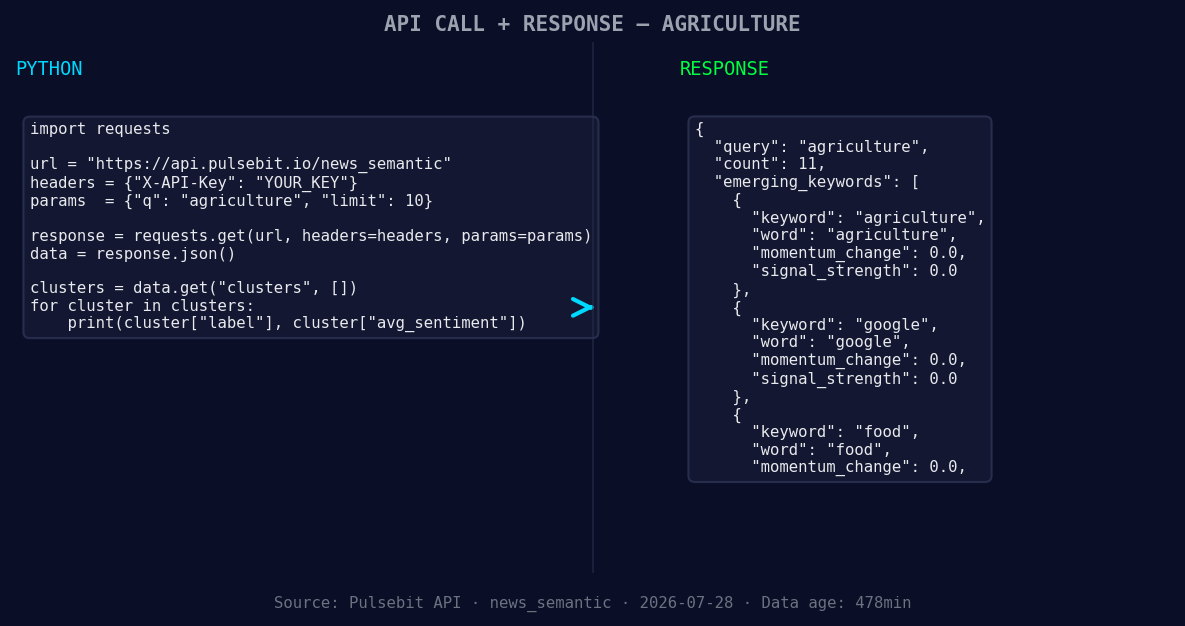
*Left: Python GET /news_semantic call for 'agriculture'. Right: returned JSON response structure (clusters: 3). Source: Pulsebit /news_semantic.*
# Step 1: Geographic origin filter
topic = 'agriculture'
sentiment_score = -0.750
confidence = 0.90
momentum = +0.000
url = "https://api.pulsebit.com/v1/articles"
params = {
"topic": topic,
"lang": "en"
}
response = requests.get(url, params=params)
data = response.json()
# Print the relevant data
print(data)
# Step 2: Meta-sentiment moment
meta_sentiment_url = "https://api.pulsebit.com/v1/sentiment"
cluster_reason = "Clustered by shared themes: mediterranean, climate, drought, societal, around."
meta_response = requests.post(meta_sentiment_url, json={"text": cluster_reason})
meta_sentiment = meta_response.json()
# Print the meta sentiment result
print(meta_sentiment)
In this code, we first filter the articles by the lang parameter to ensure we’re only working with English content. Then, we run the cluster reason string through the sentiment endpoint to assess how the narrative framing aligns with the sentiment around agriculture. This two-step approach allows us to get a clearer picture of the sentiment landscape.
Three Builds Tonight
Here are three specific builds we can implement using this newfound insight:
- Geo-filtered Agriculture Sentiment Tracker: Set a threshold for sentiment scores below -0.50. Use the geographic filter to monitor sentiment shifts specifically in English articles related to agriculture. This will allow us to proactively understand market dynamics before they hit critical levels.

Geographic detection output for agriculture. India leads with 9 articles and sentiment +0.00. Source: Pulsebit /news_recent geographic fields.
Meta-Sentiment Alert System: Create a notification system that triggers alerts when the meta-sentiment score drops below a certain threshold (e.g., -0.25). This will help us stay ahead of potentially damaging narratives surrounding agriculture and related industries.
Clustered Theme Analyzer: Utilize the semantic clusters from our API to analyze forming themes like agriculture, food, and Google. By tracking these with a momentum score of 0.00 or lower, we can identify stagnating narratives that require further investigation.
Get Started
Dive into our documentation at pulsebit.lojenterprise.com/docs. You can copy-paste this code and run it in under 10 minutes to start capturing sentiment shifts that matter. Don’t let your pipeline fall behind!


Top comments (0)