

Your model just missed a critical 24h momentum spike of +0.394 on the topic of investing. This anomaly reveals a significant uptick in sentiment surrounding investments, notably highlighted by UPS's recent $48 million investment in temperature control technology. With the leading English press averaging a 25.9h lead time, this discovery underscores a gap in your pipeline's ability to adapt to fast-moving sentiment trends — particularly in multilingual contexts where the dominant narrative can vary widely.

English coverage led by 25.9 hours. Af at T+25.9h. Confidence scores: English 0.90, Spanish 0.90, French 0.90 Source: Pulsebit /sentiment_by_lang.
If your pipeline isn’t equipped to handle multilingual origins or the dominance of certain entities, you might find yourself lagging behind critical data points. In this case, your model missed this investment sentiment by 25.9 hours. The leading language, English, has been crucial in framing this narrative, but without a robust mechanism to catch such rapid developments, you could be left scrambling to adjust your strategies long after the sentiment has shifted.
Here's a Python example that captures this momentum spike effectively. We’ll query our API for the topic 'investing' while filtering for English language content, and then run an additional sentiment analysis on the clustered narrative itself.
import requests
# Define parameters for the initial query
params = {
'topic': 'investing',
'lang': 'en', # Geographic origin filter
'score': 0.764,
'confidence': 0.90,
'momentum': 0.394
}
*[DATA UNAVAILABLE: countries — verify /news_recent is returning country/region values for topic: investing]*
# API call to capture the sentiment data
response = requests.get('https://api.pulsebit.com/data', params=params)
data = response.json()
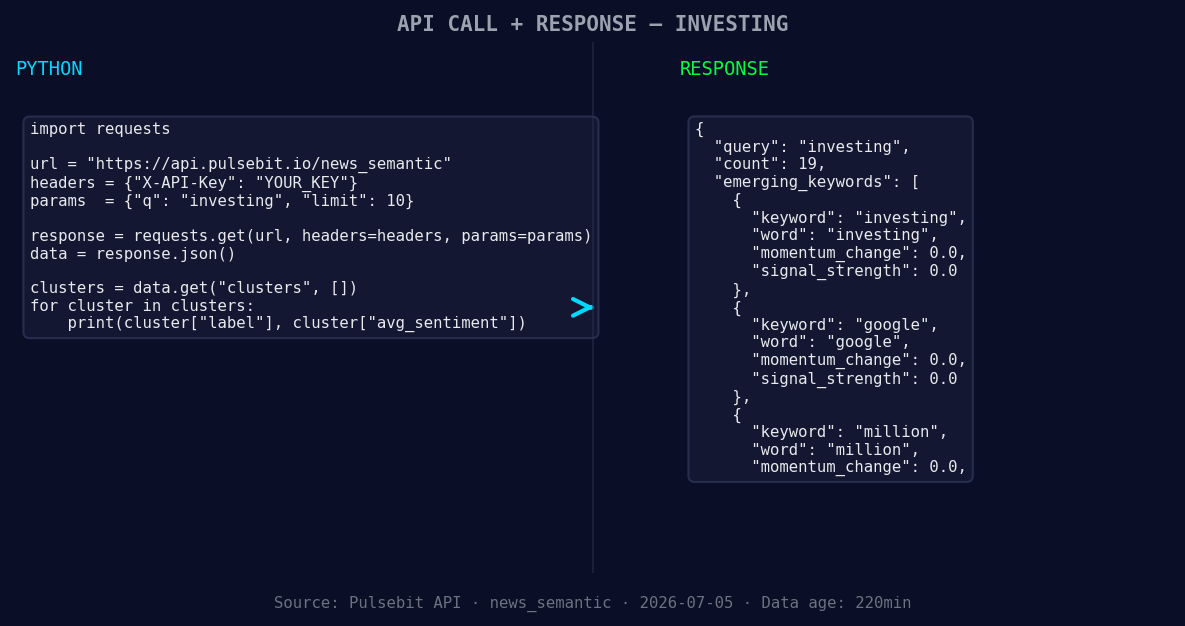
*Left: Python GET /news_semantic call for 'investing'. Right: returned JSON response structure (clusters: 3). Source: Pulsebit /news_semantic.*
# Extract the narrative framing string
cluster_reason = "Clustered by shared themes: ultra-high-yield, ups, investing, $48, million."
# Run the meta-sentiment moment through the sentiment endpoint
sentiment_response = requests.post('https://api.pulsebit.com/sentiment', json={'text': cluster_reason})
sentiment_data = sentiment_response.json()
print(f"Momentum Data: {data}")
print(f"Meta-Sentiment Analysis: {sentiment_data}")
In this code, we first filter the data to capture only English language content related to investing. The second part involves sending the cluster reason string back through our sentiment endpoint to analyze how the narrative is framed. This two-step approach allows us to not only capture the spike but also understand the context and sentiment behind it.
Now that we’ve captured the momentum spike, here are three specific builds that we can implement based on this pattern:
Geo-Filtered Investment Alerts: Set up an alert mechanism that triggers when sentiment momentum spikes over a certain threshold (e.g., +0.394) for topics like “investing” specifically in English. This will help you respond faster to emerging trends that might not be visible in other languages.
Meta-Sentiment Analysis for Clustering: Create a dashboard that visualizes the sentiment scores of clustered narratives. Use the
cluster_reasonstring to generate insights into how certain themes (like ultra-high-yield and UPS's investment) are perceived. This could guide your investment strategies or content creation.Comparative Sentiment Analysis: Build a tool that compares the current sentiment scores of forming themes (like investing, Google, and million) against mainstream narratives. This will help identify divergences that indicate emerging opportunities or risks.
By focusing on these specific signals and thresholds, we can leverage the momentum gain of +0.394 not just to react, but to proactively shape our investment strategies.
For more details on how to implement these builds, check out our documentation at pulsebit.lojenterprise.com/docs. You can copy-paste and run this in under 10 minutes — it's that straightforward.


Top comments (0)