

Your Pipeline Is 27.1h Behind: Catching Healthcare Sentiment Leads with Pulsebit
We just stumbled upon a striking anomaly: a 24h momentum spike of -0.495 in the healthcare sector. This isn't just another number; it points to a significant shift in sentiment that could easily slip through the cracks of your data pipeline. The leading language in this anomaly is English, with a lag of 27.1 hours compared to the Netherlands. If your model isn't equipped to handle multilingual origins or entity dominance, it could mean you're missing critical insights by over a day.

English coverage led by 27.1 hours. Nl at T+27.1h. Confidence scores: English 0.85, Spanish 0.85, Id 0.85 Source: Pulsebit /sentiment_by_lang.
Every hour counts in sentiment analysis, especially when it comes to healthcare, where developments can be rapid and transformative. If your pipeline isn't capable of capturing these nuances, you could miss vital trends. Imagine missing a key narrative just because your system isn't tuned to handle the leading language or entity dominance. Your model missed this by 27.1 hours, and that’s a gap we cannot afford.
To catch this anomaly and leverage the insights hidden within, we can write a simple Python script using our API. Here’s how you can set it up:
import requests
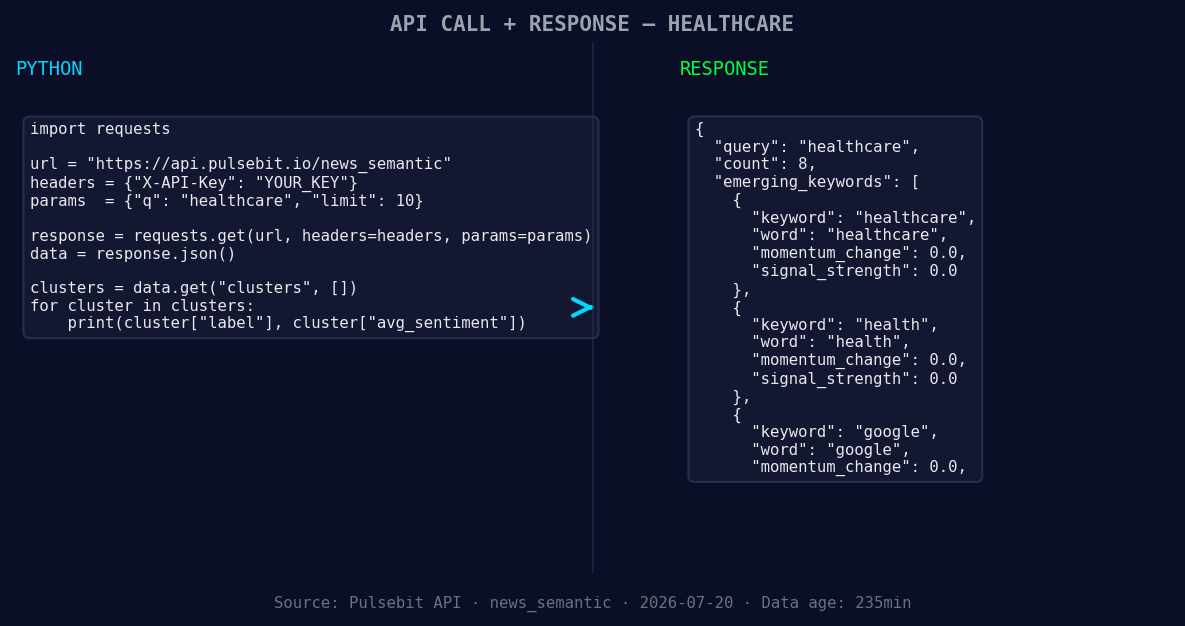
*Left: Python GET /news_semantic call for 'healthcare'. Right: returned JSON response structure (clusters: 3). Source: Pulsebit /news_semantic.*
# Define your parameters
topic = 'healthcare'
score = +0.425
confidence = 0.85
momentum = -0.495
# Geographic origin filter: query by language/country
response = requests.get(
'https://api.pulsebit.com/v1/sentiment',
params={
'topic': topic,
'lang': 'en', # Filtering by English
'score': score,
'confidence': confidence,
'momentum': momentum
}
)
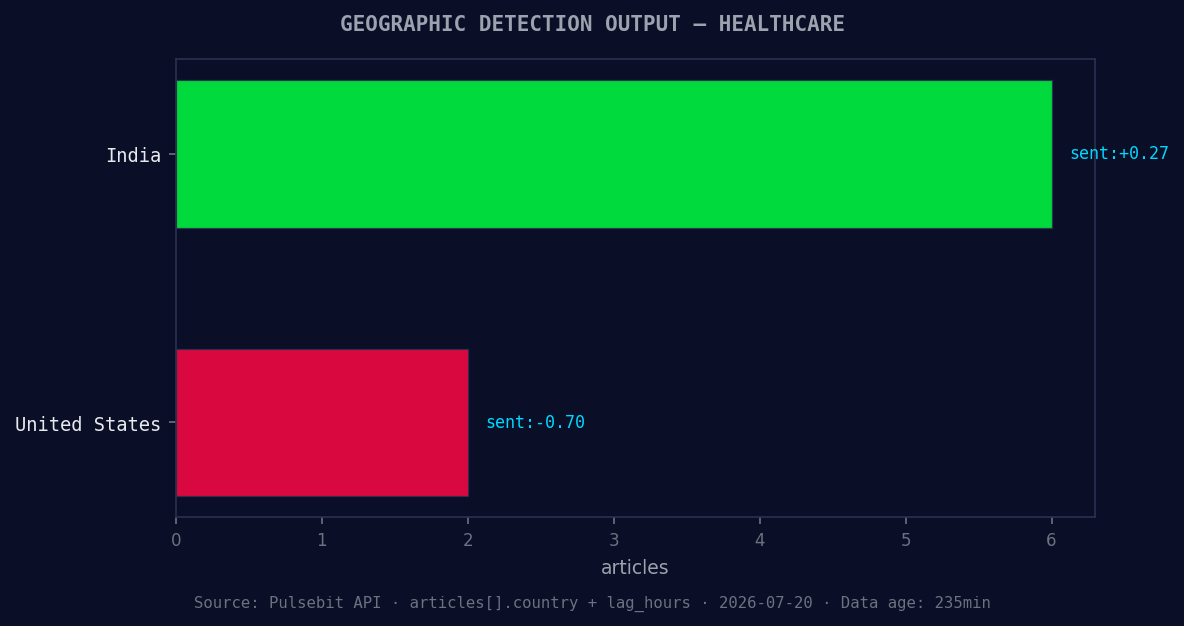
*Geographic detection output for healthcare. India leads with 6 articles and sentiment +0.27. Source: Pulsebit /news_recent geographic fields.*
# Check the response
if response.status_code == 200:
print("Data Retrieved:", response.json())
else:
print("Error retrieving data:", response.status_code)
# Meta-sentiment moment: run the cluster reason string back through POST /sentiment
cluster_reason = "Clustered by shared themes: learned, making, healthcare, startup, investments."
meta_response = requests.post(
'https://api.pulsebit.com/v1/sentiment',
json={'text': cluster_reason}
)
# Check the meta sentiment response
if meta_response.status_code == 200:
print("Meta Sentiment Data:", meta_response.json())
else:
print("Error retrieving meta sentiment data:", meta_response.status_code)
This script does two things: first, it filters for healthcare sentiment in English, giving a clear view of how the sector is performing in a specific language context. Second, it loops back to assess the meta-sentiment of the narrative framing, providing deeper insights into why these themes are clustered together.
Now that you have the tools, let’s explore three specific builds that can enhance your analysis:
Geo-Focused Alerts: Set up a threshold alert for healthcare sentiment in English (with a score above +0.425). Trigger notifications when sentiment shifts, like the current anomaly. This ensures you’re not just reactive but proactive in understanding emerging trends.
Meta-Sentiment Analysis: Create a function that takes the cluster reason string and scores it against historical data. For instance, if the themes are "learned, making, healthcare," track how often these clusters emerge and their sentiment scores over time. A consistent positive score could indicate a long-term trend worth exploring.
Cross-Topic Comparison: Establish a comparative analysis between healthcare and adjacent sectors like health or technology (with scores at +0.00). Use our API to fetch and visualize sentiment differences. This can illuminate how related sectors are influencing each other, especially regarding major players like Google.
If you want to get started with these ideas, check out our comprehensive documentation at pulsebit.lojenterprise.com/docs. You can copy, paste, and run the provided code in under 10 minutes. Let's make sure your pipeline is never behind the curve again.


Top comments (0)