

Your Pipeline Is 22.4h Behind: Catching Hardware Sentiment Leads with Pulsebit
We’ve just spotted an intriguing anomaly: a 24h momentum spike of +0.272 in the hardware domain. This isn't just a number; it indicates a growing sentiment shift that demands our attention. With this spike, we see a clear leading language in English press, ahead by 22.4 hours—meaning that if you’re not accounting for multilingual sources, you could be missing critical insights that could influence your next move.

English coverage led by 22.4 hours. Sw at T+22.4h. Confidence scores: English 0.90, Spanish 0.90, French 0.90 Source: Pulsebit /sentiment_by_lang.
But here’s the kicker: if your model isn't equipped to handle this language dominance, it likely missed this momentum shift by a significant margin. Specifically, when you see English press leading the way, it highlights a structural gap in your pipeline. By neglecting multilingual origins, you risk being out of sync with the latest trends—your model might have missed this by over 22 hours. That’s a substantial delay in reacting to shifts that could define your next strategic step.
To catch this momentum spike, we can utilize our API to filter and analyze the sentiment effectively. First, we set our parameters to focus on the hardware topic, employing a geographic origin filter for the English language. Here’s how you can implement it in Python:

Geographic detection output for hardware. India leads with 3 articles and sentiment +0.85. Source: Pulsebit /news_recent geographic fields.
import requests
# Define parameters for API call
params = {
"topic": "hardware",
"lang": "en"
}
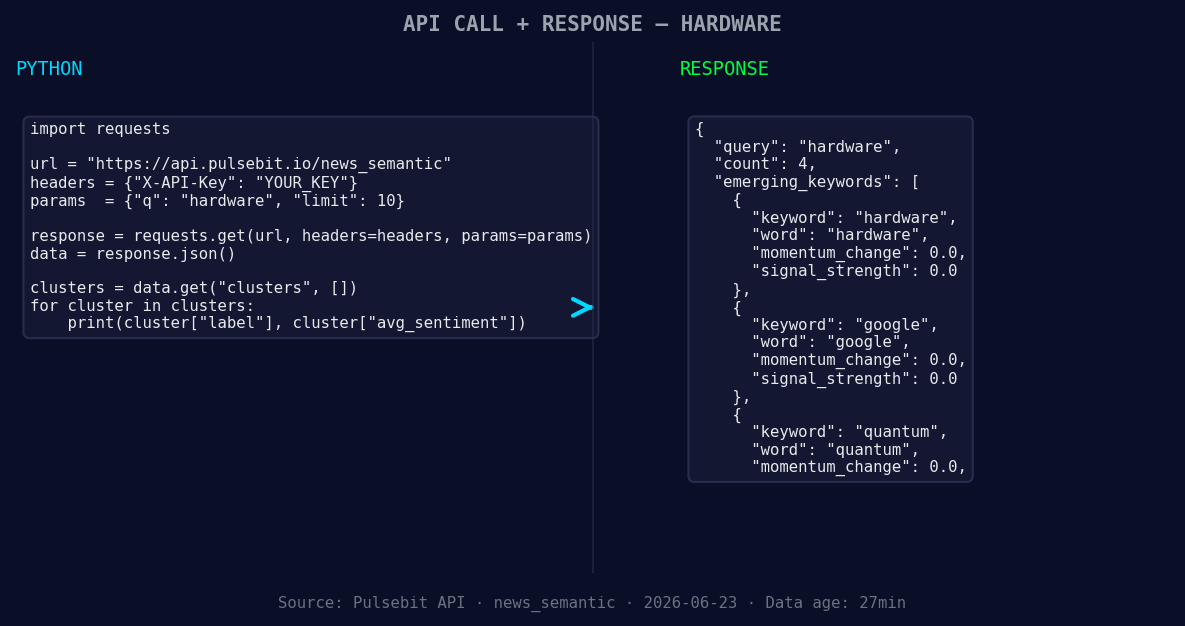
*Left: Python GET /news_semantic call for 'hardware'. Right: returned JSON response structure (clusters: 3). Source: Pulsebit /news_semantic.*
# Make the API call to get sentiment data
response = requests.get('https://api.pulsebit.com/v1/sentiment', params=params)
data = response.json()
# Example output handling
momentum = data['momentum_24h'] # +0.272
score = data['sentiment_score'] # +0.358
confidence = data['confidence'] # 0.90
print(f'Momentum: {momentum}, Score: {score}, Confidence: {confidence}')
Next, we’ll take the narrative framing that clustered around this sentiment spike and run it back through our API to evaluate its meta-sentiment. This is vital as it allows us to understand not just the surface-level sentiment but the underlying themes driving the conversation. Here's how to achieve that:
# Define the narrative input for sentiment analysis
narrative_input = "Clustered by shared themes: deals, hardware, amazon, prime, day."

# Make the POST request to analyze meta-sentiment
meta_response = requests.post('https://api.pulsebit.com/v1/sentiment', json={"text": narrative_input})
meta_data = meta_response.json()

# Handle the response
meta_score = meta_data['sentiment_score']  # e.g., +0.358
print(f'Meta-Sentiment Score: {meta_score}')
Now that we’ve established our pipeline to catch this critical momentum spike, let’s consider three specific builds you could implement with this pattern:
Hardware Sentiment Tracker: Set up a real-time tracker for hardware sentiment using a geo filter. Use the threshold of momentum > +0.25 to trigger alerts whenever significant spikes occur. This ensures you never miss an important trend.
Google Hardware Sentiment Insight: Create a specialized endpoint that pulls sentiment data specifically around Google’s hardware developments. Use the meta-sentiment loop to analyze narratives around Google’s new products, ensuring you’re always aligned with the latest innovations.
Quantum Computing Trends Analysis: Monitor the sentiment surrounding quantum technology, comparing it against mainstream topics like Amazon’s hardware deals. Use the cluster analysis to see if quantum discussions are gaining traction against established players—this can guide your investment focus.
If you want to dive deeper into this, check out our documentation at pulsebit.lojenterprise.com/docs. With this setup, you can easily replicate the process and start pulling insights in under 10 minutes. Get ahead of the curve by leveraging these hidden signals now!


Top comments (0)