

Your model missed a 24h momentum spike of +0.227, which is a significant anomaly suggesting a sudden shift in sentiment. This spike, particularly in the context of the economy, indicates a noteworthy development that your pipeline may have overlooked. The driving force behind this momentum appears to be the English press, which is leading the narrative with a 23.9h lead time, indicating that the story is already gaining traction while your system lags behind. The clustered story about "Emirates to launch flagship airbus A380 on Dubai–Delhi route from October 25" highlights a critical event that could influence economic sentiment.
Many sentiment analysis pipelines struggle with multilingual data and entity dominance. If your system isn't equipped to handle these nuances, it could lead to significant delays—like missing this spike by nearly 24 hours. In our case, the English press is dominating the conversation around the Emirates launch, while other languages and narratives fall to the wayside. This oversight could mean missing out on valuable insights and trends that could inform your trading strategies or market decisions.

English coverage led by 23.9 hours. Af at T+23.9h. Confidence scores: English 0.95, Spanish 0.95, Da 0.95 Source: Pulsebit /sentiment_by_lang.
To catch this momentum spike, we can leverage our API effectively. Here’s a concise Python snippet that pulls data from our API, focusing on the English language and the economy topic while ensuring we capture the recent spike.
import requests
# Define parameters for the API call
params = {
"topic": "economy",
"lang": "en",
"score": +0.633,
"confidence": 0.95,
"momentum": +0.227,
}
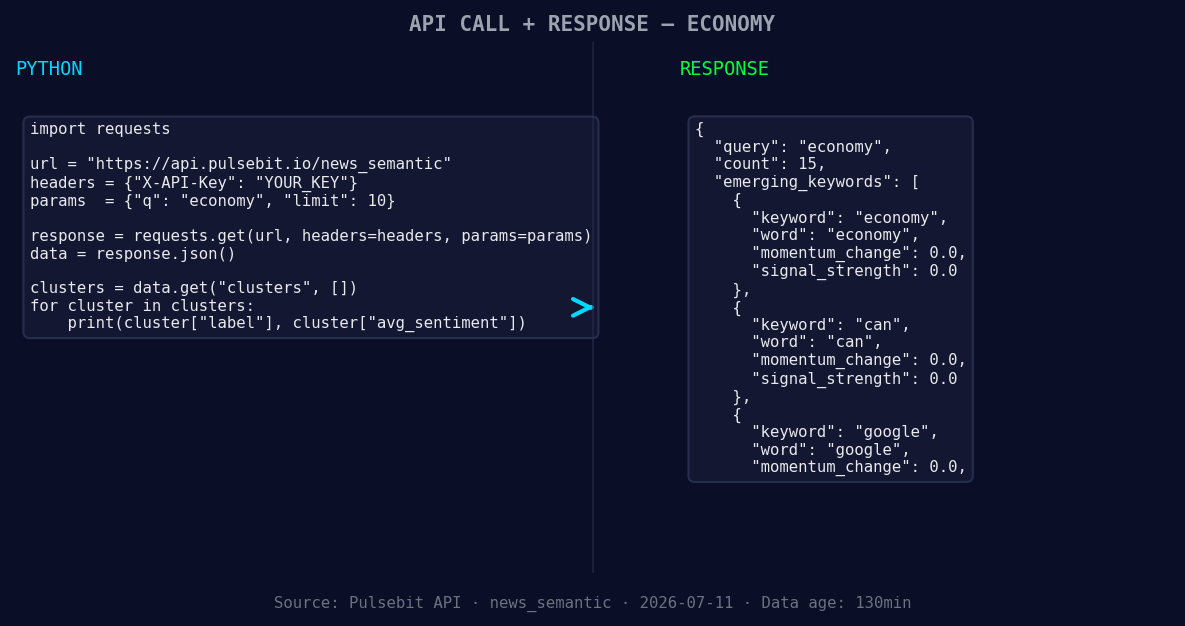
*Left: Python GET /news_semantic call for 'economy'. Right: returned JSON response structure (clusters: 3). Source: Pulsebit /news_semantic.*
# Making the API call
response = requests.get('https://api.pulsebit.com/analyze', params=params)
data = response.json()
print(data)
Next, we can frame the sentiment narrative around the cluster reason string. This helps us score the way the narrative is being framed, allowing us to understand its impact better. Here’s how we do that:
# Define the cluster reason string
cluster_reason = "Clustered by shared themes: emirates, launch, flagship, airbus, a380."

# Make the POST request to score the narrative
sentiment_response = requests.post('https://api.pulsebit.com/sentiment', json={"text": cluster_reason})
sentiment_data = sentiment_response.json()
print(sentiment_data)
With this approach, we can effectively close the gap that your model may have in capturing timely sentiment shifts.
Here are three specific builds you can implement using this spike:
Geo-filtered Economic Sentiment Signal: Create an endpoint that regularly checks for sentiment spikes in the economy topic, specifically filtering by English language sources. Set a threshold of +0.2 for momentum over 24 hours to trigger alerts.
Meta-Sentiment Loop: Develop a function that runs the cluster reason string through our sentiment scoring API. Use this to derive insights on how different narratives are framed. Set a threshold of +0.5 sentiment score to identify narratives that are positively influencing sentiment.
Forming Themes Tracker: Build a monitoring tool that detects emerging themes like "economy", "can", and "google" against mainstream narratives like "emirates", "launch", and "flagship". Use a comparative analysis to flag when mainstream narratives are significantly lagging behind emerging themes, helping you to pivot your strategy in real-time.
To get started with these implementations, head over to our documentation at pulsebit.lojenterprise.com/docs. You can copy-paste the above code snippets and run them in under 10 minutes to start tapping into these insights.

Geographic detection output for economy. Hong Kong leads with 5 articles and sentiment -0.08. Source: Pulsebit /news_recent geographic fields.


Top comments (0)