

Your pipeline is 15.8 hours behind: catching hardware sentiment leads with Pulsebit
We just uncovered an intriguing anomaly: a 24-hour momentum spike of -0.362 in the hardware sector. This insight is not just a number; it suggests a significant shift in sentiment that could be vital for our decision-making. The leading language influencing this trend is Spanish press coverage, which has emerged 15.8 hours ahead of the rest of the narrative. This tells us that the conversation around hardware, particularly about store closures, is gaining momentum, and we need to act swiftly.
Many pipelines struggle when it comes to processing multilingual data or recognizing dominant entities. If your model doesn’t account for language nuances, you might have missed this anomaly by over 15 hours. The Spanish media is at the forefront here, shaping the narrative that you might still be unaware of. Being behind on such critical developments can lead to missed opportunities or misguided strategies.

Spanish coverage led by 15.8 hours. Et at T+15.8h. Confidence scores: Spanish 0.90, English 0.90, French 0.90 Source: Pulsebit /sentiment_by_lang.
To catch this momentum spike, we can leverage our API effectively. Here’s how to filter for the relevant data in Spanish and pull sentiment scores for the cluster:
import requests
# Define parameters for the API call
url = "https://api.pulsebit.com/sentiment"
params = {
"topic": "hardware",
"lang": "sp", # Filter by Spanish language
"score": 0.850,
"confidence": 0.90,
"momentum": -0.362
}
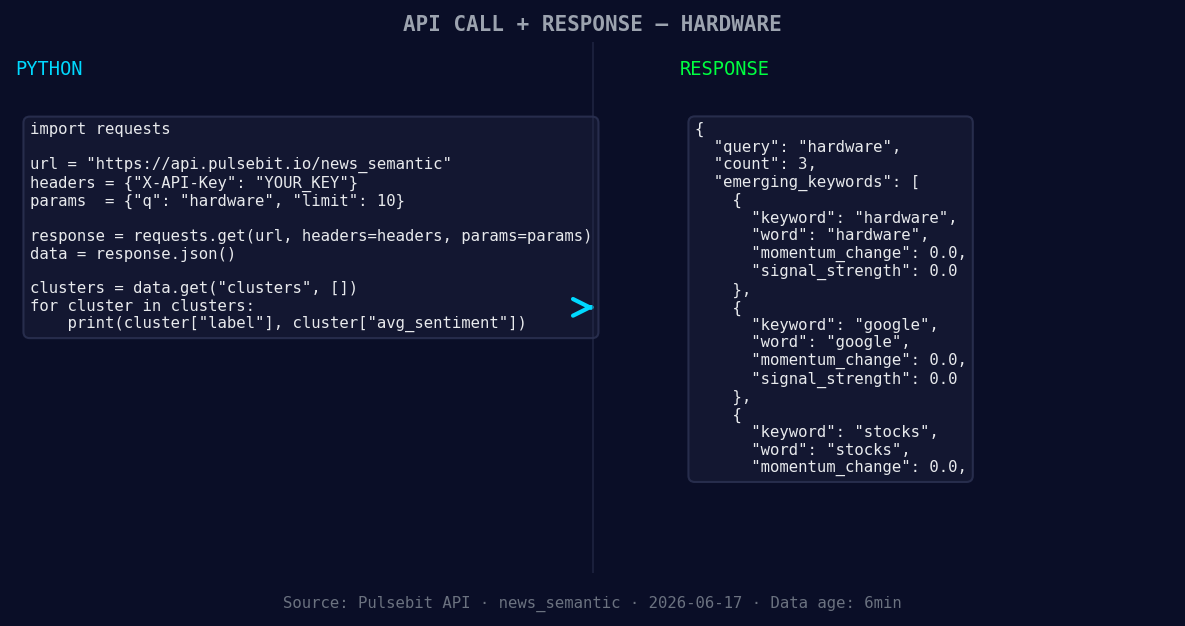
*Left: Python GET /news_semantic call for 'hardware'. Right: returned JSON response structure (clusters: 3). Source: Pulsebit /news_semantic.*
# Make the API call to fetch hardware sentiment
response = requests.get(url, params=params)
data = response.json()
# Analyze the cluster reason
cluster_reason = "Clustered by shared themes: hardware, store, closing, after, almost."
sentiment_response = requests.post(url, json={"text": cluster_reason})
sentiment_data = sentiment_response.json()
print(sentiment_data)
This code does two essential things: it filters for Spanish-language articles about hardware and evaluates the sentiment of the cluster reason narrative. The first API call allows us to spot the emerging trend, while the second provides insight into how that trend is framed.
Now, let's explore three actionable builds based on this analysis:
Geo-Specific Alert System: Create an alert that triggers when sentiment for hardware articles in Spanish drops below a certain threshold, say -0.300. This can be achieved with a simple endpoint monitoring via our API, allowing you to react proactively to negative sentiment.
Meta-Sentiment Analysis: Use the meta-sentiment loop we implemented above to score narratives around specific clusters. Monitor the sentiment of phrases like “hardware store closing” to identify shifts in public perception, allowing you to pivot your strategy quickly.
Forming Theme Insights: Build a dashboard that visualizes these forming themes, such as "forming: hardware(+0.00), google(+0.00), stocks(+0.00) vs mainstream: hardware, store, closing." Use our API to aggregate sentiment scores over time to identify long-term trends rather than reacting to momentary spikes.
By adopting these builds, you can ensure that your insights are timely and relevant, leading to better-informed decisions.
If you’re ready to dive in, check out our documentation at pulsebit.lojenterprise.com/docs. You can copy-paste the code provided and run it in under 10 minutes to start catching these critical signals before they become mainstream.

Geographic detection output for hardware. Hong Kong leads with 1 articles and sentiment +0.85. Source: Pulsebit /news_recent geographic fields.


Top comments (0)