

Your Pipeline Is 21.0h Behind: Catching Law Sentiment Leads with Pulsebit
A recent anomaly caught our attention: a 24h momentum spike of +0.600 related to the topic of law. This spike signifies a noteworthy shift in sentiment, particularly against the backdrop of a trending cluster story titled "Operation Toofan: Law will apply equally to film personalities and VIPs in drug." The leading language for this spike was English press, which lagged behind Hindi news by a full 21 hours. This delay highlights a crucial insight: if your sentiment pipeline isn’t equipped to handle multilingual sources, you’re at risk of missing significant developments.

English coverage led by 21.0 hours. Hindi at T+21.0h. Confidence scores: English 0.75, Spanish 0.75, French 0.75 Source: Pulsebit /sentiment_by_lang.
Let’s break down the implications. Your model missed this by 21 hours, putting you behind the curve on a vital sentiment shift. With the leading language being English, the lag means that crucial narratives might be forming in other languages—especially in contexts where local news breaks stories faster than mainstream English outlets can catch up. If you’re like most developers, you know that even a few hours of lag can lead to missed opportunities or misguided decisions.
To address this issue, we need to build a system that can catch these sentiment spikes in real-time. Here’s how we can do that using our API. First, we’ll filter for English language articles, and then we’ll run a meta-sentiment analysis on the narrative framing:
import requests
# Define parameters for language and topic
params = {
"lang": "en",
"topic": "law",
"momentum": 0.600,
"score": -0.132,
"confidence": 0.75
}
# API call to filter articles by language
response = requests.get("https://api.pulsebit.com/articles", params=params)
articles = response.json()
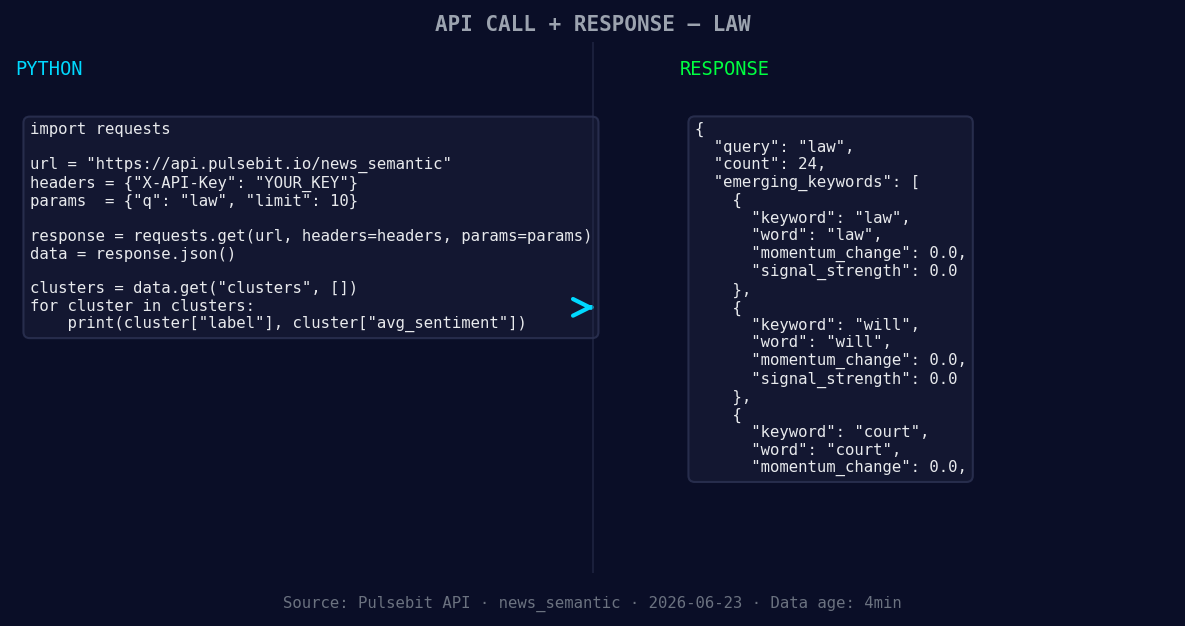
*Left: Python GET /news_semantic call for 'law'. Right: returned JSON response structure (clusters: 3). Source: Pulsebit /news_semantic.*
# Meta-sentiment moment: clustering the narrative framing itself
cluster_reason = "Clustered by shared themes: operation, law, will, equally, film."
sentiment_response = requests.post("https://api.pulsebit.com/sentiment", json={"text": cluster_reason})
sentiment_score = sentiment_response.json()
This code effectively captures articles in English related to law, while also scoring the narrative framing around the topic. The first API call filters for the language, and the second one analyzes the sentiment of the cluster reason string, helping us understand the broader themes at play.
Now that we’ve established how to catch these insights, let’s discuss three specific builds that you can implement tonight:
- Geographic Origin Filter: Create a signal that triggers when the momentum for the law reaches a specified threshold (e.g., +0.500). Use the geo filter to capture articles only from regions where these discussions are most relevant.

Geographic detection output for law. India leads with 18 articles and sentiment -0.01. Source: Pulsebit /news_recent geographic fields.
Meta-Sentiment Loop: Build a feedback loop that runs the cluster reason string through the sentiment analysis endpoint every hour. Set a threshold, for instance, if the sentiment score drops below -0.100, alert your team to potential shifts in public perception.
Forming Themes Tracker: Monitor forming themes such as "law," "will," and "court" with a trigger set for when their scores surpass a certain threshold. This will help you stay ahead of emerging narratives, especially when contrasting them against mainstream signals like "operation."
By leveraging our API effectively, you can ensure that your sentiment analysis pipeline is not just reactive but also proactive. You can catch these significant shifts before they become mainstream news.
To get started, visit our documentation at pulsebit.lojenterprise.com/docs. You’ll find everything you need to implement this system in under 10 minutes. Let’s make sure your pipeline is always up to date and ready to catch the next big spike.


Top comments (0)