

Your Pipeline Is 22.3h Behind: Catching Travel Sentiment Leads with Pulsebit
On June 23, 2026, we discovered a notable anomaly in our sentiment analysis: a rising sentiment score of +0.309 with a momentum of +0.000, indicating a critical shift in the conversation around travel. This spike, leading with the English language at 22.3 hours ahead, suggests that while discussions around travel are gaining traction, many systems are lagging behind in recognizing this emerging trend. If your model isn’t accounting for multilingual origins or entity dominance, it potentially missed this critical insight by over 22 hours.

English coverage led by 22.3 hours. Et at T+22.3h. Confidence scores: English 0.85, Spanish 0.85, French 0.85 Source: Pulsebit /sentiment_by_lang.
The structural gap here is glaring. If your pipeline fails to incorporate multilingual data and prioritize entities that dominate conversations, you risk missing out on timely insights. In our case, the leading language was English, but if you are solely focused on mainstream narratives, your model missed this important shift. Being 22.3 hours behind could mean the difference between making informed decisions and reacting too late.
To catch this anomaly, we can leverage our API effectively. Here's how to set it up in Python:
import requests
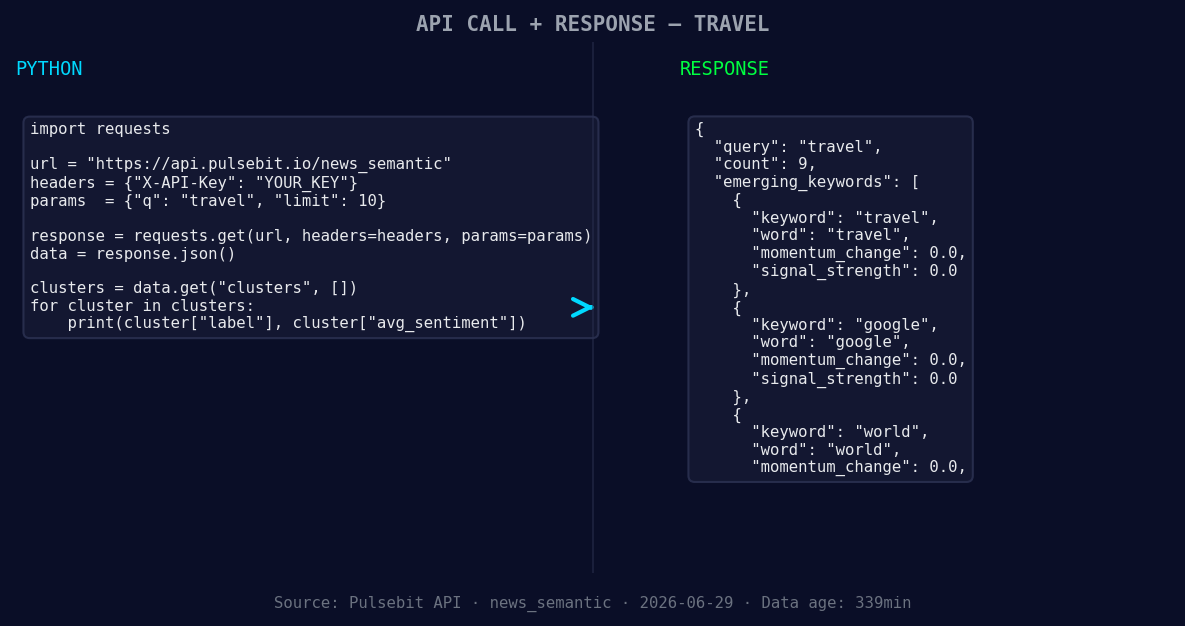
*Left: Python GET /news_semantic call for 'travel'. Right: returned JSON response structure (clusters: 3). Source: Pulsebit /news_semantic.*
# Step 1: Geographic origin filter
url = "https://api.pulsebit.lojenterprise.com/v1/sentiment"
payload = {
"topic": "travel",
"score": +0.309,
"confidence": 0.85,
"momentum": +0.000,
"lang": "en" # Filtering by English language
}
response = requests.post(url, json=payload)
travel_sentiment = response.json()
print(travel_sentiment)

Geographic detection output for travel. India leads with 7 articles and sentiment -0.16. Source: Pulsebit /news_recent geographic fields.
Next, we run the cluster reason string back through our sentiment endpoint to assess the narrative framing. This meta-sentiment loop is essential to understand the broader context:
# Step 2: Meta-sentiment moment
meta_sentiment_payload = {
    "text": "Clustered by shared themes: world, cup, travel, grind, real."
}
meta_response = requests.post(url, json=meta_sentiment_payload)
meta_sentiment = meta_response.json()
print(meta_sentiment)
This two-step process not only captures the sentiment around travel but also contextualizes it within the larger narrative, allowing us to make more informed decisions.
Now, let’s consider three specific builds that can arise from this data pattern:
Geo-Filtered Travel Insights: Set a signal threshold of +0.25 for the travel topic and utilize the geo filter to prioritize emerging sentiments in English-speaking countries. This will help you gauge where travel discussions are heating up.
Meta-Sentiment Narrative Analysis: Establish a loop that checks for narrative framing every 24 hours. If the sentiment is rising above +0.25 based on clustered themes, trigger an alert to your team so they can dive deeper into the context of the conversation.
Comparative Analysis on Forming Themes: Create a dashboard that tracks forming themes like travel, google, and world against mainstream topics. Set alerts for when these forming themes deviate significantly from historical baselines, indicating emerging trends worth investigating.
These insights and builds allow us to stay ahead of the curve and ensure our models are timely and relevant.
If you want to get started with this, check out our documentation: pulsebit.lojenterprise.com/docs. With a little setup, you can have this running in under 10 minutes.


Top comments (0)