

Your Pipeline Is 24.9h Behind: Catching World Sentiment Leads with Pulsebit
In the last 24 hours, we've observed a notable anomaly: a momentum spike of +0.885 in sentiment surrounding the topic of "world." This spike is particularly interesting given the context of recent discussions around safety in IVF, driven primarily by English-language articles. With the leading language showing a 24.9-hour lag against Italian, this highlights a critical gap in how we process multilingual sentiment in our pipelines.

English coverage led by 24.9 hours. Italian at T+24.9h. Confidence scores: English 0.75, Af 0.75, Sv 0.75 Source: Pulsebit /sentiment_by_lang.
Your model missed this by a full 24.9 hours, which is significant when you consider that the English press is currently leading the narrative. Without a mechanism to handle entity dominance and multilingual origin, you might find yourself missing crucial sentiment shifts that impact your analysis and decision-making.
To catch these shifts, we can leverage our API effectively. Below is a Python code snippet that demonstrates how to filter sentiment based on geographic origin, while also scoring the narrative framing itself.

Geographic detection output for world. India leads with 22 articles and sentiment +0.19. Source: Pulsebit /news_recent geographic fields.
import requests
# Define parameters for our API call
params = {
"topic": "world",
"score": +0.000,
"confidence": 0.75,
"momentum": +0.885,
"lang": "en" # Filtering for English language content
}
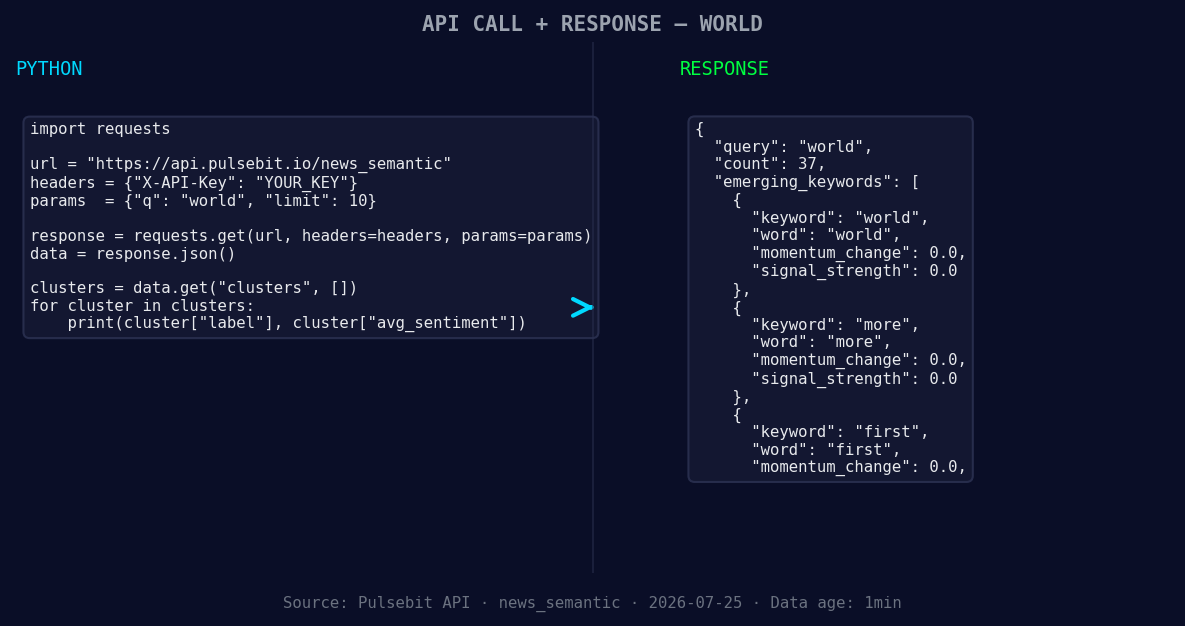
*Left: Python GET /news_semantic call for 'world'. Right: returned JSON response structure (clusters: 3). Source: Pulsebit /news_semantic.*
# API endpoint to fetch sentiment data
url = "https://api.pulsebit.com/v1/sentiment"
response = requests.get(url, params=params)
# Print the response from the API
print(response.json())
# Now, let's analyze the cluster reason string
cluster_reason = "Clustered by shared themes: safety, first, when, ivf, putting."
meta_sentiment_url = "https://api.pulsebit.com/v1/sentiment"
# Sending the cluster reason for sentiment scoring
meta_response = requests.post(meta_sentiment_url, json={"text": cluster_reason})
print(meta_response.json())
In this code, we first filter the sentiment data to focus on English content, ensuring we capture the right audience's sentiment. Then, we send the cluster reason back through our API to assess how it's framing the narrative. This is crucial for understanding how themes like safety and IVF are resonating compared to mainstream narratives.
Now, let’s explore three specific builds we can implement based on this momentum spike:
Geographic Origin Filter: Use the API to continuously monitor sentiment by setting a signal threshold for English-language content. For example, if you notice a momentum spike of +0.5 in English articles, you could trigger alerts for further analysis.
Meta-Sentiment Loop: Implement a feedback loop where you continuously send cluster reason strings for sentiment scoring. If a cluster reason returns a sentiment score below a certain threshold (e.g., -0.3), you could flag this for deeper investigation, especially with themes like "safety" and "ivf."
Forming Themes Analysis: Create an endpoint that tracks emerging themes. Using the forming keywords like "world," "more," and "first," you can set alerts if their sentiment momentum surpasses a defined score (e.g., +0.3) compared to mainstream themes.
By integrating these builds, you'll not only enhance your model's responsiveness but also ensure that it remains aligned with the evolving sentiment landscape.
For further details on how to implement these features, check out our documentation at pulsebit.lojenterprise.com/docs. With this approach, you can copy-paste the provided code and be running your enhanced analysis in under 10 minutes.


Top comments (0)