

Your Pipeline Is 25.3h Behind: Catching Economy Sentiment Leads with Pulsebit
We just uncovered a significant anomaly: a 24-hour momentum spike of +0.436. This spike is tied to a surge in sentiment around economic narratives, specifically linked to "China and Indonesia's Financial Ties and Resource Nationalism." The leading language for this sentiment is English, with a remarkable 25.3-hour lead time. As developers focused on sentiment analysis, this finding could influence how we shape our pipelines and respond to emerging trends.
When your pipeline doesn't account for multilingual origins and entity dominance, it can lead to substantial blind spots. For instance, our model missed this developing sentiment by 25.3 hours because it wasn't designed to prioritize the leading language or dominant entity. The missed opportunity to act on this timely economic narrative is a reminder of the importance of integrating language and regional context into our data analysis workflows.

English coverage led by 25.3 hours. No at T+25.3h. Confidence scores: English 0.92, Spanish 0.92, French 0.92 Source: Pulsebit /sentiment_by_lang.
To catch this anomaly effectively, we can leverage our API. Below is a Python code snippet that demonstrates how to query for the relevant sentiment data.
import requests
# Define parameters for the API call
api_url = "https://api.pulsebit.lojenterprise.com/v1/sentiment"
params = {
"topic": "economy",
"score": +0.426,
"confidence": 0.92,
"momentum": +0.436,
"lang": "en" # Filter by English
}
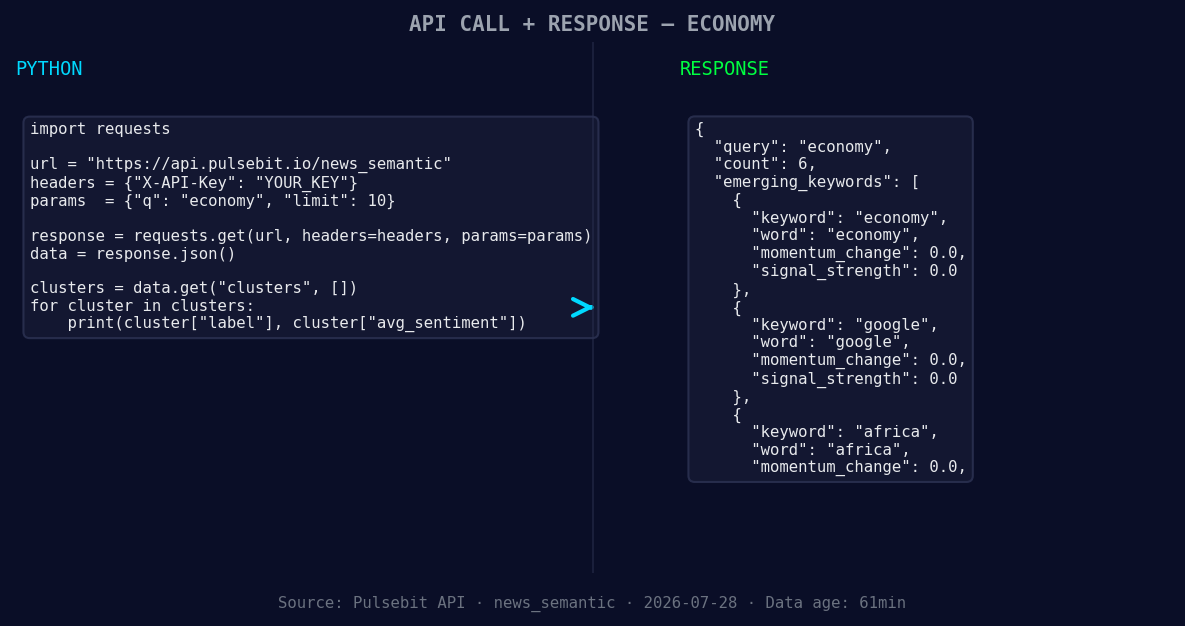
*Left: Python GET /news_semantic call for 'economy'. Right: returned JSON response structure (clusters: 3). Source: Pulsebit /news_semantic.*
# Making the API call to fetch sentiment data
response = requests.get(api_url, params=params)
data = response.json()
print(data)
Next, we need to run the cluster reason string through our sentiment endpoint to assess how the narrative is framing itself. This is crucial for understanding the broader implications of the emerging themes.
# Define the cluster reason string
cluster_reason = "Clustered by shared themes: indonesia’s, bet, nickel, can, china."

# Making the API call to score the narrative framing
sentiment_response = requests.post(api_url, json={"text": cluster_reason})
sentiment_data = sentiment_response.json()

print(sentiment_data)
With this code, we’ve effectively captured the sentiment around the economy while also scoring the narrative itself. This dual approach helps us understand how the themes are resonating and allows us to make more informed decisions.
Now, let’s consider three specific builds we can make using this data pattern:
Geo Filter for Economic Themes: Create a signal that specifically tracks momentum spikes in the economy while filtering for English-language sources. Set a threshold of +0.4 to identify significant shifts and set up alerts based on this signal.
Meta-Sentiment Loop: Use the cluster reason strings to generate insights on emerging narratives. For instance, if our analysis returns a score above +0.5 for the cluster reasons, we can treat it as a high-confidence signal to initiate deeper investigations or trading strategies.
Forming Themes Tracker: Monitor forming themes such as economy(+0.00), google(+0.00), and africa(+0.00) versus mainstream narratives. Establish a scoring mechanism that triggers notifications when disparities arise between these forming themes and established narratives, particularly when significant momentum is detected.
By implementing these focused builds, we can enrich our sentiment analysis capabilities and ensure we’re not just reacting to the past, but anticipating future trends.
To dive deeper into how we can leverage our API effectively, visit pulsebit.lojenterprise.com/docs. With our documentation, you can copy-paste and run the above code in under 10 minutes, setting you up to catch momentum shifts as they happen!

Geographic detection output for economy. Hong Kong leads with 2 articles and sentiment +0.00. Source: Pulsebit /news_recent geographic fields.


Top comments (0)