

Your Pipeline Is 28.7h Behind: Catching Economy Sentiment Leads with Pulsebit
We recently uncovered a significant anomaly: a 24-hour momentum spike of +0.236 in the sentiment surrounding the economy. This finding points to an intriguing shift in discussions around financial subjects, particularly as they relate to Africa’s evolving economic landscape. With the leading language being English and a precise 28.7-hour lead, it’s clear that there’s a lot happening that your models might be missing.
The crux of the issue lies in the structural gap many sentiment analysis pipelines face when it comes to multilingual origins or entity dominance. Your model might have missed this critical spike by a staggering 28.7 hours simply because it wasn’t equipped to handle diverse linguistic inputs effectively. The dominant entity here is English, and the emerging narrative can’t be ignored. If your system lacks the flexibility to accommodate this diversity, you risk falling behind on capturing essential market sentiment.

English coverage led by 28.7 hours. Et at T+28.7h. Confidence scores: English 0.85, Spanish 0.85, No 0.85 Source: Pulsebit /sentiment_by_lang.
Here’s how we can catch this momentum spike using our API. We’ll start with a geographic origin filter that ensures we’re only examining English-language articles related to the topic of “economy”:

Geographic detection output for economy. Hong Kong leads with 1 articles and sentiment +0.00. Source: Pulsebit /news_recent geographic fields.
import requests
# Define the parameters for the API call
params = {
"topic": "economy",
"lang": "en",
}
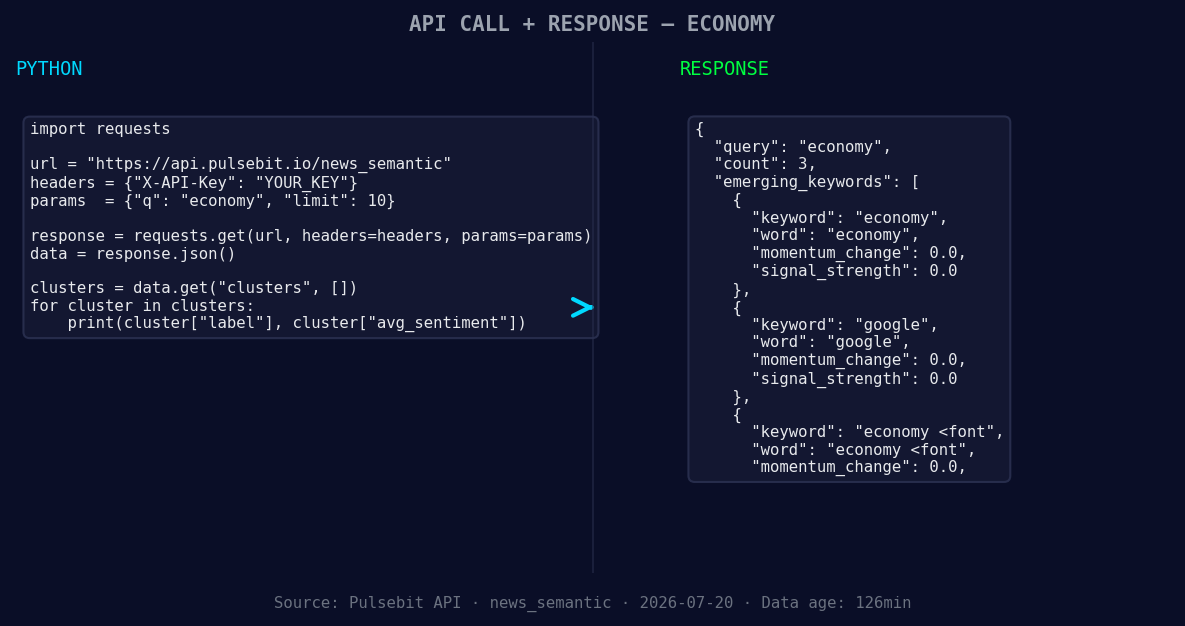
*Left: Python GET /news_semantic call for 'economy'. Right: returned JSON response structure (clusters: 3). Source: Pulsebit /news_semantic.*
# Make the API call to get sentiment data
response = requests.get("https://api.pulsebit.com/sentiment", params=params)
data = response.json()
# Output the relevant data
print(data)
Next, we need to run the cluster reason string back through our sentiment endpoint to score the narrative framing itself. This is where the meta-sentiment moment comes into play:
# Define the meta-sentiment input
meta_sentiment_input = "Clustered by shared themes: borderless, economy, outgrowing, its, financial."

# Make the API call to score the narrative
meta_sentiment_response = requests.post("https://api.pulsebit.com/sentiment", json={"text": meta_sentiment_input})
meta_sentiment_data = meta_sentiment_response.json()

# Output the meta sentiment score
print(meta_sentiment_data)
Now you have the sentiment score of the narrative, which adds depth to your understanding of the momentum spike.
Here are three specific builds we can create with this pattern:
Geo-filtered Momentum Tracker: Create an alert system based on the momentum score of the English language articles about the economy. Trigger a notification if the score exceeds +0.3, giving you a heads-up on emerging trends.
Meta-Sentiment Alert: Build a monitoring tool that scores narratives around clustered themes like "borderless economy." Set a threshold for positive sentiment above +0.5 to identify promising stories before they go mainstream.
Thematic Comparison Dashboard: Develop a dashboard that compares sentiment scores across various themes like "economy," "tech," and "finance." Use the API to fetch data and visualize it, allowing you to see which narratives are gaining traction and which are lagging behind.
If you're looking to dive into this, check out our documentation at pulsebit.lojenterprise.com/docs. With our API, you can copy-paste the provided code snippets and have this running in under 10 minutes. Let’s ensure you’re not left 28.7 hours behind in capturing sentiment that matters.


Top comments (0)