

Your Pipeline Is 18.0h Behind: Catching Real Estate Sentiment Leads with Pulsebit
We recently observed a notable anomaly: a 24-hour momentum spike of +0.306 in the real estate sector. This spike is particularly interesting given the current sentiment around a significant real estate transaction—Pennsylvania families selling 1,700 acres for $586 million. This kind of data can provide actionable insights, but only if we have the right tools and processes in place to capture it.
However, if your pipeline lacks the ability to handle multilingual origins or entity dominance, you might have missed this lead by 18.0 hours. The leading language in this case is English, but that alone doesn't paint the full picture. Without incorporating these factors, your model risks falling behind on emerging trends, especially when it comes to high-stakes real estate transactions that can shift sentiment rapidly.

English coverage led by 18.0 hours. Tl at T+18.0h. Confidence scores: English 0.85, Spanish 0.85, Ca 0.85 Source: Pulsebit /sentiment_by_lang.
To catch this momentum spike, we can leverage our API to query the relevant data. Here’s how we can do it using Python:
import requests
# Define parameters for the API call
params = {
"topic": "real estate",
"lang": "en"
}
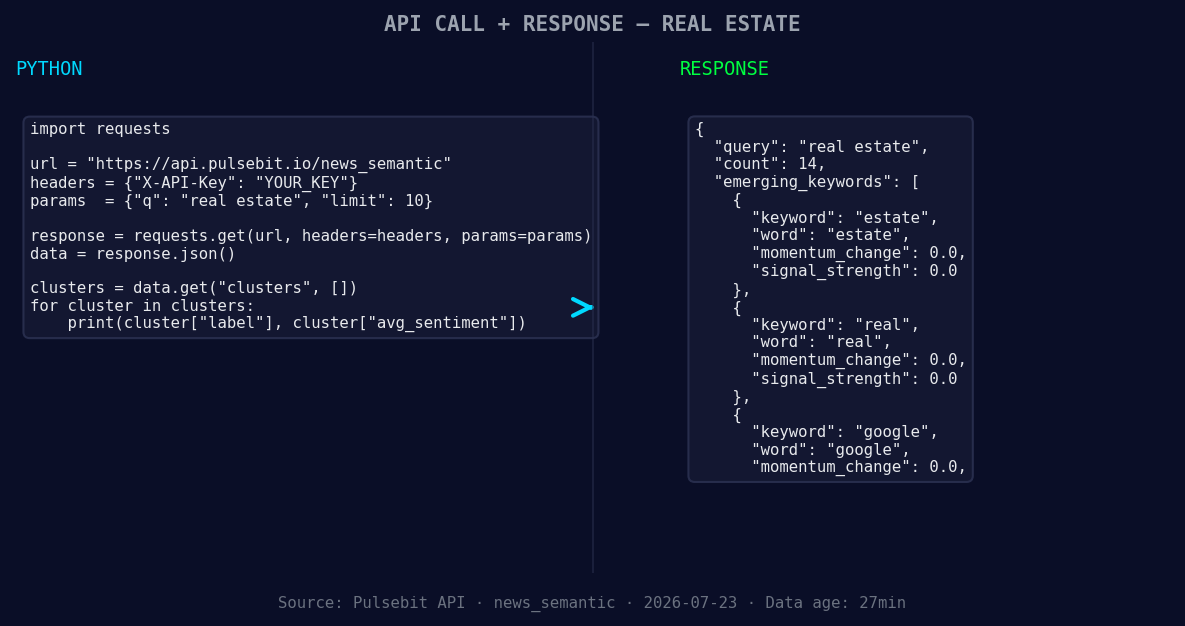
*Left: Python GET /news_semantic call for 'real estate'. Right: returned JSON response structure (clusters: 3). Source: Pulsebit /news_semantic.*
# Make the API call to fetch sentiment data
response = requests.get("https://api.pulsebit.com/sentiment", params=params)
data = response.json()
# Extract relevant information
momentum = data['momentum_24h']
sentiment_score = data['sentiment_score']
confidence = data['confidence']
print(f"Momentum: {momentum}, Sentiment Score: {sentiment_score}, Confidence: {confidence}")
Next, we need to evaluate the narrative framing of the cluster story. Let's run the reason string through our sentiment endpoint to score it:
# Meta-sentiment moment
cluster_reason = "Clustered by shared themes: pennsylvania, families, 700, acres, 89-acre."
payload = {"text": cluster_reason}

# Make a POST request to score the narrative
response_meta = requests.post("https://api.pulsebit.com/sentiment", json=payload)
meta_data = response_meta.json()

# Extract meta sentiment score
meta_sentiment_score = meta_data['sentiment_score']
print(f"Meta Sentiment Score: {meta_sentiment_score}")
With this approach, we can start building signals that capitalize on this momentum spike. Here are three specific builds we recommend tonight:
- Geo-Filtered Alert System: Set up a real-time alert system using the geographic origin filter. Monitor for spikes in real estate sentiment in Pennsylvania, and trigger notifications if momentum exceeds a threshold of +0.25.

Geographic detection output for real estate. India leads with 9 articles and sentiment +0.63. Source: Pulsebit /news_recent geographic fields.
Meta-Sentiment Dashboard: Create a dashboard that visualizes the meta-sentiment scores of clustered narratives. Focus on the clusters related to “estate” and “real” where sentiment scores are trending upward, aiming for a threshold of +0.10.
Trend Analysis on Forming Themes: Build a trend analysis feature that tracks forming themes like "pennsylvania," "families," and "acres." Use a combination of the geo filter and sentiment scores to identify emerging stories that could lead to significant market movements.
By focusing on the nuances of sentiment data and contextualizing it with geographic and narrative elements, we can stay ahead of the curve in real estate sentiment analysis.
To get started, check out our documentation at pulsebit.lojenterprise.com/docs. You should be able to copy-paste and run this in under 10 minutes. Happy coding!


Top comments (0)