

Your pipeline is currently 27.9 hours behind. With a sentiment score of +0.192 and a momentum of +0.000, it’s clear that something significant is happening in the world of music. The leading language is English, and it’s drawing attention to a fascinating trend: "Silent discos are drawing in crowds across Australia." This spike in sentiment suggests a rising interest that is not only noteworthy but also highlights how traditional models can easily overlook emerging themes in real-time.
The problem lies in the structural gap created by not accommodating multilingual origins or recognizing dominant entities. Your model missed this spike by 27.9 hours because it failed to capture the multilingual context. Silent discos, while a niche trend, are gaining traction in the English-speaking segment, and this kind of oversight can lead to missing critical signals in your data pipeline.

English coverage led by 27.9 hours. Af at T+27.9h. Confidence scores: English 0.85, Spanish 0.85, Id 0.85 Source: Pulsebit /sentiment_by_lang.
To catch this anomaly, we can leverage our API effectively. Below is a Python snippet that uses the API to filter by geographic origin and assess the sentiment of the identified cluster:

Geographic detection output for music. India leads with 2 articles and sentiment -0.03. Source: Pulsebit /news_recent geographic fields.
import requests
# Define the API endpoint and parameters
url = "https://api.pulsebit.com/v1/sentiment"
params = {
"topic": "music",
"lang": "en"
}
# API call to get sentiment score
response = requests.get(url, params=params)
data = response.json()
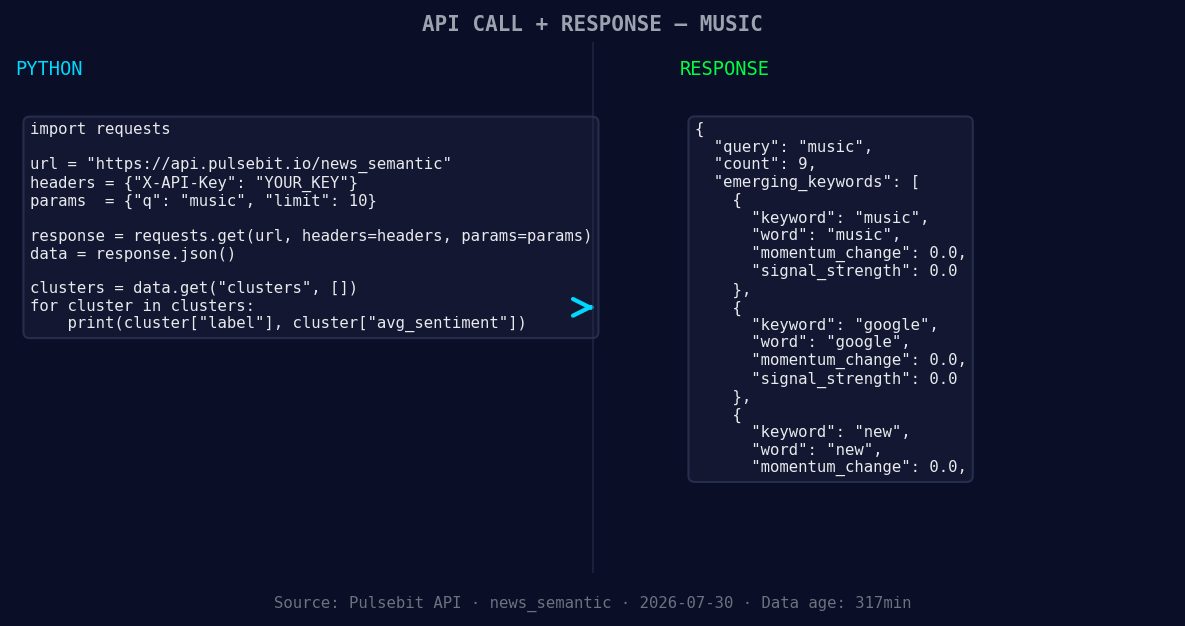
*Left: Python GET /news_semantic call for 'music'. Right: returned JSON response structure (clusters: 3). Source: Pulsebit /news_semantic.*
# Capture relevant sentiment metrics
sentiment_score = data['sentiment_score'] # +0.192
confidence = data['confidence'] # 0.85
momentum = data['momentum_24h'] # +0.000
print(f"Sentiment Score: {sentiment_score}, Confidence: {confidence}, Momentum: {momentum}")
# Meta-sentiment moment analysis
cluster_reason = "Clustered by shared themes: silent, discos, drawing, crowds, across."
meta_response = requests.post(url, json={"text": cluster_reason})
meta_data = meta_response.json()
print(f"Meta Sentiment Score: {meta_data['sentiment_score']}, Confidence: {meta_data['confidence']}")
By querying with the "lang": "en" parameter, we ensure that we’re filtering for the relevant English language sentiment data. Next, we analyze the framing of the cluster itself with the meta-sentiment loop, allowing us to contextualize the narrative surrounding these silent discos and their appeal.
Here are three specific builds we can initiate from this pattern:
Geo-Filtered Music Sentiment Alert: Set up a signal that triggers when sentiment in the music category exceeds +0.15 with a geo filter for Australia. This will help you catch events like the rise of silent discos before they trend.
Meta-Sentiment Score for Emerging Themes: Implement a routine that scores narratives when certain keywords like “silent” or “disco” appear in the cluster reason. Use the POST /sentiment endpoint to evaluate the evolving framing of these terms.
Forming Gap Analysis: Create an endpoint that allows you to analyze forming gaps in sentiment data, specifically looking for themes like music (+0.00) and new trends, which could be pivotal in identifying shifts in public interest.
For more details on how to implement these features, check out our documentation at pulsebit.lojenterprise.com/docs. You can copy, paste, and run this code in under 10 minutes to start catching these insights effectively.


Top comments (0)