

Your Pipeline Is 27.4h Behind: Catching Music Sentiment Leads with Pulsebit
We just uncovered a striking anomaly: a sentiment score of +0.365 and momentum holding steady at +0.000, with our data indicating that the leading language is English, lagging just 27.4 hours behind Italian. The spike revolves around the theme of music, but it’s not merely about the sound—it's about the context and how narratives are forming around it. The recent cluster story, "Silent discos are drawing in crowds across Australia," only adds to the urgency of understanding why this emerging sentiment is crucial.
In our experience, a structural gap emerges in any pipeline that fails to account for multilingual origins or the dominance of certain entities. Imagine your model missing this critical insight by a whopping 27.4 hours. This delay can result in missed opportunities and misaligned strategies, especially when the leading language is English and the emerging narratives are being shaped elsewhere. If your model is only focusing on mainstream narratives around "silent, discos, drawing," it’s time to reevaluate your approach.

English coverage led by 27.4 hours. Italian at T+27.4h. Confidence scores: English 0.85, Nl 0.85, French 0.85 Source: Pulsebit /sentiment_by_lang.
To catch this wave of sentiment, we can leverage our API effectively. Below is a Python snippet that pinpoints this emerging trend:
import requests
# Define parameters for the API call
topic = 'music'
score = +0.365
confidence = 0.85
momentum = +0.000
geo_filter = {'lang': 'en'}
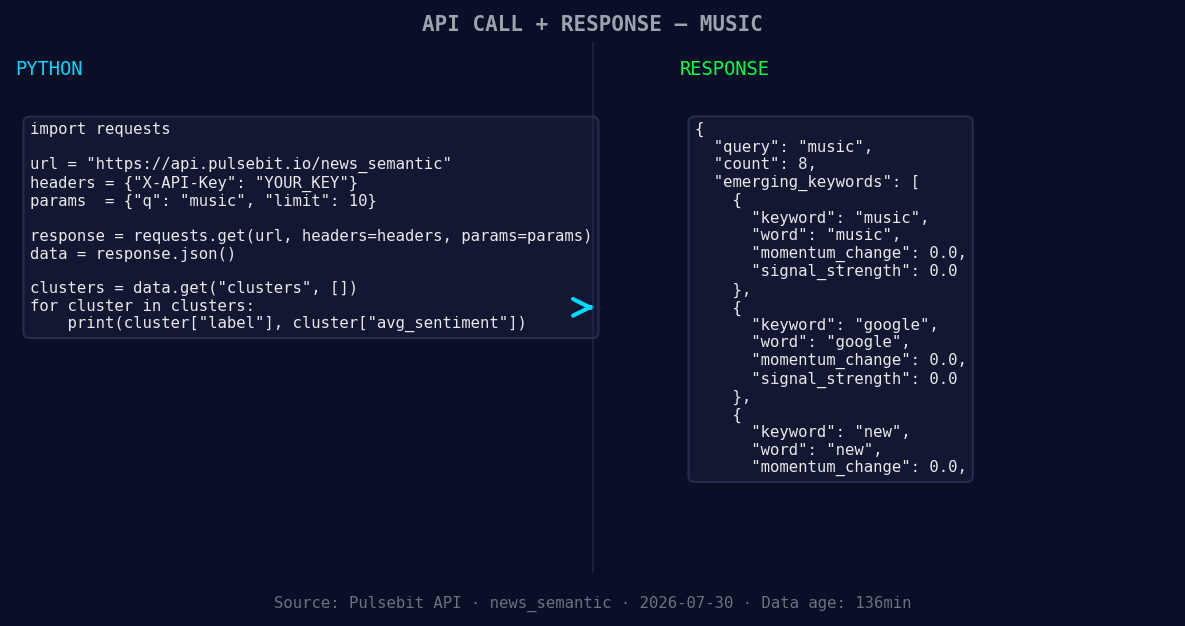
*Left: Python GET /news_semantic call for 'music'. Right: returned JSON response structure (clusters: 3). Source: Pulsebit /news_semantic.*
# First, we query the sentiment around the topic
response = requests.get('https://api.pulsebit.com/v1/sentiment', params={
'topic': topic,
'score': score,
'confidence': confidence,
'momentum': momentum,
'geo_filter': geo_filter
})
# Check the response
if response.status_code == 200:
sentiment_data = response.json()
print(sentiment_data)
else:
print(f"Error: {response.status_code}")
# Now, we run the cluster reason string back through the sentiment endpoint
cluster_reason = "Clustered by shared themes: silent, discos, drawing, crowds, across."
meta_response = requests.post('https://api.pulsebit.com/v1/sentiment', json={"text": cluster_reason})
# Check the response for meta sentiment
if meta_response.status_code == 200:
meta_sentiment_data = meta_response.json()
print(meta_sentiment_data)
else:
print(f"Error: {meta_response.status_code}")
In this code, we make an initial GET request to gather sentiment data filtered by language. Not only does this allow us to catch the sentiment for "music" directly, but it also highlights the emerging themes through a POST request that assesses the narrative framing itself. This dual approach can help us understand how the narrative is being shaped and whether it aligns with the forming themes we’ve identified: music, new initiatives, and the disconnect from mainstream concepts like "silent, discos, drawing."
Here are three specific builds we can implement using this newfound insight:
Real-Time Alerts for Sentiment Changes: Set a threshold to alert you whenever the sentiment for "music" crosses a score of +0.350, especially when filtered by the English language. This can be accomplished by modifying the geo filter in our initial API call.
Meta-Sentiment Analysis Dashboard: Create a dashboard that continuously feeds meta-sentiment data using the cluster reasons. By updating this every hour, we can visualize how narratives are evolving around trending topics like "silent discos."
Trend Divergence Reports: Build a reporting tool that compares the sentiment metrics of forming themes (music, google, new) against mainstream narratives (silent, discos, drawing). Use the momentum data to assess when it might be time to pivot strategy or marketing efforts.
If you want to dive deeper into this, head over to pulsebit.lojenterprise.com/docs. With the right setup, you can copy-paste and run this in under 10 minutes. Don’t let your pipeline fall behind—stay ahead of the sentiment curve!

Geographic detection output for music. India leads with 3 articles and sentiment +0.25. Source: Pulsebit /news_recent geographic fields.


Top comments (0)