

Your Pipeline Is 11.8h Behind: Catching Sustainability Sentiment Leads with Pulsebit
We recently observed a remarkable anomaly: a 24-hour momentum spike of +0.301 in sentiment around sustainability. This spike is not just a number; it indicates a burgeoning narrative that could shape your development pipeline. The leading language driving this change is English, with a notable 11.8-hour lead on other languages. This could mean the difference between capitalizing on emerging trends and falling behind.
Without a robust multilingual pipeline, your model missed this momentum shift by 11.8 hours, primarily led by English sentiment. If your data processing doesn't account for language dominance, you might find yourself out of the loop as trends rapidly evolve. The focus here on sustainability, particularly in the English-speaking press, suggests a significant gap that could impact your decision-making and strategic planning.

English coverage led by 11.8 hours. Et at T+11.8h. Confidence scores: English 0.75, Spanish 0.75, French 0.75 Source: Pulsebit /sentiment_by_lang.
import requests
# Define parameters for our API call
params = {
"topic": "sustainability",
"score": +0.715,
"confidence": 0.75,
"momentum": +0.301,
"lang": "en" # Geographic origin filter
}
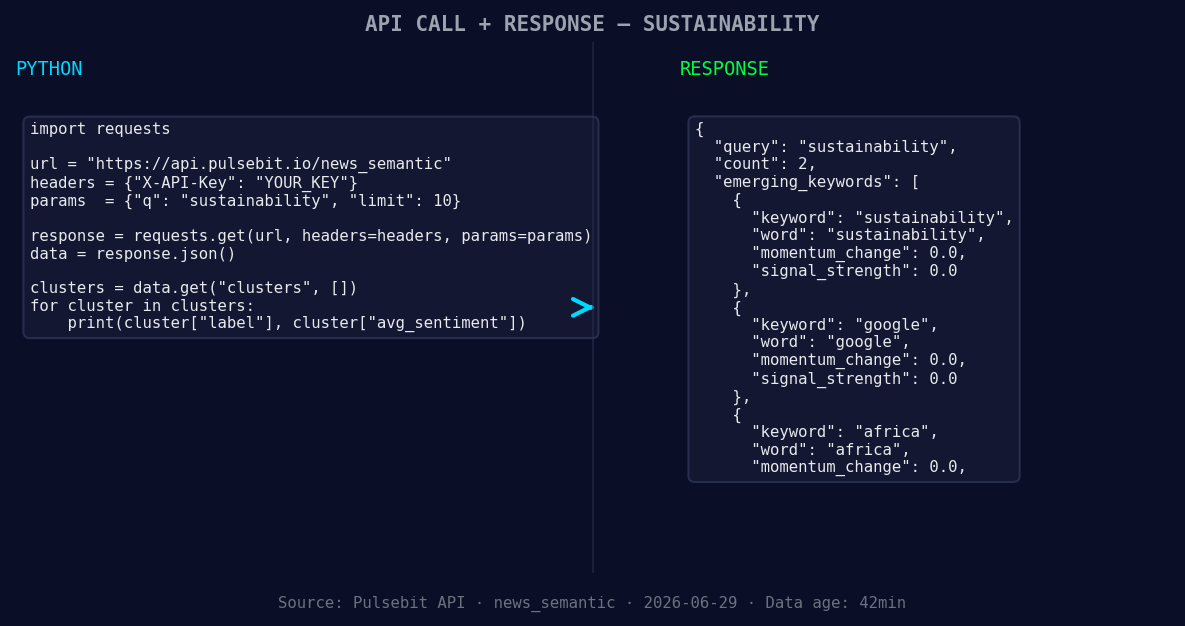
*Left: Python GET /news_semantic call for 'sustainability'. Right: returned JSON response structure (clusters: 3). Source: Pulsebit /news_semantic.*
# Perform the API call to get sentiment data
response = requests.get('https://api.pulsebit.com/sentiment', params=params)
data = response.json()
print(data) # Output the sentiment data
Next, we need to dive deeper into the meta-sentiment. This is crucial for understanding the narrative framing surrounding our spike. We will run the cluster reason string through our sentiment endpoint to gauge the overall sentiment.
# Cluster reason string
cluster_reason = "Clustered by shared themes: launches, cloud, sustainability, tracker, scheme."

# Perform the API call to analyze the cluster reason
sentiment_response = requests.post('https://api.pulsebit.com/sentiment', json={"input": cluster_reason})
sentiment_data = sentiment_response.json()

print(sentiment_data)  # Output the meta-sentiment data
From this, we can build actionable insights based on the current trends. Here are three specific builds you can implement tonight:
Geo-Sentiment Dashboard: Create a dashboard that filters sustainability sentiment by geographic origin, focusing on English-speaking regions. Use the
langparameter to track spikes in sentiment and understand regional differences.Meta-Sentiment Analyzer: Build an endpoint that continuously analyzes narrative framing using the cluster reason strings. Focus on keywords like "sustainability" and "cloud" to define thresholds for alerts when sentiment shifts dramatically.
Trend Divergence Monitor: Set up an alert system that flags when emerging topics such as "sustainability", "Google", or "Africa" diverge from mainstream themes like "launches" or "cloud". Use the momentum score to prioritize which trends need immediate attention.
If you’re ready to catch these trends before your competitors, head over to our documentation at pulsebit.lojenterprise.com/docs. You can copy-paste the code above and run it in under 10 minutes. Don’t let your pipeline fall behind—let’s harness this momentum together!


Top comments (0)