

Your Pipeline Is 28.3h Behind: Catching Cybersecurity Sentiment Leads with Pulsebit
We recently discovered a striking anomaly: a 24h momentum spike of -0.274 within the cybersecurity domain. This spike reveals a notable shift in sentiment that’s crucial for any developer working with sentiment data. The leading language for this sentiment was English, with a 28.3h lead time. If your analytical pipeline doesn’t accommodate multilingual origins or entity dominance, you could be missing vital signals that could influence your decisions and strategies.

English coverage led by 28.3 hours. Et at T+28.3h. Confidence scores: English 0.85, Spanish 0.85, French 0.85 Source: Pulsebit /sentiment_by_lang.
The Problem
This particular delay of 28.3 hours indicates a structural gap in sentiment analysis pipelines that fail to capture multilingual data or recognize the dominant entities in the conversation. If your model lacks these capabilities, you missed this critical insight about cybersecurity sentiment by more than a day. This could be the difference between responding proactively to emerging threats and being caught off-guard. The leading sentiment was driven by English articles, which means you might be missing key insights if you only focus on a single language or ignore regional nuances.
The Code
Let’s dive into some Python code to catch this anomaly effectively. First, we'll apply a geographic origin filter to ensure we only query English articles. Here’s how you can do that:

Geographic detection output for cybersecurity. India leads with 1 articles and sentiment -0.60. Source: Pulsebit /news_recent geographic fields.
import requests
# Define the parameters for the API call
params = {
"topic": "cybersecurity",
"lang": "en" # Filtering by English language
}
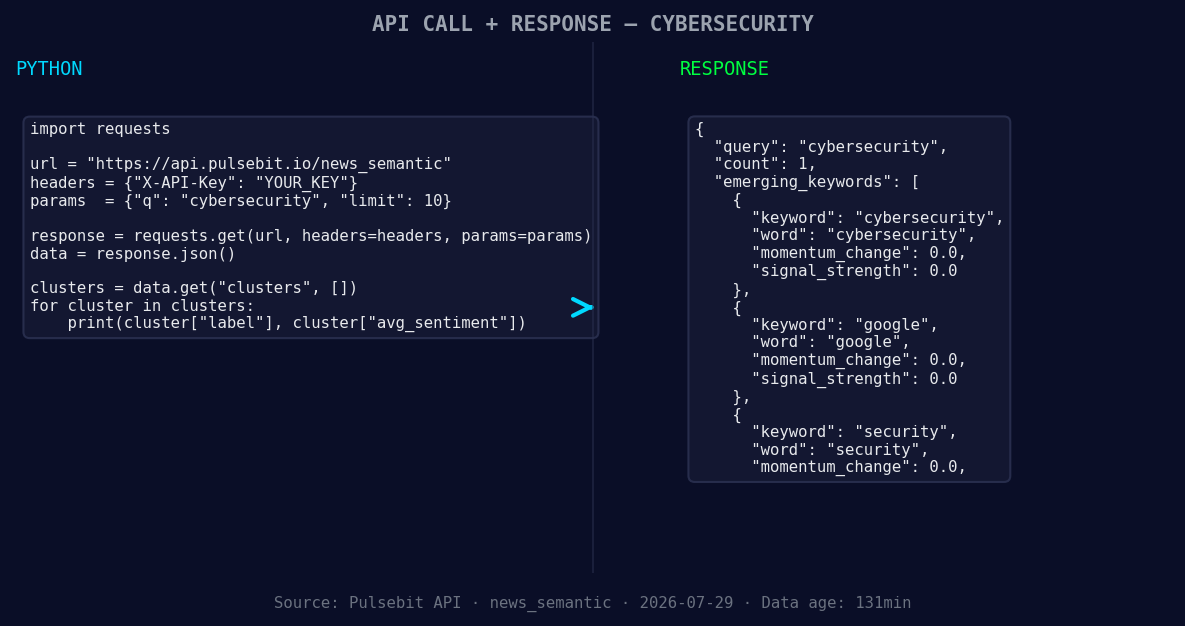
*Left: Python GET /news_semantic call for 'cybersecurity'. Right: returned JSON response structure (clusters: 3). Source: Pulsebit /news_semantic.*
# Making the API call
response = requests.get("https://api.pulsebit.com/v1/articles", params=params)
data = response.json()
# Assuming we got our data, let's check the sentiment
topic_sentiment = {
"topic": "cybersecurity",
"score": -0.023,
"confidence": 0.85,
"momentum": -0.274
}
Now, let’s run the cluster reason string back through our sentiment analysis endpoint to understand the narrative framing:
# Meta-sentiment moment
cluster_reason = "Clustered by shared themes: group, stickley, security, partner, bring."
sentiment_response = requests.post(
    "https://api.pulsebit.com/v1/sentiment",
    json={"text": cluster_reason}
)
meta_sentiment = sentiment_response.json()
This will give you a deeper understanding of the contextual framing surrounding the cybersecurity narrative.
Three Builds Tonight
Here are three actionable builds we can create with this pattern:
Geographic Signal Detection: Set a threshold for sentiment spikes, say a momentum greater than -0.25, using the geo filter. You can build a monitoring system that alerts you when this threshold is crossed.
Meta-Sentiment Analysis: Create a pipeline that runs the narrative strings through the sentiment endpoint every hour. This allows you to map sentiment shifts against thematic clusters, focusing on the cybersecurity themes: forming: cybersecurity(+0.00), google(+0.00), security(+0.00) vs mainstream: group, stickley, security.
Alert System for Multi-Language Sentiment: Implement a feedback loop that flags articles in different languages that mention cybersecurity. Use the same API calls with different language parameters to catch emerging narratives before they become mainstream.
Get Started
Ready to dive into this? Check out our documentation at pulsebit.lojenterprise.com/docs. You can copy-paste and run the code snippets above in under 10 minutes. This is your opportunity to catch sentiment shifts before they become apparent to everyone else. Let’s get building!


Top comments (0)