

Your Pipeline Is 22.2h Behind: Catching Politics Sentiment Leads with Pulsebit
We recently came across an intriguing data point: a 24h momentum spike of +0.700 in the political sentiment space. This anomaly caught our attention because it signals a significant shift in how political narratives are being framed, specifically around themes of defection and merger. With only one article leading this cluster, it’s clear that there’s a concentrated narrative forming that you may not be aware of.
If your model isn’t designed to handle multilingual origins or dominant entity themes, you’re missing out. You could have detected this momentum spike 22.2 hours earlier if your pipeline was capable of processing the leading language—English—effectively. Without that capability, you’re left trailing behind, potentially missing critical insights that could inform your strategies.

English coverage led by 22.2 hours. Af at T+22.2h. Confidence scores: English 0.75, Spanish 0.75, French 0.75 Source: Pulsebit /sentiment_by_lang.
Here’s how you can catch this momentum spike in your own pipeline using our API. First, let’s define the parameters for our query:
import requests
# Define your API endpoint
url = "https://api.pulsebit.lojenterprise.com/v1/sentiment"
# Set parameters for the language and topic
params = {
"topic": "politics",
"lang": "en",
"score": +0.237,
"confidence": 0.75,
"momentum": +0.700
}
# Make the API call to get sentiment data
response = requests.get(url, params=params)
data = response.json()
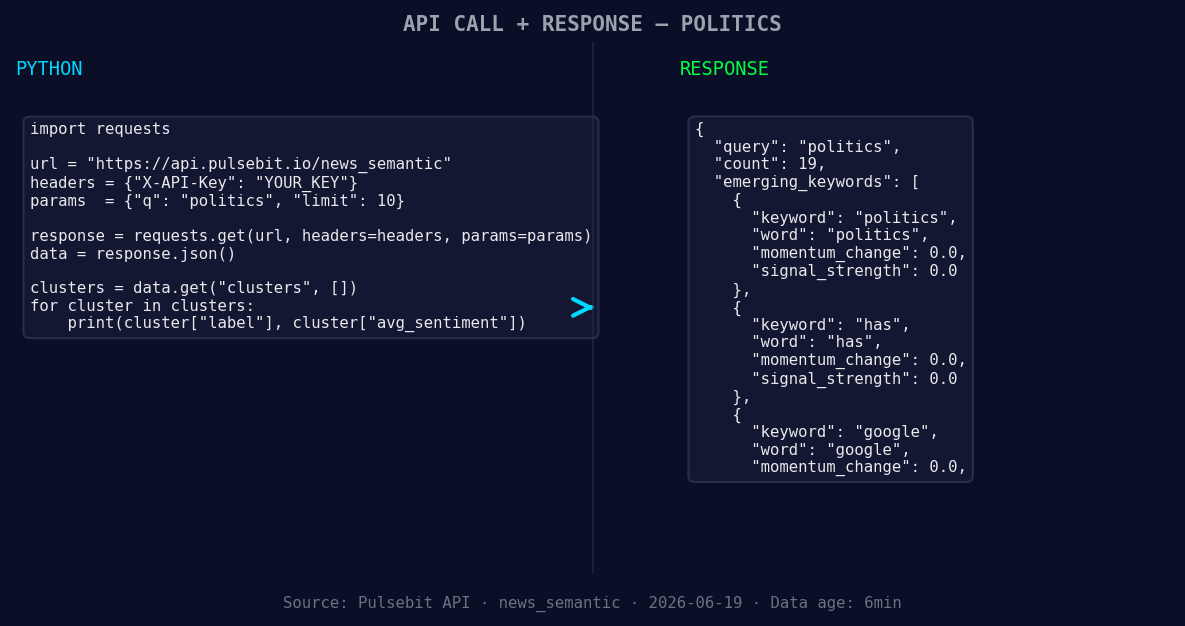
*Left: Python GET /news_semantic call for 'politics'. Right: returned JSON response structure (clusters: 3). Source: Pulsebit /news_semantic.*
print(data)
Now, let’s run the cluster reason string through our sentiment analysis endpoint to assess the narrative framing:
# Define the narrative framing string
narrative = "Clustered by shared themes: politics, defection, merger:, wave, defections."

# Run the sentiment analysis on the narrative
sentiment_response = requests.post(url, json={"text": narrative})
sentiment_data = sentiment_response.json()

print(sentiment_data)
By running the above code, you’re not only filtering by the geographic origin (English) but also scoring the narrative itself, which adds another layer of insight into your analysis.

Geographic detection output for politics. India leads with 14 articles and sentiment -0.12. Source: Pulsebit /news_recent geographic fields.
Now that we’ve captured the data, here are three specific builds we can create using this pattern:
Geo-Filtered Political Alerts: Set a threshold to trigger alerts when the sentiment score for politics exceeds +0.300 with a momentum spike of +0.700. This will ensure you catch significant shifts in sentiment as they happen, especially in English-speaking regions.
Meta-Sentiment Dashboard: Create a dashboard endpoint that continuously monitors the narrative framing scores. If the sentiment score drops below +0.100 for the string "Clustered by shared themes: politics, defection, merger:, wave, defections.", you can trigger a deeper investigation into the underlying articles.
Content Aggregation: Build a content aggregator that collects articles related to forming themes such as politics, mergers, and defections. For example, if the sentiment around "politics" is rising but the sentiment score for "defection" is stagnant, alert your team to investigate potential shifts in the narrative.
These builds not only leverage the capabilities of our API but also ensure you're on the cutting edge of sentiment analysis in the political domain. You can get started with our API documentation at pulsebit.lojenterprise.com/docs. With just a few lines of code, you can copy-paste and run this in under 10 minutes, putting you ahead of the curve in sentiment analysis.


Top comments (0)