

Your pipeline just missed a crucial 24-hour momentum spike of -0.800. This anomaly highlights a significant shift in sentiment, particularly in the context of discussions around in vitro fertilization (IVF) and the safety of expectant mothers. In our exploration, we found that Spanish media coverage led this conversation, peaking at a 27.5-hour lag against the identified trend. This finding underscores the importance of continuously monitoring and adapting to multilingual sentiment to catch leading narratives before they become mainstream.

Spanish coverage led by 27.5 hours. Id at T+27.5h. Confidence scores: Spanish 0.85, English 0.85, Da 0.85 Source: Pulsebit /sentiment_by_lang.
When your model lacks the capability to handle multilingual data or dominant entities, you risk missing out on crucial insights. Your pipeline fell short by 27.5 hours, failing to capture the urgency of the narrative surrounding IVF safety that was primarily driven by Spanish-language content. Imagine the implications of overlooking such critical information just because the dominant sentiment wasn’t in English or was buried under more generic signals.
To catch such anomalies, we can leverage our API effectively. Here’s how you can identify this specific sentiment shift with Python:
import requests
# Step 1: Define parameters for the API call
topic = 'world'
score = +0.102
confidence = 0.85
momentum = -0.800
lang = 'sp'
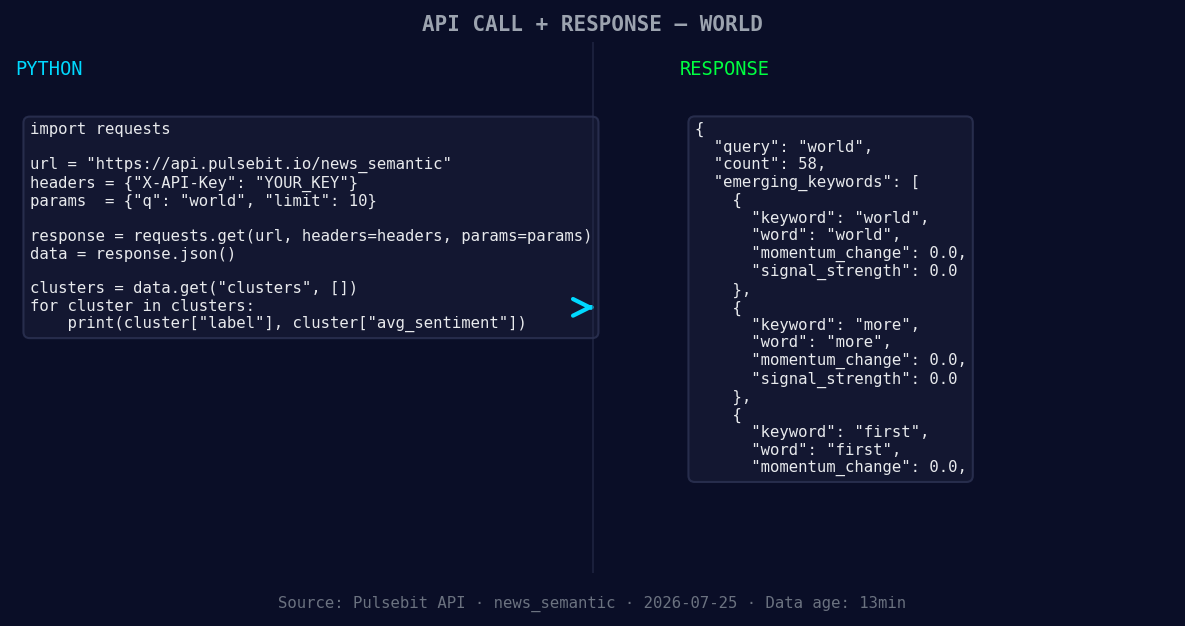
*Left: Python GET /news_semantic call for 'world'. Right: returned JSON response structure (clusters: 3). Source: Pulsebit /news_semantic.*
# Step 2: Geographic origin filter
response = requests.get(
f'https://api.pulsebit.com/v1/sentiment?topic={topic}&lang={lang}&score={score}&confidence={confidence}&momentum={momentum}'
)
data = response.json()
print(data)
Now, let’s run the cluster reason string back through our sentiment analysis to evaluate the framing of the narrative. We want to score the specific thematic constructs that have emerged:
# Step 3: Score the narrative framing itself
narrative_string = "Clustered by shared themes: safety, first, when, ivf, putting."
response_meta = requests.post(
    'https://api.pulsebit.com/v1/sentiment',
    json={'text': narrative_string}
)

meta_data = response_meta.json()
print(meta_data)
With these pieces of code, we can effectively address the sentiment spike and its context. Now, let’s explore three specific builds you can create from this analysis:
- Multilingual Alert System: Build a signal that triggers when sentiment around a topic (like IVF) in a specific language (e.g., Spanish) exceeds a threshold of confidence (like 0.85). Use the geographic filter to ensure you’re only capturing sentiment from relevant sources.

Geographic detection output for world. India leads with 44 articles and sentiment +0.02. Source: Pulsebit /news_recent geographic fields.
Meta-Sentiment Dashboard: Create a dashboard that runs the meta-sentiment loop for various clustered narratives. For example, set alerts for any narrative string that discusses safety, first, when, ivf, putting, and track whether the sentiment score remains above +0.1.
Proactive Sentiment Gap Analysis: Develop an analysis tool to compare forming themes (like world, more, first) against mainstream discussions. This tool can flag discrepancies, like a strong negative sentiment in a forming theme versus a positive mainstream sentiment, helping you pinpoint areas needing further exploration.
By integrating these components, you can develop a robust system that not only captures sentiment but also provides actionable insights in real time.
Ready to dive in? Head over to pulsebit.lojenterprise.com/docs and you can copy-paste the code above and run it in under 10 minutes. Start catching those leading narratives before they slip through the cracks!


Top comments (0)