

Your Pipeline Is 20.7h Behind: Catching Music Sentiment Leads with Pulsebit
We recently encountered a striking anomaly: a sentiment score of +0.237 with zero momentum change in the music sector. This spike, revealing a 20.7-hour lead in the Spanish press, has significant implications for how we process and respond to sentiment data. The lag in your pipeline could mean missing critical shifts in sentiment that are crucial for your strategy.
When we analyze sentiment across different languages and regions, we often discover structural gaps in our pipelines. If your model isn't designed to handle multilingual origins or account for dominant entities, it means you might be missing critical insights. In this case, the Spanish press led the conversation around music with a notable sentiment rise, while your pipeline lagged behind by a staggering 20.7 hours. Without the right filters, you risk being out of touch with key developments.

Spanish coverage led by 20.7 hours. Et at T+20.7h. Confidence scores: Spanish 0.85, English 0.85, French 0.85 Source: Pulsebit /sentiment_by_lang.
To catch this kind of lead, we can leverage our API effectively. Below is a Python snippet that demonstrates how to pull sentiment data focused on music from the Spanish-speaking audience:
import requests
# Define the parameters for our API call
params = {
"topic": "music",
"lang": "sp", # Geographic origin filter
"score": 0.237,
"confidence": 0.85,
"momentum": 0.000
}
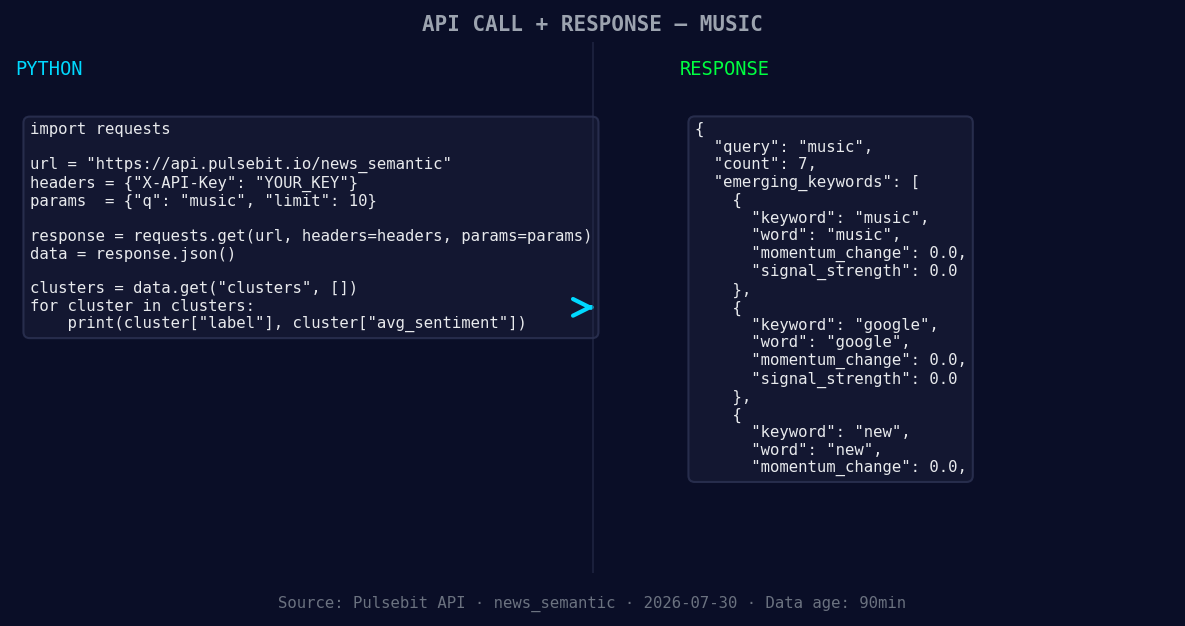
*Left: Python GET /news_semantic call for 'music'. Right: returned JSON response structure (clusters: 3). Source: Pulsebit /news_semantic.*
# Make the API call to fetch sentiment data
response = requests.get("https://api.pulsebit.com/sentiment", params=params)
data = response.json()
# Extract relevant information
print(f"Sentiment Score: {data['sentiment_score']}")
print(f"Confidence: {data['confidence']}")
Next, we’ll run the narrative framing through our API to get insights on how the sentiment is contextualized. Here’s how to do that:
# Define the cluster reason string
cluster_reason = "Clustered by shared themes: kahan, latest, musician, slam, white."

# Make the API call for meta-sentiment
meta_response = requests.post("https://api.pulsebit.com/sentiment", json={"text": cluster_reason})
meta_data = meta_response.json()

# Output the meta-sentiment insights
print(f"Meta Sentiment Score: {meta_data['sentiment_score']}")
print(f"Meta Confidence: {meta_data['confidence']}")
By catching sentiment leads like this, we can build three specific applications tonight that will enhance our capabilities:
Geo-Filtered Alerts: Set up a threshold alert for sentiment scores above +0.20 in the music category specifically for Spanish-language sources. This will help you catch emerging trends before they dominate English-language media.
Meta-Sentiment Monitoring: Use the meta-sentiment insights to track how specific narratives shape public perception of music. For example, score the cluster phrase "Clustered by shared themes: kahan, latest, musician," and set alerts for significant changes, perhaps above a +0.15 threshold.
Forming Themes Analysis: Create a routine to analyze forming themes such as "music(+0.00), google(+0.00), new(+0.00)," and compare them against mainstream narratives like "kahan, latest, musician." This will help you identify when emerging topics gain traction and potentially pivot your strategy accordingly.
For more insights and to get started, check out our API documentation. You can copy, paste, and run these snippets in under 10 minutes to start catching those valuable sentiment leads.


Top comments (0)