

Your pipeline just missed a significant anomaly: a 24h momentum spike of +0.221 in the sports sentiment. This isn't just a blip; it's a clear sign that something important is happening. The leading language for this spike is English, with a 27.9-hour lead over other sources. If you’re not tapping into multilingual origin or entity dominance, you’re severely lagging behind the curve.

English coverage led by 27.9 hours. Nl at T+27.9h. Confidence scores: English 0.90, Spanish 0.90, Sv 0.90 Source: Pulsebit /sentiment_by_lang.
What does this mean for you? Your model missed this by nearly 28 hours. The English press is driving this sentiment surge, and if you’re only looking at a single language or source, you're likely missing critical insights. This is especially concerning given the cluster story: "New Course on Sports Governance." If your pipeline isn't capturing these nuances, you're at risk of making decisions based on outdated information.
Let’s get straight into how you can catch this momentum spike with our API. Here’s how to set up your request to filter for English news on sports:
import requests
# Set the parameters
params = {
'topic': 'sports',
'lang': 'en',
'score': +0.561,
'confidence': 0.90,
'momentum': +0.221
}
# Make the API call
response = requests.get("https://api.pulsebit.com/v1/sentiment", params=params)
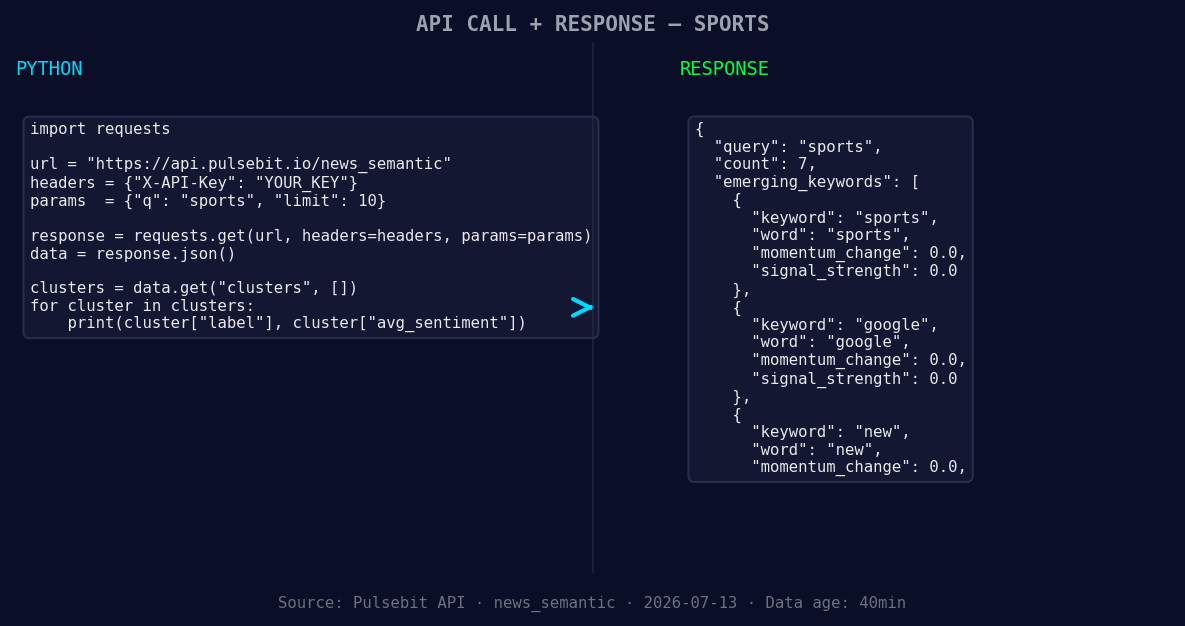
*Left: Python GET /news_semantic call for 'sports'. Right: returned JSON response structure (clusters: 3). Source: Pulsebit /news_semantic.*
# Check response
print(response.json())
Next, we need to analyze the cluster narrative itself. Let’s run the cluster reason string back through our sentiment analysis to evaluate how the narrative is framing this momentum. Here’s how you can do that:
# Define the meta-sentiment moment
cluster_reason = "Clustered by shared themes: sports, governance, new, hong, course."

# Run the sentiment analysis
meta_sentiment_response = requests.post("https://api.pulsebit.com/v1/sentiment", json={'text': cluster_reason})

# Check the response
print(meta_sentiment_response.json())
By employing both the geographic origin filter and the meta-sentiment loop, you can ensure that your insights are not only timely but also contextually rich.

Geographic detection output for sports. India leads with 5 articles and sentiment +0.74. Source: Pulsebit /news_recent geographic fields.
Now, what can you build with this information? Here are three specific ideas:
Geo-Filtered Alerts: Set up an alert system that triggers when the sentiment score for 'sports' in English exceeds a threshold (e.g., +0.60). This can help you catch spikes early, ensuring you stay ahead of trends.
Meta-Sentiment Dashboard: Create a dashboard that visualizes the narratives surrounding emerging topics. Use the meta-sentiment endpoint to score cluster reasons in real-time, helping you understand how public perception shifts with key events.
Dynamic Content Strategy: Leverage the forming themes—like 'sports,' 'new,' and 'governance'—to inform your content strategy. If your sentiment analysis shows a rise in these areas, consider developing articles or reports that dive deeper into these interconnected topics.
We’re excited for you to explore these insights further. To get started, head over to our documentation: pulsebit.lojenterprise.com/docs. You can copy-paste and run this code in under 10 minutes to begin capturing these significant shifts in sentiment.


Top comments (0)