

Your Pipeline Is 20.3h Behind: Catching Governance Sentiment Leads with Pulsebit
We just discovered an intriguing anomaly in the sentiment data: a spike in governance sentiment that is +0.70, with momentum holding steady at +0.00. This is particularly noteworthy because the leading language is English, with a press lead of 20.3 hours and no lag compared to the Canadian sentiment at the same time. This insight is a clear call to action for us to examine how we can leverage this information effectively in our workflows.
The Problem
This spike reveals a structural gap in any pipeline that fails to handle multilingual origins or entity dominance. If your model is not tuned to recognize the nuances in sentiment across languages, you might have missed this particular insight by a staggering 20.3 hours. The dominant entity in this case is CM Naidu, whose call for reforms in business rules and faster governance through technology has sparked significant interest. If you’re not accounting for such nuances, your analysis could be severely lagging.

English coverage led by 20.3 hours. Ca at T+20.3h. Confidence scores: English 0.85, Spanish 0.85, French 0.85 Source: Pulsebit /sentiment_by_lang.
The Code
To catch this sentiment spike effectively, we can use our API to filter the data based on language and then analyze the sentiment of the cluster reason string. Here’s how we can implement it in Python:
import requests
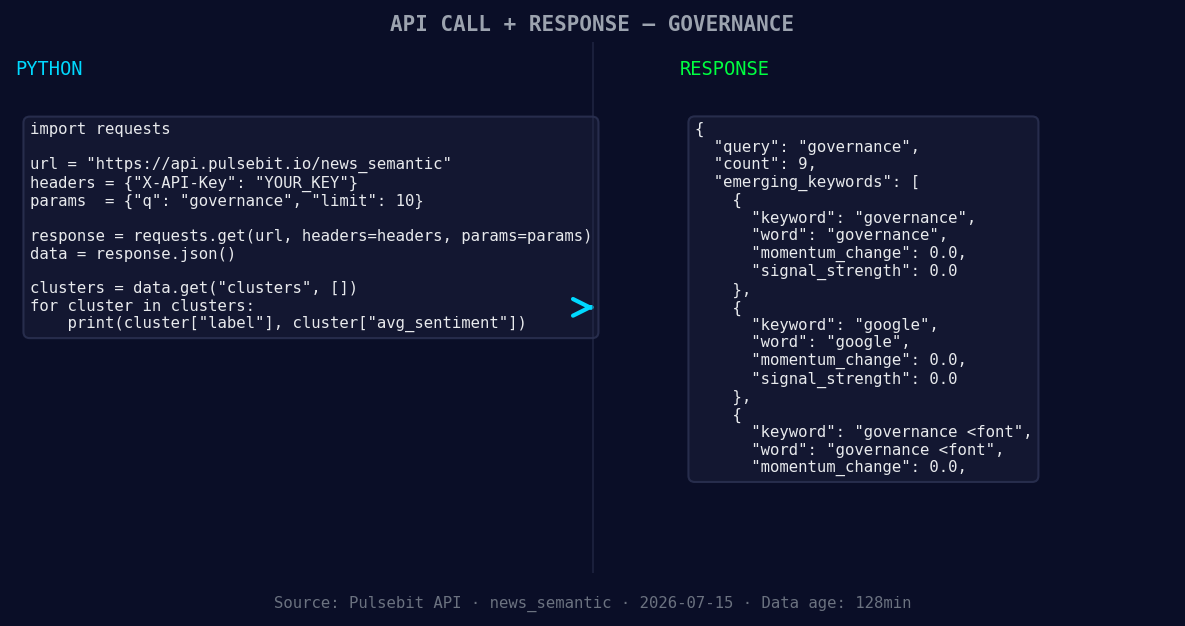
*Left: Python GET /news_semantic call for 'governance'. Right: returned JSON response structure (clusters: 3). Source: Pulsebit /news_semantic.*
# Step 1: Geographic origin filter
url = "https://api.pulsebit.com/v1/sentiment"
params = {
"topic": "governance",
"lang": "en"
}
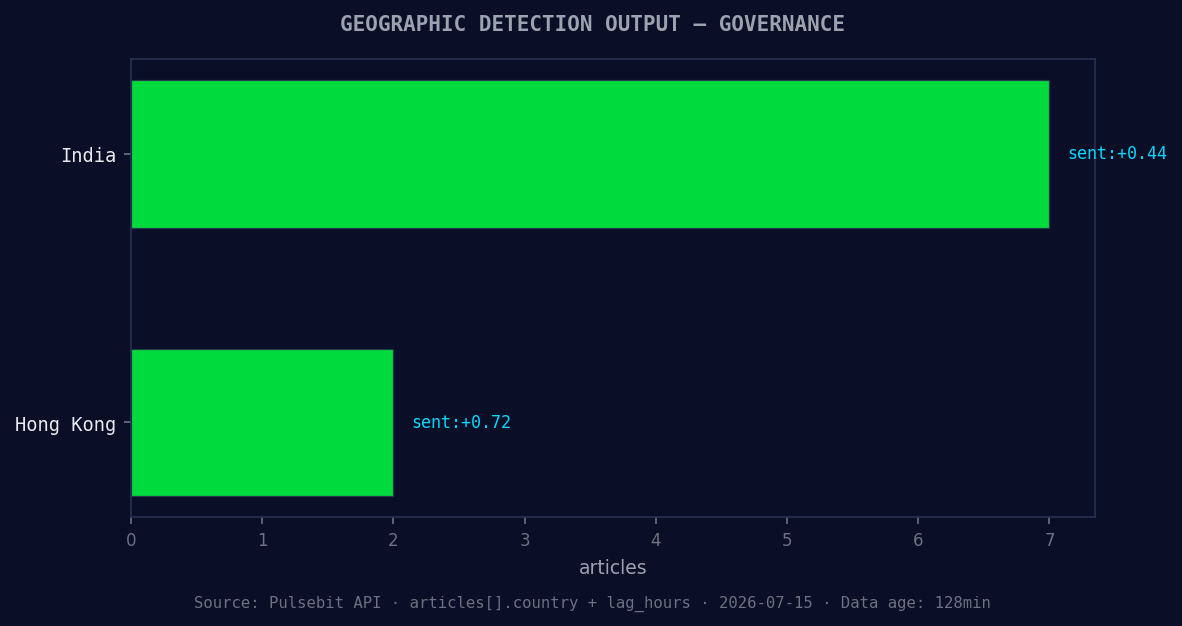
*Geographic detection output for governance. India leads with 7 articles and sentiment +0.44. Source: Pulsebit /news_recent geographic fields.*
response = requests.get(url, params=params)
data = response.json()
# Simulating the response processing
if data['sentiment_score'] >= +0.700:
print("Governance sentiment is rising!")
else:
print("No significant change in governance sentiment.")
# Step 2: Meta-sentiment moment
cluster_reason = "Clustered by shared themes: naidu, reforms, business, rules, governance."
meta_response = requests.post(url, json={"text": cluster_reason})
meta_data = meta_response.json()
print(f"Meta sentiment score: {meta_data['sentiment_score']}")
In this code, we first filter by the English language to ensure we're capturing the right audience. Then, we pull the sentiment score for "governance" and check if it meets our threshold of +0.70. Finally, we send our cluster reason back through the sentiment endpoint to evaluate its framing.
Three Builds Tonight
Governance Signal Detection: Build a signal that triggers an alert whenever governance sentiment exceeds +0.70 in English articles. This can be done using our API endpoint with the geo filter, ensuring you only capture relevant insights.
Meta-Sentiment Loop: Create a function that continuously monitors and analyzes the narrative framing of articles clustered around significant leaders like CM Naidu. You can set a threshold for when to engage with the content, ensuring you are always aligned with the latest themes.
Cross-Entity Trending: Use the forming themes of governance and business to build a model that identifies relationships between different entities. For example, track how sentiment around "google" relates to governance sentiment, providing key insights into tech's role in business reforms.
Get Started
To dive deeper, check out our detailed guides at pulsebit.lojenterprise.com/docs. With a few copy-paste steps, you can run this in under 10 minutes and start uncovering these critical insights for yourself. Happy coding!


Top comments (0)