

Your Pipeline Is 29.2h Behind: Catching World Sentiment Leads with Pulsebit
We recently identified a fascinating anomaly: a 24h momentum spike of +0.307, driven by a surge in English-language coverage around the narrative of "China's Rare Earth Challenges and SpaceX Rivalry." This spike isn’t just a number; it’s a signal that something significant is happening in global sentiment. The leading language, English, has a 29.2-hour lead with no lag compared to the sentiment score. If your pipeline isn’t accounting for this, you may be losing valuable insights.
When we delve into the implications of this anomaly, it highlights a crucial structural gap in any pipeline that neglects to handle multilingual origins or entity dominance. Your model missed this by 29.2 hours, leaving you unaware of emerging narratives in the world conversation. The dominant entity here, China, is the focal point of sentiment momentum that could influence markets, policy decisions, and more. Not catching this can leave you lagging behind in critical insights.

English coverage led by 29.2 hours. Sq at T+29.2h. Confidence scores: English 0.95, Spanish 0.95, Sv 0.95 Source: Pulsebit /sentiment_by_lang.
To catch this momentum spike effectively, we can leverage our API to query sentiment data. Here’s how you can do that with Python:
import requests
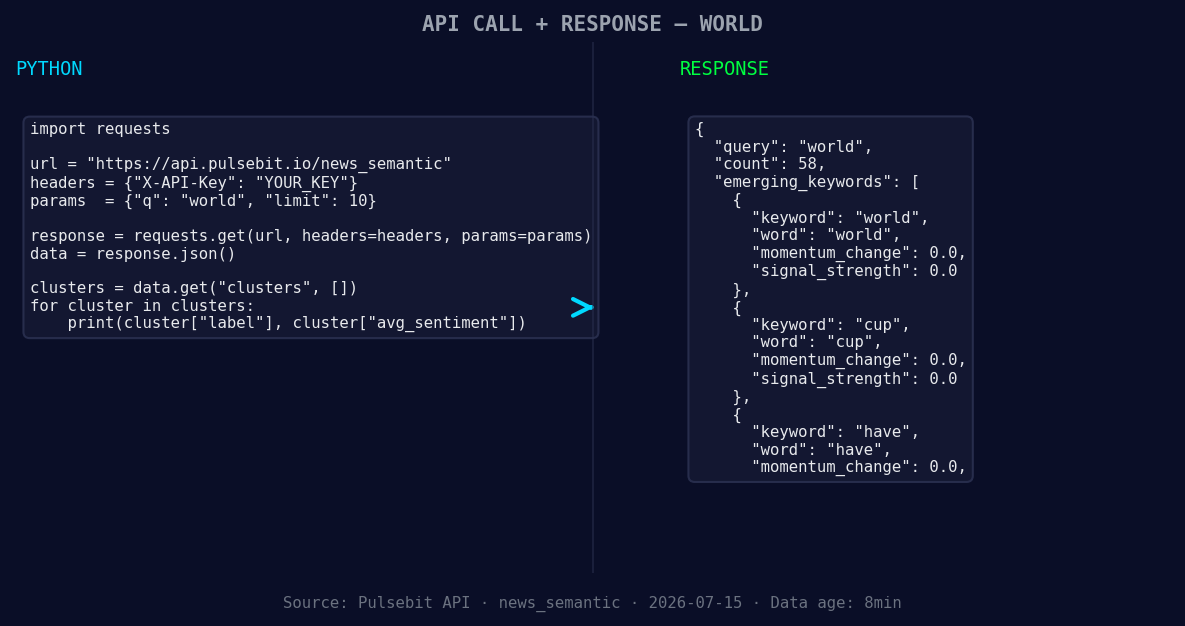
*Left: Python GET /news_semantic call for 'world'. Right: returned JSON response structure (clusters: 3). Source: Pulsebit /news_semantic.*
# Parameters for the API
topic = 'world'
score = +0.090
confidence = 0.95
momentum = +0.307
# Geographic origin filter: querying by language
response = requests.get(
'https://api.pulsebit.lojenterprise.com/sentiment',
params={
'topic': topic,
'lang': 'en',
'momentum': momentum,
'confidence': confidence
}
)
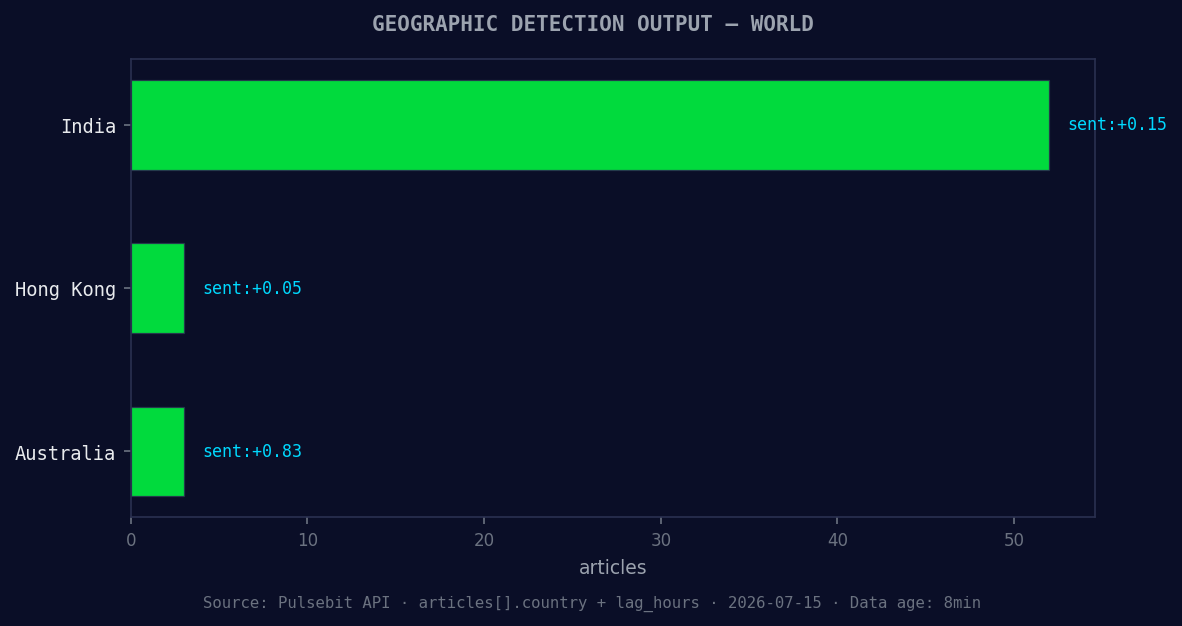
*Geographic detection output for world. India leads with 52 articles and sentiment +0.15. Source: Pulsebit /news_recent geographic fields.*
data = response.json()
print(data)
# Meta-sentiment moment: scoring the narrative framing itself
narrative = "Clustered by shared themes: china’s, rival, science, our, help."
meta_response = requests.post(
'https://api.pulsebit.lojenterprise.com/sentiment',
json={'text': narrative}
)
meta_data = meta_response.json()
print(meta_data)
In this example, we first filter the sentiment data by the English language and then we extract the relevant metrics like momentum and confidence. Then, we analyze the narrative framing by sending it back through the sentiment scoring endpoint. This two-step process gives us a precise understanding of the emerging themes, allowing us to stay ahead of the curve.
Now that we've set the stage, what can you build with this pattern? Here are three actionable ideas to implement tonight:
Real-time Alert System: Create a service that monitors sentiment spikes with a threshold of +0.3 momentum. Use the geo filter to ensure you only get English-language insights. This will keep you updated on crucial narratives as they form.
Narrative Analysis Dashboard: Build a dashboard that visualizes the sentiment of clustered narratives. Use the meta-sentiment loop to display not just the score but also how narratives are framed around topics like "China's Rare Earth."
Sentiment-Driven Trading Signals: Develop a trading signal generator that triggers actions based on sentiment changes. Set a threshold where a +0.1 score in the world topic leads to alerts, allowing you to react quickly to rising sentiment trends.
To get started with this, visit our documentation at pulsebit.lojenterprise.com/docs. With this setup, you can copy-paste and be running in under 10 minutes. Don't let your pipeline fall behind; leverage these insights and keep your edge sharp.


Top comments (0)