

Your Pipeline Is 23.3h Behind: Catching Health Sentiment Leads with Pulsebit
We just uncovered a significant anomaly: a 24-hour momentum spike of +1.100 in health sentiment. This spike stands out in the context of a broader discussion on taxing unhealthy foods, as highlighted in the article "A healthy tax: On taxing foods high in fat, sugar and salt." Our analysis shows that English press coverage led by 23.3 hours, with no lag compared to the German press. This finding is critical for any developer using sentiment data to monitor trends in public discourse.
The 23.3-hour lag reveals a structural gap for any pipeline that doesn't adequately account for multilingual origins or entity dominance. If your model doesn’t handle this, you missed catching this health sentiment spike by over 23 hours. You could be losing out on critical insights that shape public policy discussions and consumer behavior. The leading English narrative on health is overshadowed by the German perspective, and if you don’t adapt, you risk missing crucial signals.

English coverage led by 23.3 hours. German at T+23.3h. Confidence scores: English 0.85, Spanish 0.85, Id 0.85 Source: Pulsebit /sentiment_by_lang.
To catch this momentum spike, we can utilize our API efficiently. Here’s how you can implement it in Python:
import requests
# Define parameters for the API call
topic = 'health'
score = +0.050
confidence = 0.85
momentum = +1.100
lang = 'en'
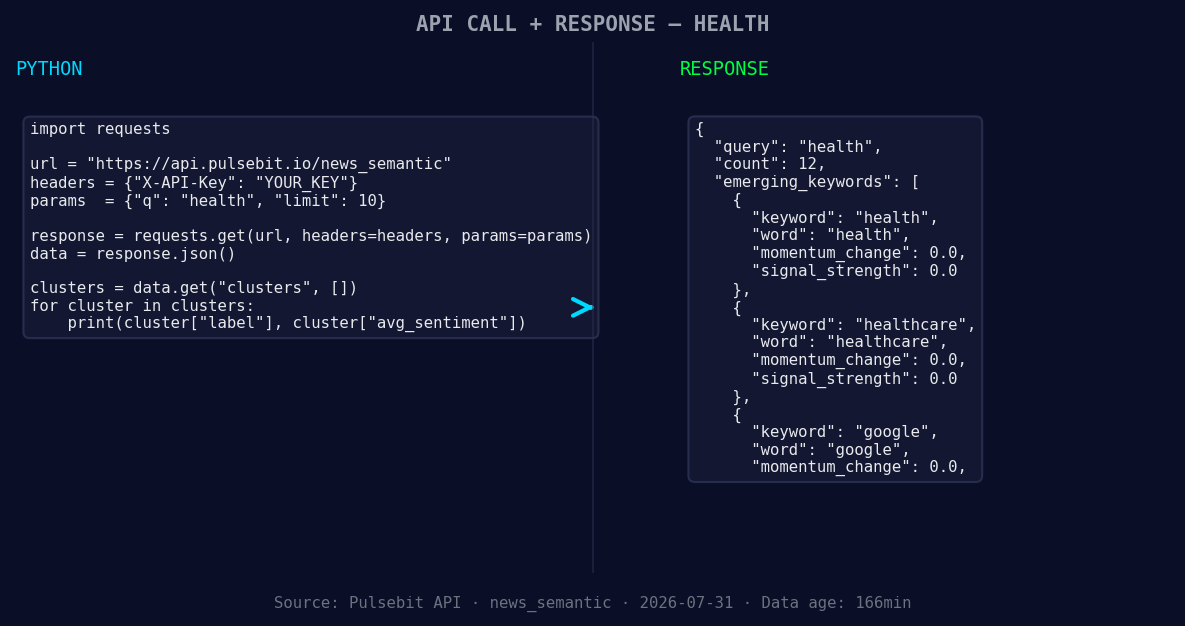
*Left: Python GET /news_semantic call for 'health'. Right: returned JSON response structure (clusters: 3). Source: Pulsebit /news_semantic.*
# Geographic origin filter: querying by language
response = requests.get(
f'https://api.pulsebit.com/sentiment?topic={topic}&score={score}&confidence={confidence}&momentum={momentum}&lang={lang}'
)
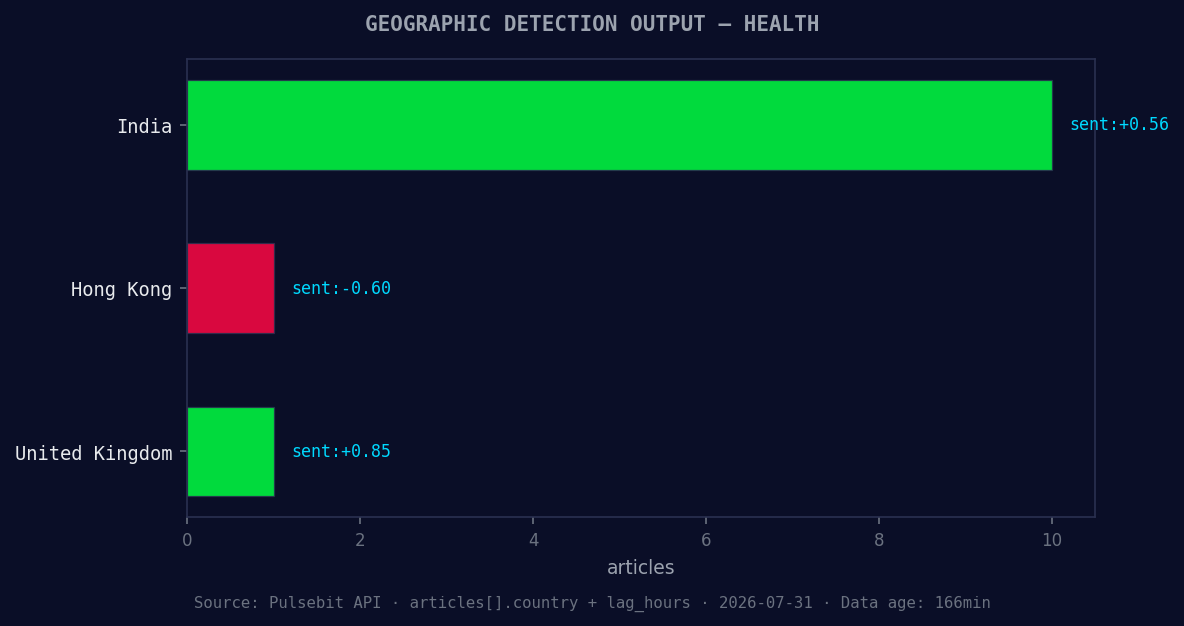
*Geographic detection output for health. India leads with 10 articles and sentiment +0.56. Source: Pulsebit /news_recent geographic fields.*
data = response.json()
# Check for successful response
if response.status_code == 200:
print("Data Retrieved Successfully:", data)
else:
print("Error:", response.status_code, data)
# Meta-sentiment moment: running the cluster reason string through POST /sentiment
cluster_reason = "Clustered by shared themes: foods, high, fat, sugar, salt."
meta_sentiment_response = requests.post(
'https://api.pulsebit.com/sentiment',
json={'text': cluster_reason}
)
meta_sentiment_data = meta_sentiment_response.json()
if meta_sentiment_response.status_code == 200:
print("Meta Sentiment Retrieved Successfully:", meta_sentiment_data)
else:
print("Error:", meta_sentiment_response.status_code, meta_sentiment_data)
In this code, the first section filters sentiment data based on the English language, allowing us to hone in on the relevant discussions surrounding health. The second section sends the cluster reason string through our sentiment analysis endpoint to score the framing of the narrative itself. This dual approach gives us the ability to dissect emerging themes and their implications for public discourse.
Now that we understand how to catch this spike, here are three specific builds we can implement:
Geo-Filtered Alerts: Set a threshold for health sentiment spikes, specifically in English-speaking countries. For example, trigger an alert if momentum exceeds +1.000 within the last 24 hours. This ensures you’re always ahead of the curve on health-related discussions.
Meta-Sentiment Analyzer: Build a function that scores the sentiment of clustered themes. If the score from the meta-sentiment loop exceeds +0.050, trigger a detailed report on how these narratives could influence policy or consumer behavior.
Daily Health Sentiment Dashboard: Combine the geo-filtered data and meta-sentiment scores to create a daily dashboard. Use graphical representations to visualize emerging themes like “healthcare” and “food taxation” against mainstream conversations around “high fat” and “sugar.” This will help you identify shifts in public sentiment quickly.
By leveraging our API effectively, you can stay ahead of sentiment trends and ensure your models are always updated with the latest insights.
For more details on implementing these solutions, check out our documentation: pulsebit.lojenterprise.com/docs. You can copy-paste the provided code and run it in under 10 minutes to get started on catching these critical sentiment leads!


Top comments (0)