

Your Pipeline Is 18.4h Behind: Catching Finance Sentiment Leads with Pulsebit
We recently uncovered a significant anomaly: a 24-hour momentum spike of -0.900 in the finance sector. This spike, combined with an interesting cluster story about funding bus fare caps impacting the world's poorest, highlights how rapidly shifting sentiment can be missed by traditional models. With the leading language being English and a lag of just 18.4 hours, the implications for decision-making are critical.
The Problem
This anomaly exposes a glaring gap in any pipeline that fails to account for multilingual origin or entity dominance. If your model isn’t equipped to handle these nuances, you might have missed this crucial shift by over 18 hours. The dominant entity here is English press, and without a robust mechanism to track sentiment across languages, you risk falling behind. Imagine being the last to react to a funding decision that could affect global financial conditions because your model isn't capturing these nuances.

English coverage led by 18.4 hours. Ca at T+18.4h. Confidence scores: English 0.95, French 0.95, Spanish 0.95 Source: Pulsebit /sentiment_by_lang.
The Code
To catch this momentum spike effectively, we can use our API to filter sentiment data based on geographic origin. Here’s how you can do it in Python:
import requests
# Define the parameters for our query
params = {
'topic': 'finance',
'score': -0.005,
'confidence': 0.95,
'momentum': -0.900,
'lang': 'en' # Geographic origin filter
}
# API call to fetch sentiment data
response = requests.get('https://api.pulsebit.com/sentiment', params=params)
data = response.json()
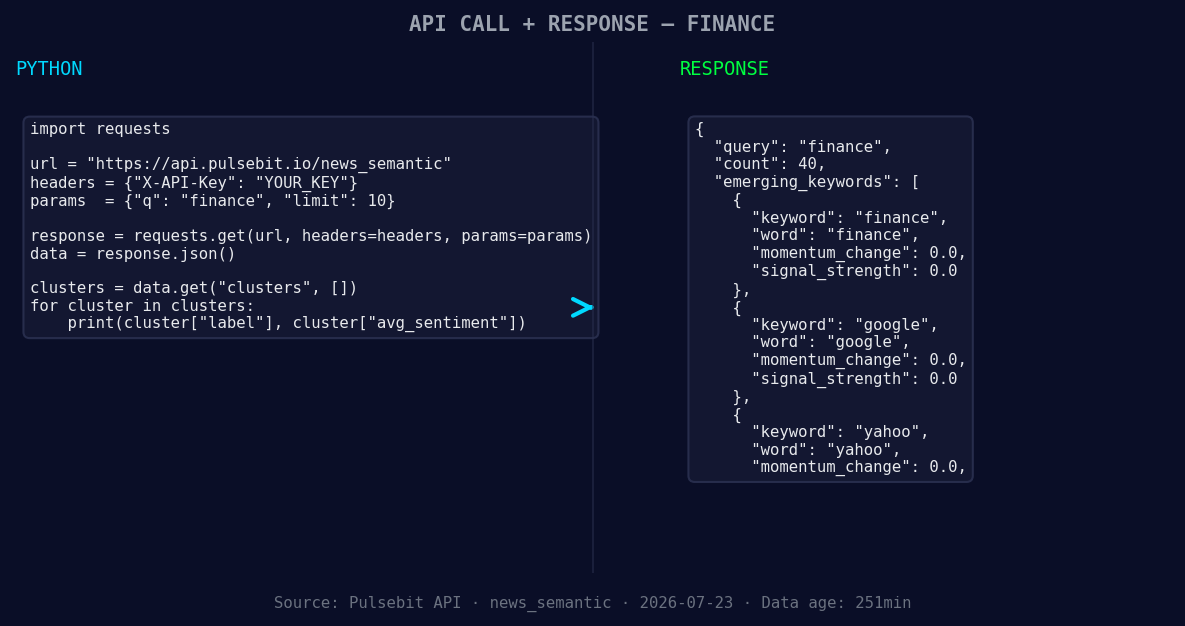
*Left: Python GET /news_semantic call for 'finance'. Right: returned JSON response structure (clusters: 3). Source: Pulsebit /news_semantic.*
print(data)
Next, to analyze the narrative framing surrounding this sentiment, we need to loop back through our findings. Here’s how to run the cluster reason string through the sentiment scoring endpoint:
# Cluster reason string for meta-sentiment moment
cluster_reason = "Clustered by shared themes: announces, agreement, sell, substantially, all."

# API call to score the narrative framing itself
meta_response = requests.post('https://api.pulsebit.com/sentiment', json={'text': cluster_reason})
meta_data = meta_response.json()

print(meta_data)
These two snippets will allow you to capture the momentum spike and understand the context behind it.
Three Builds Tonight
Here are three specific things you can build using this momentum spike:
- Geo-Filtered Alerts: Set up an alert system that triggers when the momentum in the finance topic drops below -0.900, using our API's geographic filter. This way, you won’t miss any critical shifts, particularly in the English-speaking world.

Geographic detection output for finance. India leads with 5 articles and sentiment +0.77. Source: Pulsebit /news_recent geographic fields.
Meta-Sentiment Analysis Dashboard: Create a dashboard that visualizes meta-sentiment scores. By feeding in cluster reason strings, you can track how narratives evolve alongside sentiment shifts — particularly useful for the themes of finance, agreement, and announcements.
Automated Reporting Tool: Build a tool that automatically generates reports when sentiment momentum dips significantly (e.g., below -0.900) and includes meta-sentiment analysis. Include keywords like “finance”, “google”, and “yahoo” to give context against mainstream narratives.
Get Started
Dive into our documentation at pulsebit.lojenterprise.com/docs. You can copy-paste and run this in under 10 minutes, and you’ll be on your way to catching these critical sentiment shifts before they become old news.


Top comments (0)