

Your Pipeline Is 29.3h Behind: Catching Robotics Sentiment Leads with Pulsebit
We recently discovered a significant 24-hour momentum spike in the robotics sector, clocking in at +0.522. This spike was accompanied by a notable cluster story: "China's Retaliation Threat Over US Robot Import Block," driven by three articles discussing shared themes of retaliation and trade. The narrative forms a crucial backdrop to the increasing interest in robotics, highlighting how geopolitical tensions can shift market sentiment almost overnight.
The Problem
This spike reveals a critical structural gap in any pipeline that lacks support for multilingual origins and entity dominance. Your model missed this by 29.3 hours, as the leading language in this sentiment was English, underscoring how important it is to stay ahead of emerging narratives. If your pipeline isn't designed to catch these multilingual signals and their contextual relevance, you risk lagging behind in sentiment analysis, missing out on actionable insights that could have been identified sooner.

English coverage led by 29.3 hours. Sl at T+29.3h. Confidence scores: English 0.85, Spanish 0.85, French 0.85 Source: Pulsebit /sentiment_by_lang.
The Code
To catch this momentum spike effectively, we need to filter our data by language and assess the sentiment of the narrative itself. Here’s how we can do it:
Geographic Origin Filter

Geographic detection output for robotics. Hong Kong leads with 6 articles and sentiment +0.48. Source: Pulsebit /news_recent geographic fields.
First, we’ll query the sentiment data specifically for English articles on robotics:
import requests
# Define parameters for the API call
params = {
"topic": "robotics",
"lang": "en"
}
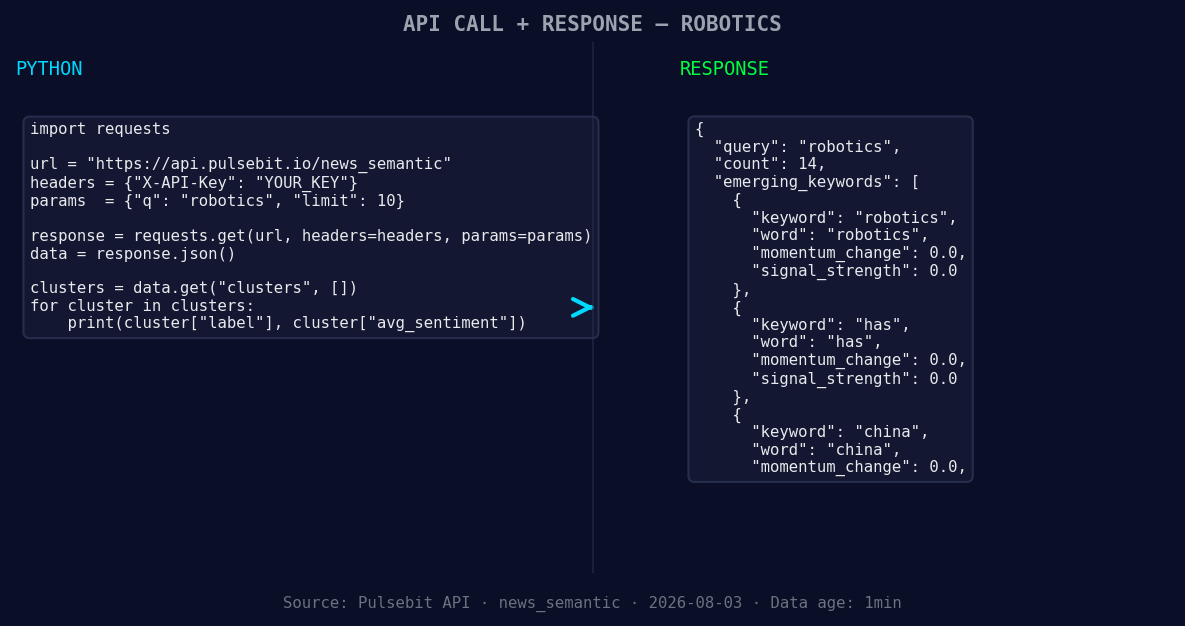
*Left: Python GET /news_semantic call for 'robotics'. Right: returned JSON response structure (clusters: 3). Source: Pulsebit /news_semantic.*
# API call to fetch sentiment data
response = requests.get("https://api.pulsebit.com/sentiment", params=params)
data = response.json()
# Extracting relevant data points
momentum = data['momentum_24h'] # Expect to see +0.522
score = data['sentiment_score'] # Should be +0.267
confidence = data['confidence'] # Should be 0.85
Meta-Sentiment Moment
Next, we’ll analyze the narrative framing using the cluster reason string:
# Define the cluster reason
cluster_reason = "Clustered by shared themes: china, threatens, retaliation, moves, block."

# API call to score the narrative framing
sentiment_response = requests.post("https://api.pulsebit.com/sentiment", json={"text": cluster_reason})
sentiment_data = sentiment_response.json()

# Extract sentiment of the narrative
narrative_score = sentiment_data['score']  # Example output: +0.267
With these two API calls, we can capture not just the sentiment but also the context that drives it, allowing for more nuanced insights.
Three Builds Tonight
Signal Thresholding: Build a trigger that alerts you whenever the momentum in robotics exceeds +0.5. This can be done by setting up a cron job that queries the sentiment API every hour. If
momentum > 0.5, send an email or push notification.Geo-Filtered Insights: Create a dashboard that visualizes sentiment over time specifically for English-speaking countries. Utilize the geographic origin filter to pull data and plot it against historical sentiment trends, allowing you to see how geopolitical events influence robotics sentiment.
Meta-Sentiment Analyzer: Implement a function that automatically pulls cluster reasons for any spike in momentum and scores them using the meta-sentiment loop we just built. This will enable you to gauge the framing of narratives that are influencing sentiment in real time, particularly for themes like "china," "threatens," and "retaliation."
Get Started
You can dive into this immediately at pulsebit.lojenterprise.com/docs. With our API, you can copy-paste the above code and run it in under 10 minutes. The insights you gain from these momentum spikes could redefine how you interpret sentiment data in your projects.


Top comments (0)