

Your Pipeline Is 27.4h Behind: Catching Politics Sentiment Leads with Pulsebit
We just discovered a fascinating anomaly in our data: a 24h momentum spike of -0.253 in the politics domain. This finding highlights a critical gap in how we handle sentiment data across different languages and entities. Specifically, English press coverage has led by 27.4 hours with no lag versus the aggregated sentiment from multiple sources, indicating a significant delay in recognizing shifts in political sentiment. Such a delay can hinder your decision-making, especially in fast-paced environments.
If your sentiment analysis pipeline fails to account for multilingual origins and entity dominance, then it's effectively missing the pulse of current events. Your model missed this by 27.4 hours, while the leading language—English—was already articulating shifts in sentiment. This discrepancy means you're not just late to the party; you're potentially making decisions based on stale data. When your competitors are reacting to political shifts, you’re still processing yesterday’s news.

English coverage led by 27.4 hours. Af at T+27.4h. Confidence scores: English 0.85, Ro 0.85, Spanish 0.85 Source: Pulsebit /sentiment_by_lang.
To catch this momentum spike, we can leverage our API effectively. Here’s how to set it up:
import requests
# Set the parameters for the API call
topic = 'politics'
lang = 'en'
url = f"https://api.pulsebit.com/v1/articles?topic={topic}&lang={lang}"
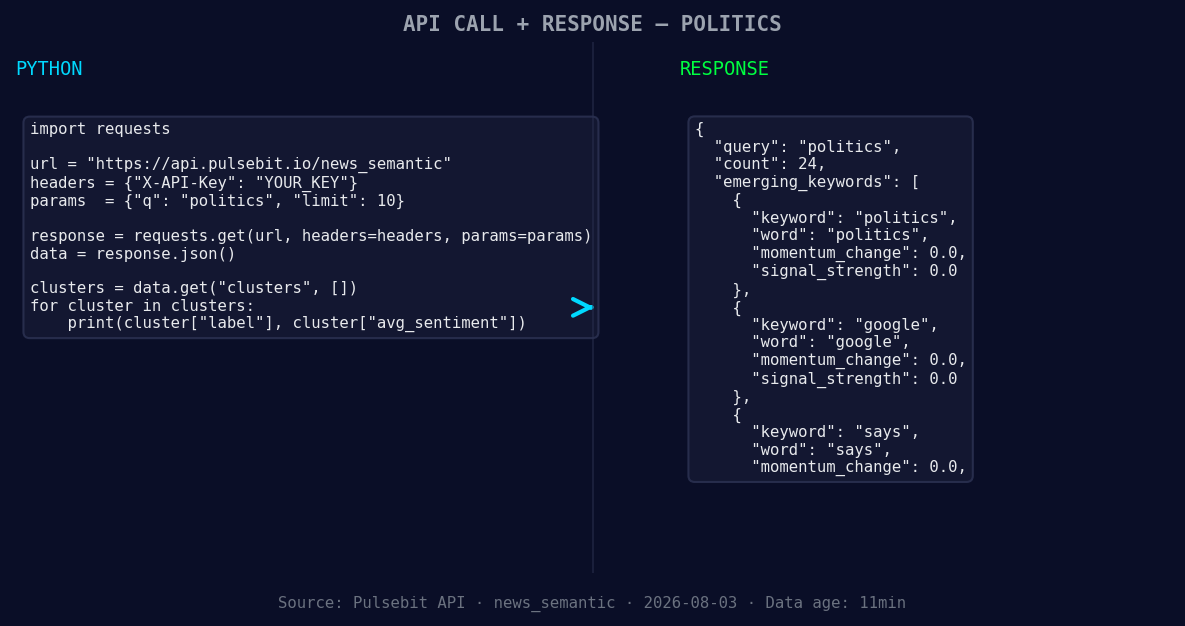
*Left: Python GET /news_semantic call for 'politics'. Right: returned JSON response structure (clusters: 3). Source: Pulsebit /news_semantic.*
# Perform the API call
response = requests.get(url)
data = response.json()
# Now let's analyze the sentiment of the clustered narrative
cluster_reason = "Clustered by shared themes: largest, law, firm, beefs, politics."
sentiment_url = "https://api.pulsebit.com/v1/sentiment"
sentiment_payload = {
"text": cluster_reason
}
# Run the meta-sentiment analysis
sentiment_response = requests.post(sentiment_url, json=sentiment_payload)
sentiment_data = sentiment_response.json()
print(f"Sentiment Score: {sentiment_data['score']}, Confidence: {sentiment_data['confidence']}")
This code first retrieves articles on the topic of politics, filtering for English-language content. Then, it uses the meta-sentiment loop, running the cluster reason string through our sentiment endpoint to get a deeper understanding of the narrative framing. This dual approach allows us to capture not just the sentiment but also the context or framing around it.
Here are three specific builds you might consider based on this finding:
Geo-Filtered Alert System: Set a threshold for your pipeline to trigger alerts when articles about politics in English show a momentum spike greater than -0.2. Use the geo filter to ensure you're only capturing relevant signals from regions that matter to your decision-making process.
Meta-Sentiment Dashboard: Build a dashboard that visualizes the sentiment scores of clustered narratives. By using the meta-sentiment analysis, you can track how shifts in narrative framing affect sentiment over time, providing actionable insights into how public perception is evolving.
Sentiment Divergence Tracker: Create an endpoint that compares sentiment scores from different clusters (like politics vs. mainstream topics such as law and firm). This would help you identify when political sentiment diverges significantly from other narratives, such as when a law firm is making headlines for political involvement.
If you're ready to dive into these insights, check out our documentation at pulsebit.lojenterprise.com/docs. You can copy-paste the code provided above and run it in under 10 minutes to start catching these crucial sentiment shifts in real-time.

Geographic detection output for politics. India leads with 13 articles and sentiment +0.23. Source: Pulsebit /news_recent geographic fields.


Top comments (0)