

Your Pipeline Is 9.4h Behind: Catching Business Sentiment Leads with Pulsebit
We recently uncovered a striking anomaly in our data: a 24h momentum spike of +1.200, indicating a significant shift in sentiment around the topic of business. This spike is particularly interesting given its connection to a cluster story about "Homestay owners seek relaxation of tourism curbs in Kodagu, Chikkamagaluru." With this development, it’s clear that there’s a rising sentiment that your pipeline might be missing if you're not equipped to handle multilingual content or entity dominance.

English coverage led by 9.4 hours. No at T+9.4h. Confidence scores: English 0.85, Spanish 0.85, French 0.85 Source: Pulsebit /sentiment_by_lang.
If your model isn’t adept at managing these nuances, you could be lagging behind by over 9.4 hours. This is a critical gap, especially when the leading language in this narrative is English, but the conversation is rooted in specific regional contexts—like the homestay business in Chikkamagaluru. Ignoring this could mean missing out on valuable insights that could inform your business decisions.
To catch this momentum spike, we can leverage our API effectively. Here’s how you can utilize it to pinpoint this emerging trend using Python.
import requests
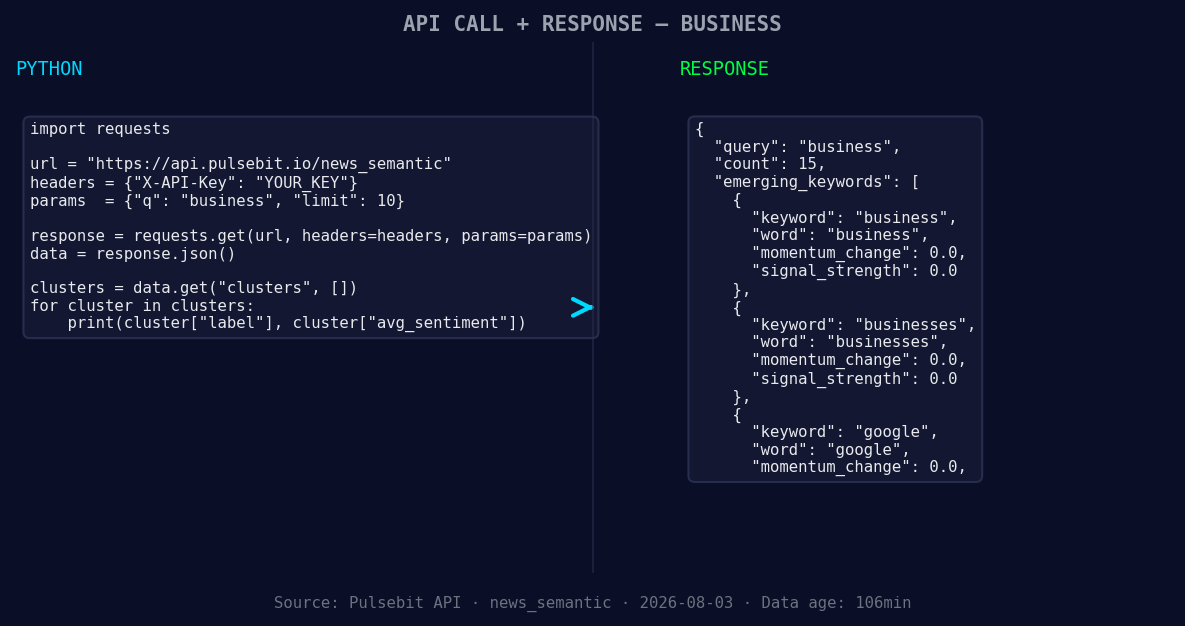
*Left: Python GET /news_semantic call for 'business'. Right: returned JSON response structure (clusters: 3). Source: Pulsebit /news_semantic.*
# Define your parameters
topic = 'business'
score = +0.086
confidence = 0.85
momentum = +1.200
# Geographic origin filter: querying by language/country
response = requests.get(
'https://api.pulsebit.com/v1/sentiment',
params={
'topic': topic,
'lang': 'en',
'momentum': momentum,
'score': score,
'confidence': confidence
}
)
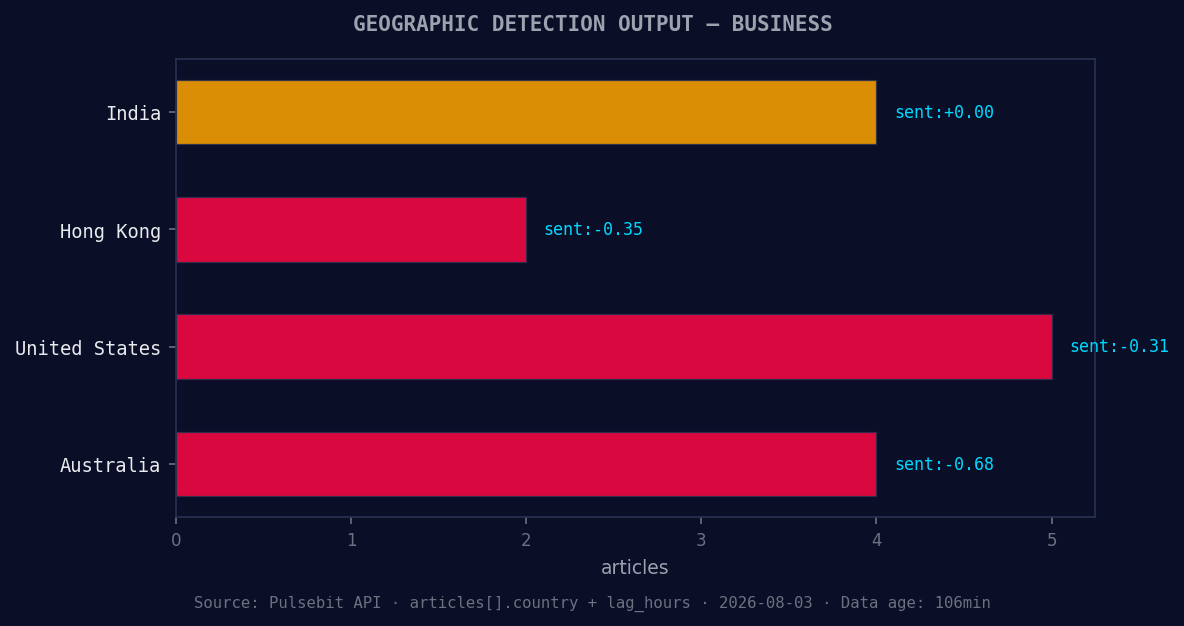
*Geographic detection output for business. India leads with 4 articles and sentiment +0.00. Source: Pulsebit /news_recent geographic fields.*
# Check the response
data = response.json()
print(data)
Next, we need to evaluate the meta-sentiment of the cluster reason string itself. This isn't just about the articles; it’s about how we frame the narrative.
# Meta-sentiment moment: running the cluster reason string through POST /sentiment
cluster_reason = "Clustered by shared themes: homestay, owners, seek, relaxation, tourism."
meta_response = requests.post(
    'https://api.pulsebit.com/v1/sentiment',
    json={'text': cluster_reason}
)

# Check the meta sentiment response
meta_data = meta_response.json()
print(meta_data)
This dual approach not only retrieves the sentiment data but also scores the narrative that surrounds this trend. The combination of these insights allows us to see how the emerging themes of business and homestay are interacting in real-time.
Here are three specific things we can build using this momentum spike:
Geo-filtered Alerts: Set up a system to trigger alerts whenever there’s a momentum spike greater than +1.200 in English for the topic of business within specific regions like Chikkamagaluru. This keeps you ahead of localized trends.
Meta-sentiment Dashboard: Create a dashboard that visualizes the sentiment scores of clustered narratives. Use the meta-sentiment loop to assess how framing changes over time, especially for themes like homestay and tourism.
Forming Theme Integrations: Develop an integration that pulls in forming themes, such as business and the related entities, whenever the score is above a certain threshold (e.g., +0.00). This can help identify emerging opportunities in the business landscape.
Getting started with our API is straightforward. You can dive right into the documentation at pulsebit.lojenterprise.com/docs. With these snippets, you can copy, paste, and run your analysis in under 10 minutes. Let's get to work on identifying those critical sentiment leads!


Top comments (0)