

Your Pipeline Is 28.9h Behind: Catching Travel Sentiment Leads with Pulsebit
On July 27, 2026, we observed a significant anomaly: a 24-hour momentum spike of +0.255 in travel sentiment. This spike indicates a rising trend, suggesting that public interest in travel is gaining momentum. Surprisingly, the leading language for this sentiment is English, with a 28.9-hour lead over Italian. If your model isn't tuned to handle multilingual sources or entity dominance, you could be missing out on vital insights like this.

English coverage led by 28.9 hours. Italian at T+28.9h. Confidence scores: English 0.90, French 0.90, Da 0.90 Source: Pulsebit /sentiment_by_lang.
The structural gap in pipelines that fail to account for multilingual origins is glaring. Your model missed this spike by 28.9 hours, leaving you out of touch with the rapidly changing landscape of travel sentiment. With the English press leading the charge, the urgency to adapt your pipeline is clear. If you’re not processing multiple languages effectively, you risk being outpaced by trends, particularly when it comes to dominant entities like travel.
To catch this momentum spike effectively, we can leverage our API. Below is a Python snippet that demonstrates how to filter by geographic origin while capturing sentiment:
import requests
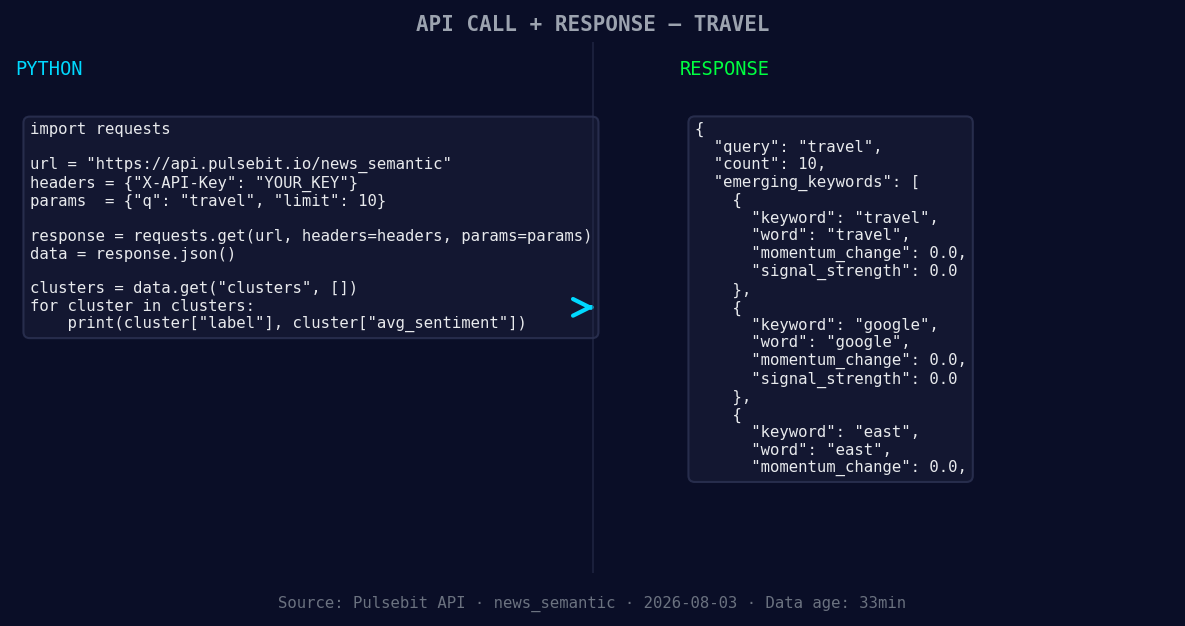
*Left: Python GET /news_semantic call for 'travel'. Right: returned JSON response structure (clusters: 3). Source: Pulsebit /news_semantic.*
# Geographic origin filter: query by language/country
url = "https://api.pulsebit.com/v1/articles"
params = {
"topic": "travel",
"lang": "en",
"momentum": "+0.255"
}
response = requests.get(url, params=params)
data = response.json()
# Check the response
print(data)
Next, we need to run a meta-sentiment moment by scoring the narrative framing itself. We’ll take the cluster reason string and pass it through our sentiment analysis endpoint:
# Meta-sentiment moment: score the narrative framing itself
cluster_reason = "Clustered by shared themes: travel, trend, report, leisure,"
sentiment_url = "https://api.pulsebit.com/v1/sentiment"
sentiment_response = requests.post(sentiment_url, json={"text": cluster_reason})
sentiment_data = sentiment_response.json()

# Check the sentiment response
print(sentiment_data)
This dual-layer approach ensures that we're not only capturing real-time sentiment trends but also understanding the context that drives them. The data shows forming gaps in themes like travel, google, and east, which are crucial to monitor against mainstream topics such as travel, trend, and report.
Now, let’s talk about three specific builds you could implement using this momentum spike pattern:
- Travel Sentiment Alert: Set a threshold at +0.200 for sentiment spikes in travel articles. Use the geographic filter to ensure you’re only capturing English-language content. You can set up a webhook that notifies you immediately when this threshold is breached.

Geographic detection output for travel. India leads with 7 articles and sentiment +0.21. Source: Pulsebit /news_recent geographic fields.
Cluster Analysis Dashboard: Create a dashboard that visualizes the output of the meta-sentiment analysis. Use the sentiment scores from the narrative framing to identify which themes are gaining traction, specifically monitoring the forming clusters of travel, google, and east.
Predictive Trend Model: Build a model that leverages momentum scores to predict future trends in travel. Use the historical data from the sentiment scores and momentum spikes to create a predictive analytics tool that accounts for both geographic and thematic shifts.
By focusing on these specific signals and thresholds, you’ll be better equipped to catch emerging trends and insights in real time.
If you're ready to dive in, you can start building right away. Check out our documentation at pulsebit.lojenterprise.com/docs. We believe you can copy-paste and run this in under 10 minutes. Let's get started!


Top comments (0)