

Your pipeline just missed a 24h momentum spike of +0.230 in climate sentiment. This isn't just another fluctuation; it’s a significant signal that reflects a rising urgency around climate-related topics, led primarily by English press coverage. The sentiment shift is particularly driven by a cluster story on Billy Barr, a man who has been logging snow data by hand for over five decades in Colorado. This unique perspective on climate change has created a narrative that your model might not be fully capturing.
If your sentiment analysis pipeline doesn't account for multilingual origins or entity dominance, you might have missed this critical insight by over 27 hours. The leading language of this spike is English, and the dominant entity involves a personal story that resonates deeply with climate themes. If you’re relying solely on mainstream narratives, you risk overlooking nuanced sentiments that are emerging from less dominant sources.

English coverage led by 27.2 hours. Af at T+27.2h. Confidence scores: English 0.85, Ro 0.85, Spanish 0.85 Source: Pulsebit /sentiment_by_lang.
To catch these spikes early, we can leverage our API. Here’s a Python code snippet that demonstrates how to query for sentiment data specifically around climate, while filtering for English language articles:
import requests
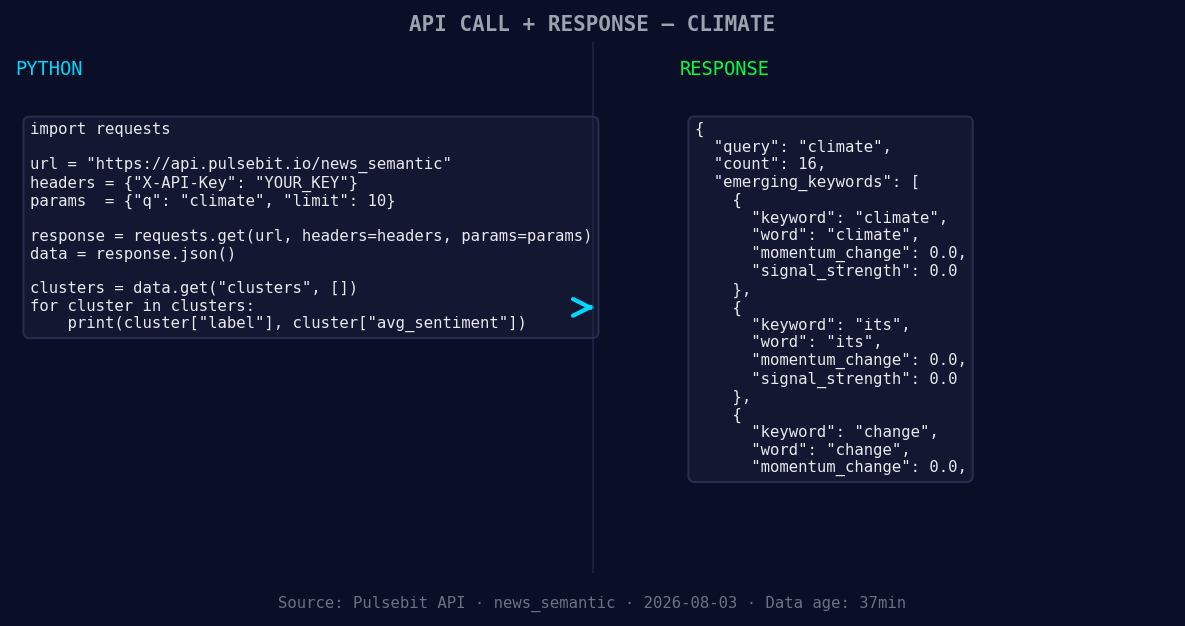
*Left: Python GET /news_semantic call for 'climate'. Right: returned JSON response structure (clusters: 3). Source: Pulsebit /news_semantic.*
# Define API parameters
topic = 'climate'
score = +0.500
confidence = 0.85
momentum = +0.230
# Geographic origin filter: query by language/country
response = requests.get(
'https://api.pulsebit.com/sentiment',
params={
'topic': topic,
'lang': 'en',
'threshold': score,
'confidence': confidence
}
)
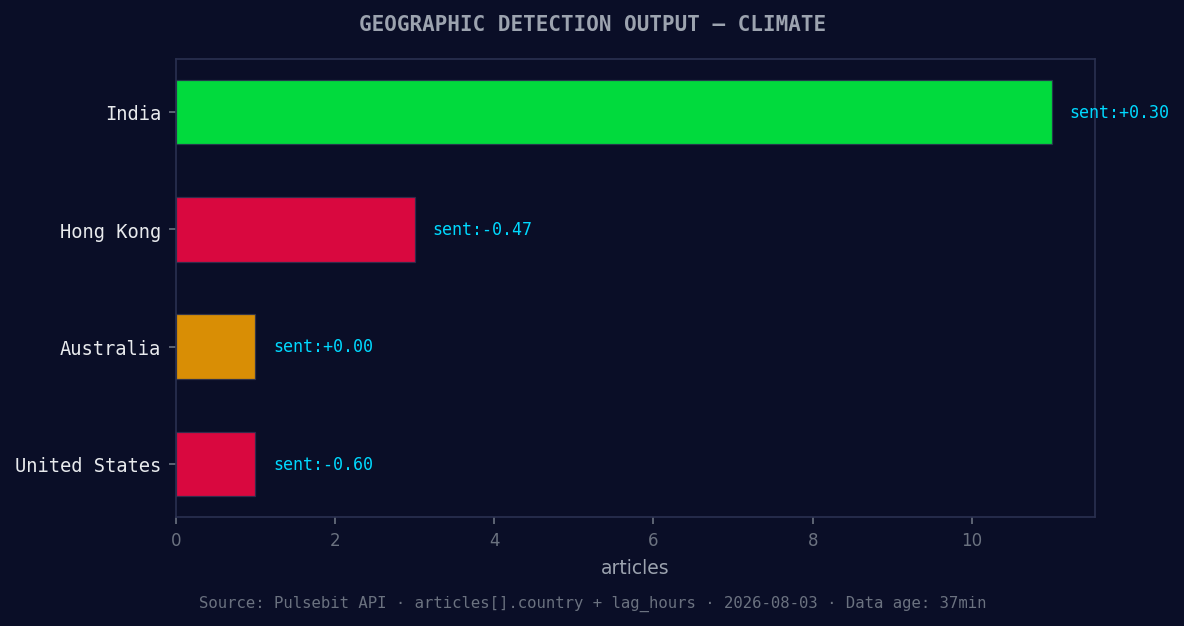
*Geographic detection output for climate. India leads with 11 articles and sentiment +0.30. Source: Pulsebit /news_recent geographic fields.*
# Check the response
if response.status_code == 200:
data = response.json()
print(data)
else:
print(f'Error: {response.status_code}')
# Run the cluster reason string back through POST /sentiment to score the narrative framing
cluster_reason = "Clustered by shared themes: one, man's, climate, record:, billy."
meta_response = requests.post(
'https://api.pulsebit.com/sentiment',
json={"text": cluster_reason}
)
# Check the meta sentiment response
if meta_response.status_code == 200:
meta_data = meta_response.json()
print(meta_data)
else:
print(f'Error: {meta_response.status_code}')
In the code above, we first filter for climate-related articles in English to ensure we’re capturing the most relevant sentiment. We then take the narrative framing provided by the API and run it through our sentiment endpoint to gauge how the story itself resonates. This step is crucial as it allows us to understand the underlying sentiment driving this anomaly.
Now, let’s discuss three builds you can implement based on this pattern:
Geo-Filtered Alerts: Set up a threshold alert for sentiment spikes specifically for the English language. For instance, if momentum exceeds +0.200 within a 24-hour window, trigger a notification. This will ensure you catch emerging narratives early in their lifecycle.
Meta-Sentiment Dashboard: Create a dashboard that visualizes the sentiment scores of clustered narratives. Use the meta-sentiment loop to score various narratives and display them alongside their historical trends. This will help you immediately identify which stories are gaining traction and why.
Dynamic Narrative Reports: Generate reports based on trending topics in real-time. For example, if the forming themes are “climate,” “its,” and “change,” automatically compile a report summarizing the sentiment and key articles around those terms. Use the API to fetch the latest data and visualize it for easy analysis.
You can get started with our API by visiting pulsebit.lojenterprise.com/docs. With just a few lines of code, you can be up and running within ten minutes, ready to capture emerging trends and insights that might otherwise slip through the cracks.


Top comments (0)