

Your model missed a critical anomaly: a 24-hour momentum spike of +0.288 in climate sentiment, with a notable leading language of French press articles dominating the conversation by 5.4 hours. This significant delay in capturing momentum reveals a structural gap in any pipeline that doesn’t properly account for multilingual origins or entity dominance. If your sentiment analysis isn’t tuned to handle diverse languages and the nuances of local narratives, you're likely trailing behind the curve by several hours or even days. In this case, the French narrative around climate change, led by the poignant story of Billy Barr logging snow for over five decades, showcases how local sentiment can drastically shift before your pipeline even registers the change.

French coverage led by 5.4 hours. No at T+5.4h. Confidence scores: French 0.85, English 0.85, Spanish 0.85 Source: Pulsebit /sentiment_by_lang.
Here’s how you can catch this momentum spike using our API. First, let’s filter the data by geographic origin, specifically focusing on the French language. Here’s the Python code you can use:

Geographic detection output for climate. India leads with 11 articles and sentiment +0.22. Source: Pulsebit /news_recent geographic fields.
import requests
# Define the parameters for the API call
params = {
"topic": "climate",
"lang": "fr", # Filter by French language
"score": 0.400,
"confidence": 0.85,
"momentum": 0.288
}
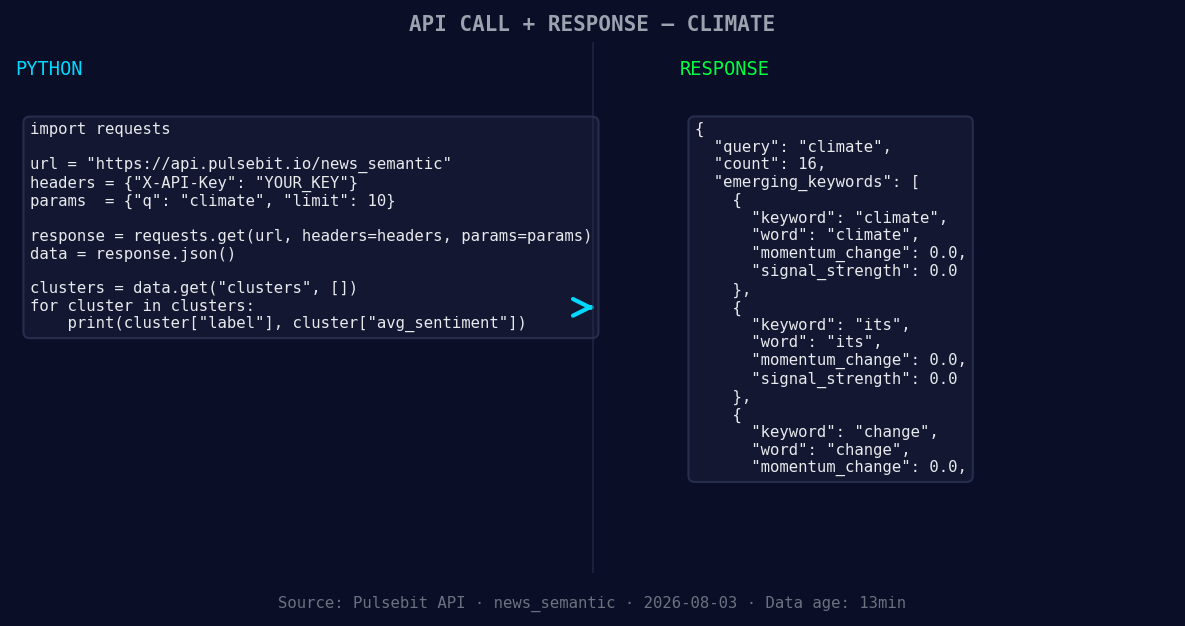
*Left: Python GET /news_semantic call for 'climate'. Right: returned JSON response structure (clusters: 3). Source: Pulsebit /news_semantic.*
# Make the API call
response = requests.get("https://api.pulsebit.com/v1/sentiment", params=params)
# Process the response
data = response.json()
print(data)
Now, to further evaluate the framing of the narrative that emerged around this topic, we can run the cluster reason string back through the sentiment analysis to capture its meta-sentiment. This is essential for understanding how the narrative themes are resonating:
# Define the meta-sentiment input
meta_sentiment_input = "Clustered by shared themes: one, man's, climate, record:, billy."

# Make the API call for meta-sentiment
meta_response = requests.post("https://api.pulsebit.com/v1/sentiment", json={"text": meta_sentiment_input})

# Process the response
meta_data = meta_response.json()
print(meta_data)
By combining these two approaches, you can effectively close the gap in your sentiment analysis, ensuring that you’re not only catching spikes in sentiment but also understanding the narrative framing behind them.
Now, let’s explore three specific builds you can create with this new insight:
Geo-Filtered Alert System: Set up a real-time alert that triggers when sentiment around climate topics in French reaches a threshold of +0.300. This allows you to act on local sentiment shifts instantly.
Meta-Sentiment Analysis Dashboard: Create a dashboard that visualizes the sentiment scores of narratives like “one man’s climate record.” Use the sentiment from the meta-sentiment loop to gauge how these narratives are perceived over time.
Clustered Sentiment Comparison: Implement a function that compares the sentiment scores of clustered narratives (like those surrounding climate) against mainstream sentiment indicators. This can help you identify when local stories are diverging from broader trends.
To get started, visit our documentation at pulsebit.lojenterprise.com/docs. You can copy-paste the code snippets above and run them in under 10 minutes to start catching these critical insights in real time. Make sure your pipeline isn't lagging behind — the world of sentiment is moving fast, and you need to keep up!


Top comments (0)