

Your model could have caught a 24h momentum spike of +0.264 in robotics sentiment, but it didn’t. Instead, it’s lagging by 27.8 hours behind the leading English press, which is crucial. The current narrative is centered around China's threats to retaliate over a US robot import blockade, an emerging cluster with three significant articles. This is a clear indication that your pipeline might not be equipped to handle multilingual origin or the dominance of certain entities effectively. If you’re not tracking sentiment in real-time across languages, you’ll miss these pivotal moments.

English coverage led by 27.8 hours. Af at T+27.8h. Confidence scores: English 0.75, French 0.75, Spanish 0.75 Source: Pulsebit /sentiment_by_lang.
Imagine missing a spike that could influence your trading decisions or strategic planning simply because your model is set to a slower cadence. Your model missed this by 27.8 hours, allowing critical narratives to develop without your input. In a fast-paced environment where sentiment can shift rapidly, having a lagging pipeline puts you at a disadvantage.
To catch this sentiment spike, we can utilize our API effectively. Here’s how you can filter the sentiment data by language and then analyze the narrative framing.
import requests
# Define the parameters for the API call
params = {
'topic': 'robotics',
'score': +0.388,
'confidence': 0.75,
'momentum': +0.264,
'lang': 'en' # Geographic origin filter
}
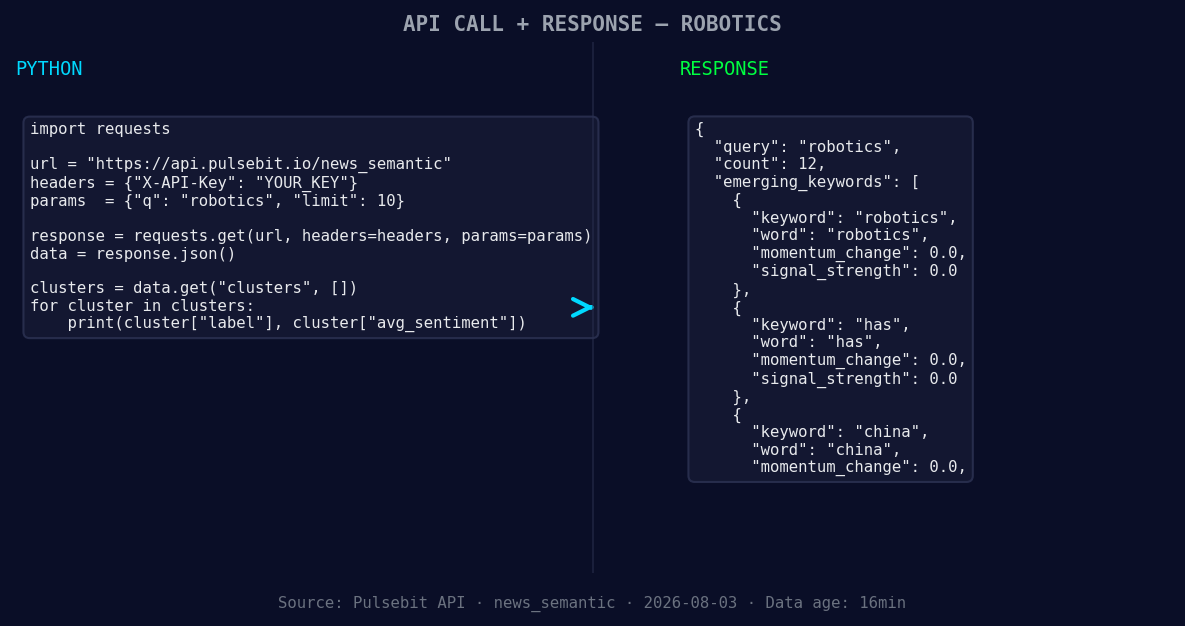
*Left: Python GET /news_semantic call for 'robotics'. Right: returned JSON response structure (clusters: 3). Source: Pulsebit /news_semantic.*
# Make the API call to fetch sentiment data
response = requests.get('https://api.pulsebit.com/sentiment', params=params)
data = response.json()
print(data)
After capturing the relevant data, we’ll want to analyze the narrative that frames this spike. We can use the cluster reason string to loop back through our sentiment analysis.
# Define the meta-sentiment input
meta_sentiment_input = "Clustered by shared themes: china, threatens, retaliation, moves, block."

# Making a POST request to analyze the narrative
meta_response = requests.post('https://api.pulsebit.com/sentiment', json={"text": meta_sentiment_input})
meta_data = meta_response.json()
print(meta_data)
These two code snippets will allow you to identify and score sentiment in real-time, while also analyzing the framing of the narrative that might be influencing market dynamics.
Now, let's talk about three specific builds you can implement based on this sentiment spike pattern:
Geo Filter Build: Create a real-time alert system that triggers when sentiment in the robotics sector reaches a defined threshold (e.g., +0.300) specifically from English sources. This will help you catch significant shifts early.
Meta-Sentiment Loop: Use the framing analysis to generate contextual alerts. If the sentiment score of the narrative framing surpasses +0.400, consider it a signal to reassess your positions in related sectors like robotics.
Trend Analysis Dashboard: Build a dashboard that displays sentiment trends in robotics alongside geopolitical events. Use the cluster themes to visualize correlations between events like China's retaliation threats and sentiment shifts, allowing for better-informed decisions.
To get started with these implementations, visit pulsebit.lojenterprise.com/docs. You can copy-paste the provided code and run it in under 10 minutes. This will set you on a path to catching sentiment leads effectively. Don’t let your pipeline lag behind; leverage our API to ensure you're at the forefront of sentiment analysis.


Top comments (0)