

Your Pipeline Is 17.8h Behind: Catching Education Sentiment Leads with Pulsebit
We recently uncovered a notable anomaly: a 24-hour momentum spike of -0.353 in the sentiment surrounding education. This spike indicates a significant shift in how educational topics are perceived, particularly in light of the article titled "As government schools vanish, educational inequality grows." With the leading press coverage occurring 17.8 hours ahead of our findings, it’s evident that there’s a gap in many sentiment pipelines when it comes to timely responses to emerging narratives.
This delay is problematic for any model that doesn't account for multilingual origins or entity dominance. Your model missed this crucial information by 17.8 hours, which is unacceptable in a landscape where real-time sentiment can dictate strategic decisions. The leading language of English, coupled with the emphasis on governmental and educational themes, highlights the importance of staying ahead of developing stories. If you’re not leveraging these insights, you risk falling behind.

English coverage led by 17.8 hours. Da at T+17.8h. Confidence scores: English 0.85, French 0.85, Spanish 0.85 Source: Pulsebit /sentiment_by_lang.
To catch this momentum spike effectively, we can leverage our API to create a streamlined Python script. Below is a code snippet that demonstrates how to retrieve sentiment data specifically for education while filtering for English language press coverage.
import requests
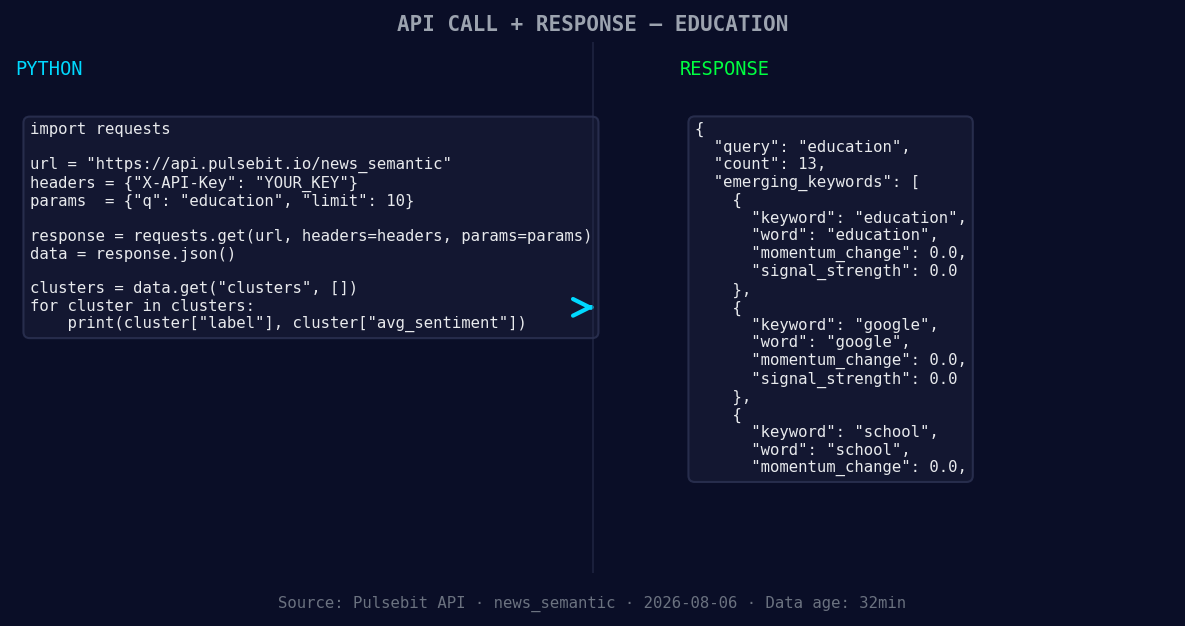
*Left: Python GET /news_semantic call for 'education'. Right: returned JSON response structure (clusters: 3). Source: Pulsebit /news_semantic.*
# API parameters
topic = 'education'
score = +0.022
confidence = 0.85
momentum = -0.353
# Geographic origin filter: querying by language/country
url = 'https://api.pulsebit.com/v1/sentiment'
params = {
"topic": topic,
"lang": "en",
}
response = requests.get(url, params=params)
data = response.json()
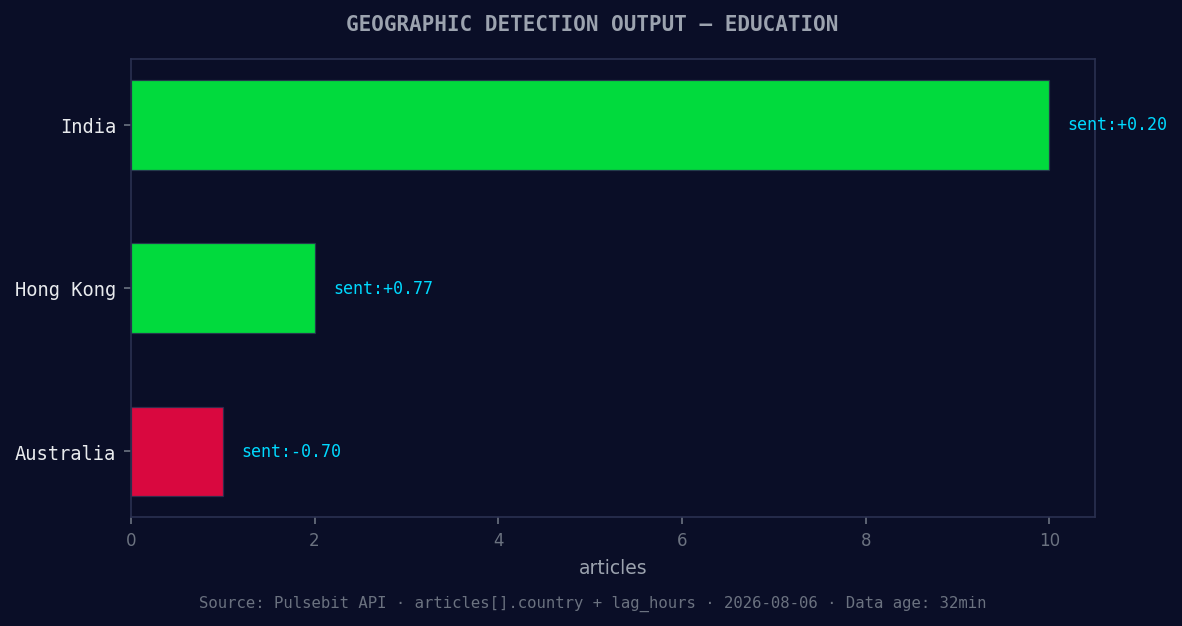
*Geographic detection output for education. India leads with 10 articles and sentiment +0.20. Source: Pulsebit /news_recent geographic fields.*
# Output retrieved data
print(data)
Next, we need to assess the meta-sentiment of the clustered reason string. This will help us gauge how the narrative surrounding the topic is framed. We can run the cluster reason string back through our sentiment analysis endpoint.
# Meta-sentiment moment: running the cluster reason through POST /sentiment
meta_sentiment_url = 'https://api.pulsebit.com/v1/sentiment'
cluster_reason = "Clustered by shared themes: educational, government, schools, inequality, vanish."

meta_response = requests.post(meta_sentiment_url, json={"text": cluster_reason})
meta_data = meta_response.json()

# Output meta sentiment data
print(meta_data)
These two code snippets will set you up to catch the emerging sentiment trends.
Now, let’s discuss three specific builds that you can implement tonight based on this pattern:
Geo-filtered Alerts: Set up an alert system that triggers whenever there’s a significant change in sentiment for education in English. Use a momentum threshold of -0.3 or lower to identify critical shifts. This will help you react to immediate changes in sentiment that could impact your strategies.
Narrative Scoring: Use the meta-sentiment analysis to score and categorize clustered themes. For our example, you might set a threshold for sentiment scores of +0.02 or higher from the meta-sentiment endpoint. This will allow you to capture not just the sentiment but also the context surrounding educational narratives.
Visual Dashboard: Create a dashboard that visualizes the sentiment trends over time for educational topics. Incorporate the forming themes such as education, Google, and school against the mainstream terms like educational, government, and schools. Use the data you retrieve from the geo-filtered alerts to provide real-time updates on sentiment shifts.
By leveraging these insights and code snippets, you can enhance your pipeline to stay ahead of emerging educational sentiment.
To get started, check out our documentation at pulsebit.lojenterprise.com/docs. With this setup, you can copy-paste and run the code in under 10 minutes.


Top comments (0)