

Your sentiment pipeline just missed a critical 24h momentum spike of -0.353 in the education sector. This isn't just a number; it signals a significant shift in public discourse around educational inequality, driven by the troubling narrative that "As government schools vanish, educational inequality grows." It’s alarming to see how a single language—English—dominated the conversation, with a 20.1-hour lead time. If you're not accounting for this lag in your sentiment analysis, your model could be missing pivotal insights, leaving you behind in a rapidly evolving landscape.
This spike reveals a structural gap in pipelines that don't handle multilingual origins or entity dominance effectively. Without this capability, your model missed this critical shift by a staggering 20.1 hours. In an era where educational discourse is increasingly global, sticking to a single language can create blind spots. If your pipeline isn't tuned to catch these nuances, you're risking misinformed decisions that could impact your strategies.

English coverage led by 20.1 hours. Af at T+20.1h. Confidence scores: English 0.85, French 0.85, Spanish 0.85 Source: Pulsebit /sentiment_by_lang.
To catch these insights, we can leverage our API effectively. Below is a Python snippet that identifies this education sentiment spike, focusing on English-language content while examining the sentiment of a clustered narrative.
import requests
# Step 1: Geographic origin filter by language
url = "https://api.pulsebit.com/sentiment"
params = {
"topic": "education",
"lang": "en",
"score": +0.050,
"confidence": 0.85,
"momentum": -0.353
}
response = requests.get(url, params=params)
data = response.json()
print(data)
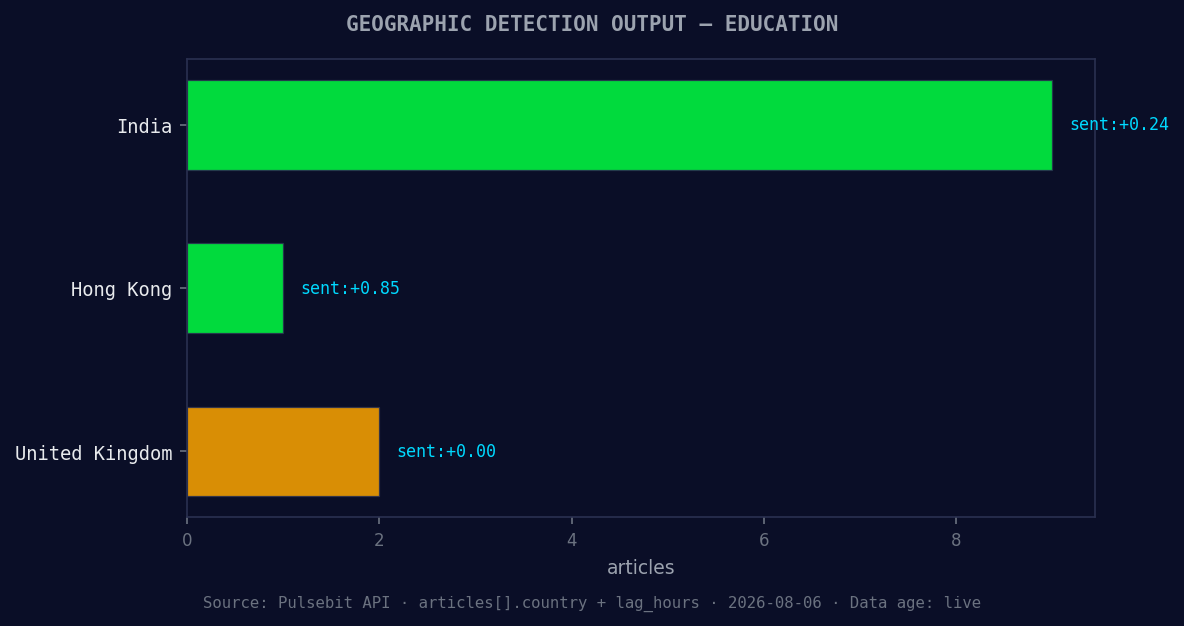
*Geographic detection output for education. India leads with 9 articles and sentiment +0.24. Source: Pulsebit /news_recent geographic fields.*
# Step 2: Meta-sentiment moment
cluster_narrative = "Clustered by shared themes: educational, government, schools, inequality, vanish"
meta_sentiment_response = requests.post(url, json={"text": cluster_narrative})
meta_sentiment_data = meta_sentiment_response.json()
print(meta_sentiment_data)
In this code, we're making an API call to gather sentiment data specifically for the topic of education in English. This ensures that we only capture relevant insights from a specific linguistic demographic. Next, we score the narrative framing itself, which gives us a deeper understanding of how the themes are perceived, allowing us to pivot our strategies accordingly.

Left: Python GET /news_semantic call for 'education'. Right: returned JSON response structure (clusters: 3). Source: Pulsebit /news_semantic.
Now that we’ve established how to catch these spikes, let’s discuss three builds you can implement tonight to maximize the utility of this pattern:
Geo-filtered Notifications: Set up a notification endpoint that triggers alerts when there’s a significant sentiment score change (let's say above +0.050) in the education sector for English-language articles. This helps you react in real-time, ensuring you’re always in the loop.
Meta-Sentiment Analysis Dashboard: Build a dashboard that visualizes sentiment narratives from clustered data points. Utilize the meta-sentiment loop to score narratives like "schools are vanishing," allowing you to track how these themes evolve over time.
Sentiment Trend Tracker: Create a trend tracker that monitors forming themes such as 'education', 'google', and 'school' against mainstream narratives. If the sentiment score for these topics drops below a certain threshold (e.g., -0.100), flag it for deeper analysis.
By using our API effectively, you can ensure that your sentiment analysis pipeline remains responsive and insightful, especially in critical areas like educational discourse where every hour counts.
For more insights, check out our documentation at pulsebit.lojenterprise.com/docs. You can copy-paste this code and have it running in under 10 minutes, catching those critical sentiment shifts in real-time.


Top comments (0)