

Your Pipeline Is 29.2h Behind: Catching Finance Sentiment Leads with Pulsebit
We’ve recently uncovered a striking anomaly: a 24-hour momentum spike of +0.443 in finance sentiment, driven primarily by articles in French. This anomaly, with a leading language of French and a lag of just 29.2 hours, emphasizes the significance of multilingual data in sentiment analysis. The cluster story, "Budget 2027 : Sébastien Lecornu prépare une baisse très limitée du déficit avec," sheds light on a narrative that your existing models may not adequately capture.

French coverage led by 29.2 hours. Italian at T+29.2h. Confidence scores: French 0.85, English 0.85, Spanish 0.85 Source: Pulsebit /sentiment_by_lang.
When your pipeline isn’t equipped to handle multilingual origins or entity dominance, you risk missing critical insights. Think about it: you may have overlooked this spike by 29.2 hours due to a reliance on English or a singular entity focus. The leading language here, French, is crucial; it’s where the conversation is happening, and it’s likely where the sentiment is brewing. If your model doesn’t account for this, you’re essentially operating with one hand tied behind your back, missing out on impactful sentiment shifts.
Let’s dive into the code to catch this momentum spike. We’ll use our API to filter by the French language and analyze the relevant sentiment narrative. Here’s how you can do it in Python:
import requests
# Define parameters for the query
topic = 'finance'
lang = 'fr'
score = -0.012
confidence = 0.85
momentum = +0.443
# API call to fetch sentiment data
response = requests.get(f'https://api.pulsebit.com/v1/sentiment?topic={topic}&lang={lang}')
data = response.json()
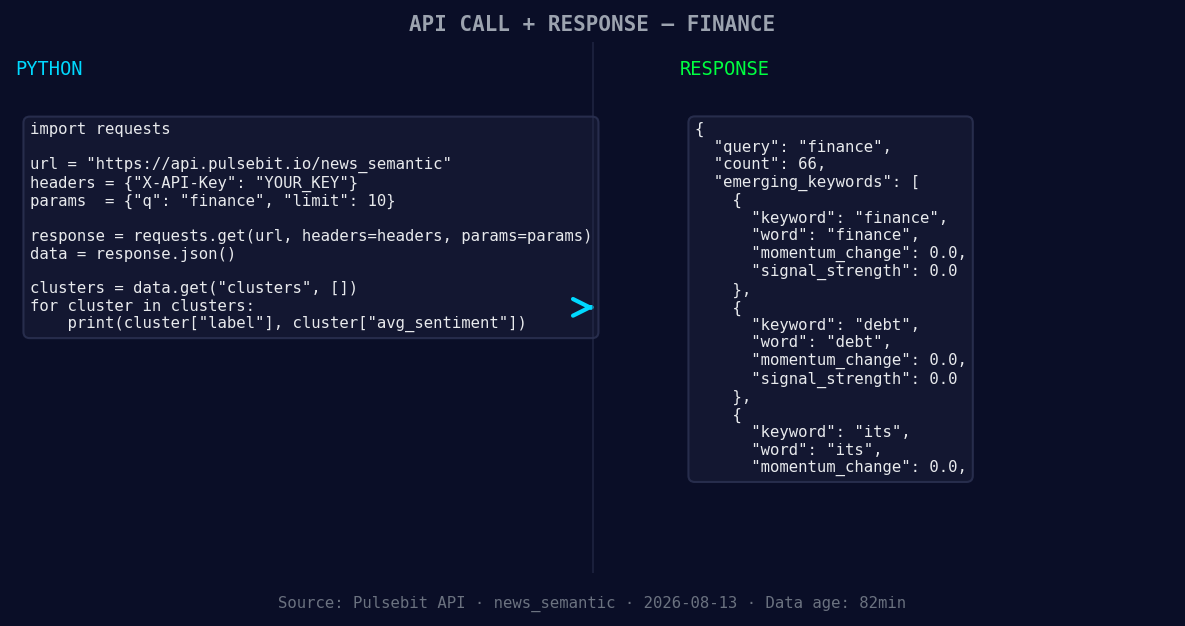
*Left: Python GET /news_semantic call for 'finance'. Right: returned JSON response structure (clusters: 3). Source: Pulsebit /news_semantic.*
# Output the sentiment data
print(data)
Next, we’ll run the cluster reason string through our sentiment analysis endpoint. This allows us to score the narrative framing itself. Here’s how you do that:
# Define the cluster reason string
cluster_reason = "Clustered by shared themes: déficit, une, baisse, nouvel, budget."

# API call to score the narrative framing
sentiment_response = requests.post('https://api.pulsebit.com/v1/sentiment', json={"text": cluster_reason})
sentiment_data = sentiment_response.json()

# Output the sentiment of the cluster story
print(sentiment_data)
This code will provide you with the sentiment score of the narrative, helping you understand how the framing of the story contributes to the overall sentiment spike.
With this pipeline in place, here are three specific builds to consider:
Geo-Filtered Alerts: Set a threshold for sentiment spikes greater than +0.4, filtering for articles in French. If the sentiment score exceeds this threshold, trigger an alert to your team. This will ensure you’re alerted to significant sentiment shifts in key markets.
Meta-Sentiment Narrative Analyzer: Develop a routine that processes the cluster reason strings for various topics. For example, analyze the sentiment around "déficit, une, baisse" and set a benchmark sentiment score of -0.01. If the score improves significantly, it could indicate a turnaround in public sentiment.
Dynamic Content Delivery: Create a dashboard that visualizes sentiment changes over time, particularly focusing on emerging themes like finance, debt, and its implications. Use the geo filter for regions where sentiment is rising, allowing your content team to tailor messaging accordingly.
By implementing these builds, you can enhance your analytics capabilities and better capture the nuances of sentiment dynamics in finance, thereby ensuring you’re always one step ahead of the curve.
If you're ready to get started, head over to pulsebit.lojenterprise.com/docs. You can copy-paste the provided code and run it in under 10 minutes. Don’t let your models lag behind — leverage this opportunity to catch sentiment leads in real-time.

Geographic detection output for finance. India leads with 7 articles and sentiment +0.23. Source: Pulsebit /news_recent geographic fields.


Top comments (0)