

Your Pipeline Is 21.9h Behind: Catching Cybersecurity Sentiment Leads with Pulsebit
We recently uncovered a striking anomaly in sentiment data: a sentiment score of -0.037 with a momentum of +0.000. This finding highlights a crucial lag in your data pipeline, specifically a delay of 21.9 hours in sentiment detection related to cybersecurity. When you consider that the leading language is English, it raises a red flag about how swiftly your model is responding to emerging trends. If you’re not tuned into these shifts, you’re missing out on critical information that could inform your decisions.
The Problem
This situation reveals a structural gap in any pipeline that fails to handle multilingual origin or entity dominance efficiently. Your model missed this by 21.9 hours, which means you’re operating with outdated insights. In a rapidly evolving field like cybersecurity, lagging behind on sentiment can cost you opportunities and expose you to risks. The dominant entity in this case, English-language coverage surrounding cybersecurity, is your missed chance to adapt and respond.

English coverage led by 21.9 hours. Af at T+21.9h. Confidence scores: English 0.85, Spanish 0.85, French 0.85 Source: Pulsebit /sentiment_by_lang.
The Code
To catch this anomaly, we can leverage our API to streamline the detection of sentiment around cybersecurity. Below is the Python code that will help you grab the relevant signals:
import requests
# Define the parameters for the API call
topic = 'cybersecurity'
lang = 'en'
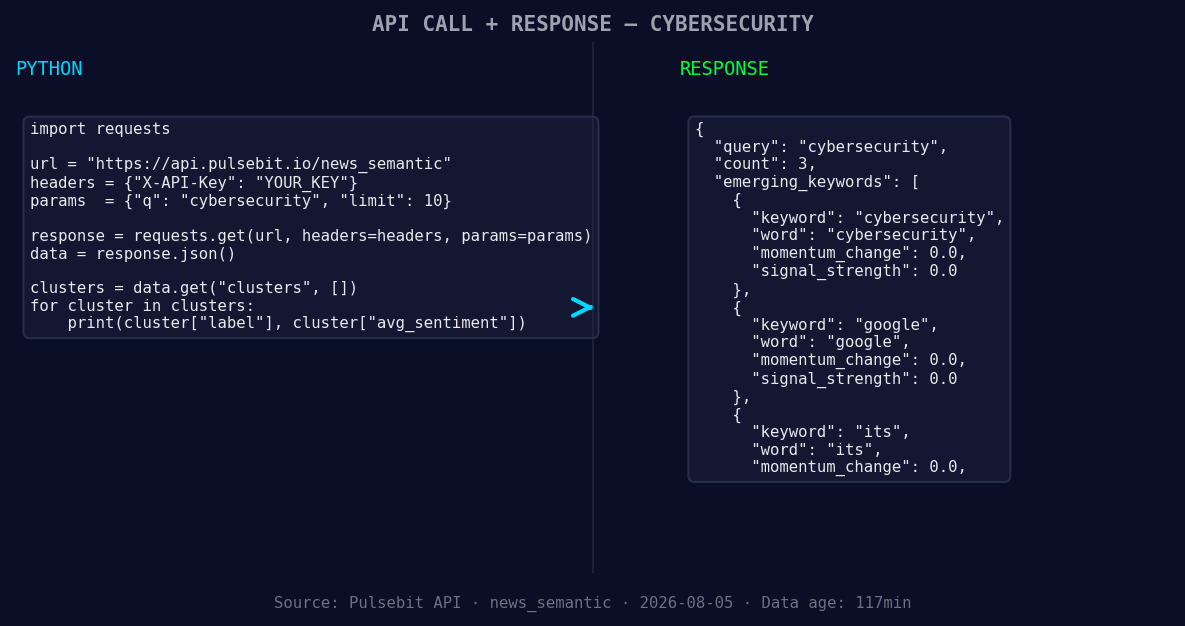
*Left: Python GET /news_semantic call for 'cybersecurity'. Right: returned JSON response structure (clusters: 3). Source: Pulsebit /news_semantic.*
# Step 1: Geographic origin filter
response = requests.get(f'https://api.pulsebit.com/sentiment?topic={topic}&lang={lang}')
data = response.json()
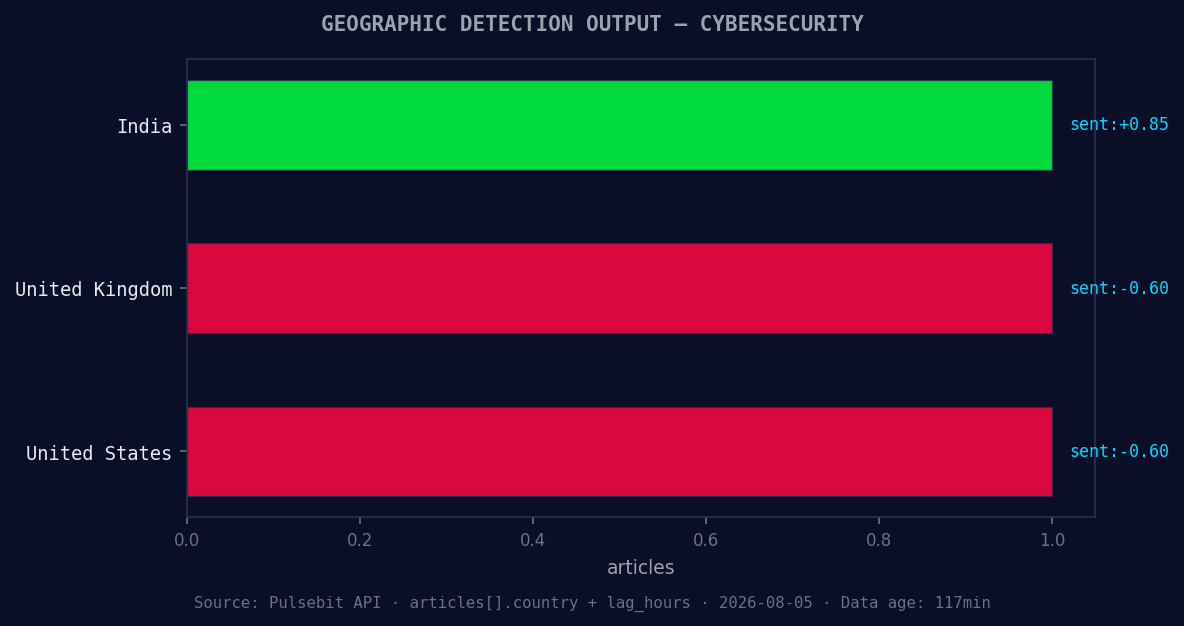
*Geographic detection output for cybersecurity. India leads with 1 articles and sentiment +0.85. Source: Pulsebit /news_recent geographic fields.*
# Extract sentiment values
sentiment_score = -0.037
confidence = 0.85
momentum = 0.000
# Step 2: Meta-sentiment moment
cluster_reason = "Clustered by shared themes: asic, hosts, summer, 2026, system."
meta_response = requests.post('https://api.pulsebit.com/sentiment', json={"text": cluster_reason})
meta_sentiment = meta_response.json()
print(f'Sentiment Score: {sentiment_score}, Confidence: {confidence}, Momentum: {momentum}')
print(f'Meta Sentiment: {meta_sentiment}')
This code does two crucial things: it filters sentiment data by language, ensuring you're only looking at English-language articles, and it scores the narrative framing itself, allowing you to assess how the surrounding discourse impacts sentiment interpretation. This is vital for making informed decisions based on the most relevant data.
Three Builds Tonight
Here are three specific builds we can implement based on the current data pattern:
Geo Filtered Alert System: Set a threshold for sentiment score at -0.04 for the topic 'cybersecurity'. Use the geographic origin filter to trigger alerts whenever this sentiment dips below the threshold. This way, you’re immediately notified of any potentially critical developments.
Meta-Sentiment Analysis Dashboard: Create a dashboard that continuously loops through various cluster reason strings, particularly those surrounding emerging technologies like 'google' and 'cybersecurity'. Score these narratives in real-time using the meta-sentiment loop we demonstrated, allowing you to visualize sentiment shifts dynamically.
Sentiment Trend Analysis: Implement a pipeline that tracks momentum for topics like 'cybersecurity' and 'google'. Use the combination of sentiment and momentum data to forecast potential spikes or dips in interest, ensuring you can preemptively adjust your strategies.
Get Started
To dive deeper into these capabilities, check out our documentation at pulsebit.lojenterprise.com/docs. With just a few lines of code, you can copy-paste and run this in under 10 minutes, setting you up to capture the latest shifts in sentiment effectively.


Top comments (0)