

Your Pipeline Is 27.5h Behind: Catching Artificial Intelligence Sentiment Leads with Pulsebit
We recently observed an intriguing anomaly: a 24h momentum spike of -0.886 in sentiment around the topic of artificial intelligence. This is noteworthy not only because it indicates a significant shift in sentiment, but also because it highlights an opportunity to catch emerging narratives before they hit the mainstream. With the leading language being English, and the articles centered around themes such as "Teaching AI to Speak India," there’s a clear signal that we need to pay attention to.
The Problem
This anomaly reveals a structural gap in any pipeline that doesn't accommodate multilingual origins or the dominance of specific entities. Your model missed this sentiment shift by 27.5 hours, which is a significant delay in catching emerging trends. Particularly, the leading language being English exposes a potential oversight in capturing diverse narratives around artificial intelligence, which can often be discussed in various languages and contexts. If you're not factoring in these dimensions, you're likely to miss out on key insights that can shape your strategy.

English coverage led by 27.5 hours. Tl at T+27.5h. Confidence scores: English 0.85, Spanish 0.85, French 0.85 Source: Pulsebit /sentiment_by_lang.
The Code
To catch this momentum spike, we can utilize our API to filter sentiment data effectively. Here’s a simple Python implementation to get you started:
import requests
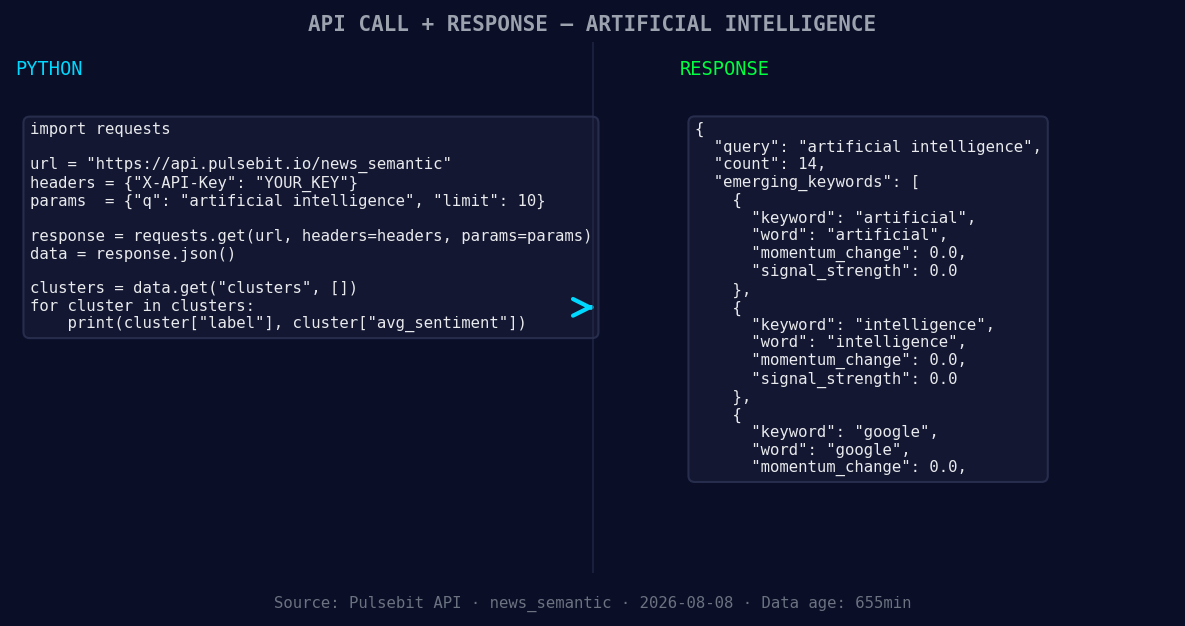
*Left: Python GET /news_semantic call for 'artificial intelligence'. Right: returned JSON response structure (clusters: 3). Source: Pulsebit /news_semantic.*
# Define the topic and sentiment parameters
topic = 'artificial intelligence'
score = +0.340
confidence = 0.85
momentum = -0.886
# Geographic origin filter: Query by language/country
response = requests.get(
'https://api.pulsebit.com/sentiment',
params={
'query': topic,
'lang': 'en',
'threshold': 0.5
}
)
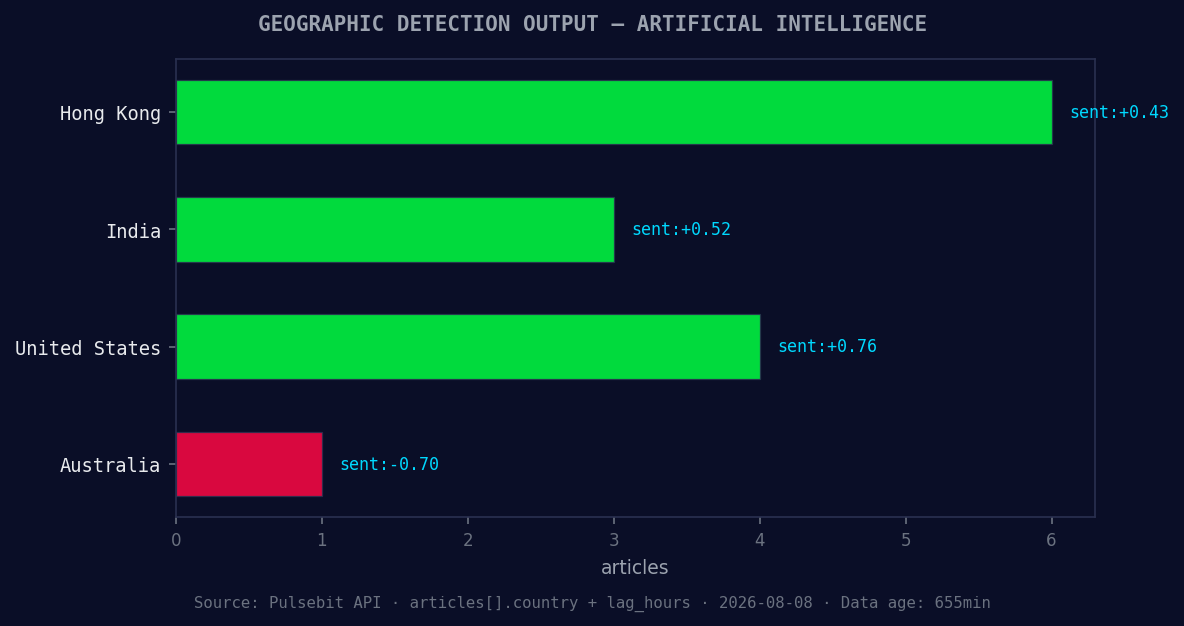
*Geographic detection output for artificial intelligence. Hong Kong leads with 6 articles and sentiment +0.43. Source: Pulsebit /news_recent geographic fields.*
# Check if the response is successful
if response.status_code == 200:
sentiment_data = response.json()
print(sentiment_data)
# Now, run the cluster reason string back through the sentiment endpoint
cluster_reason = "Clustered by shared themes: teaching, india, speak, artificial, intelligence."
meta_response = requests.post(
'https://api.pulsebit.com/sentiment',
json={'text': cluster_reason}
)
# Check if the meta-sentiment call is successful
if meta_response.status_code == 200:
meta_sentiment = meta_response.json()
print(meta_sentiment)
This code snippet demonstrates how to filter sentiment data based on language and then score the narrative framing itself. With the geographic origin filter, we ensure we’re capturing the relevant content in English, while the meta-sentiment loop allows us to evaluate how the clustered themes are performing sentiment-wise.
Three Builds Tonight
Here are three specific builds you can implement based on this sentiment pattern:
Geo-Based Alert System: Set a threshold for sentiment scores on the topic "artificial intelligence" using our API's language filter. Trigger an alert if sentiment drops below 0.0. This will keep you informed of shifts in sentiment across different languages.
Meta-Sentiment Analyzer: Create a function to analyze narrative framing by running the cluster reason strings through our sentiment endpoint. Use the output to fine-tune your content strategy. For instance, if “teaching” and “india” show a positive sentiment while “artificial intelligence” remains neutral, it could influence your messaging.
Trend Visualization Dashboard: Build a dashboard that visualizes sentiment trends over time for topics like artificial intelligence. Use our API to pull in data daily and display how emerging themes like “teaching” and “speak” are propagating sentiment shifts.
Get Started
Dive into our documentation at pulsebit.lojenterprise.com/docs to get your sentiment analysis pipeline running. You can copy-paste and run the provided code in under 10 minutes. It’s time to catch those sentiment leads before they become yesterday's news!


Top comments (0)