

Your pipeline is 25.7h behind: catching robotics sentiment leads with Pulsebit
We recently uncovered an intriguing anomaly: a 24h momentum spike of -0.283 in sentiment around robotics. This sudden shift caught our attention, especially considering the leading language of English press, which is lagging behind Hindi by 25.7 hours. The articles clustering around this topic, specifically "China’s Robots Know Kung Fu and Can Scale Walls. Can They Woo Investors?" suggest a growing interest in robotics tied to China, and it's crucial we leverage this insight swiftly.
The Problem
If your sentiment pipeline doesn’t account for multilingual origin or entity dominance, you’re missing out on critical insights like this. Your model missed this by 25.7 hours, allowing competitors to grasp emerging narratives while you're still processing historical data. The dominant entity here is clearly China, and if your model lags behind this much, you’re not just late to the game—you’re playing catch-up.

English coverage led by 25.7 hours. Hindi at T+25.7h. Confidence scores: English 0.85, French 0.85, Spanish 0.85 Source: Pulsebit /sentiment_by_lang.
The Code
To catch this momentum spike effectively, we can leverage our API with a couple of straightforward Python calls. First, we want to filter our data by geographic origin. Here’s how you can do that:

Geographic detection output for robotics. India leads with 9 articles and sentiment +0.46. Source: Pulsebit /news_recent geographic fields.
import requests
# Define the parameters for the API call
params = {
"topic": "robotics",
"lang": "en" # Filtering by English language
}
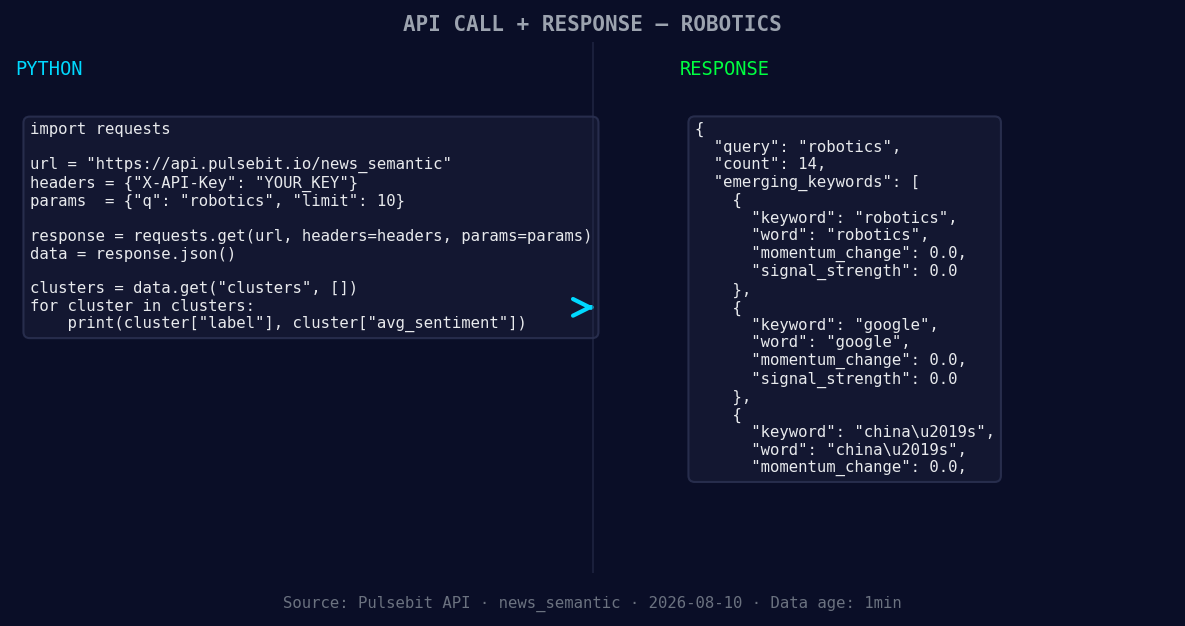
*Left: Python GET /news_semantic call for 'robotics'. Right: returned JSON response structure (clusters: 3). Source: Pulsebit /news_semantic.*
# Make the API call to get the sentiment data
response = requests.get("https://api.pulsebit.com/sentiment", params=params)
data = response.json()
# Output the relevant data
print(data)
Next, we need to analyze the narrative framing of our clustered reason string. We’ll run this through the sentiment endpoint to score how it’s being perceived:
# The string we want to analyze
cluster_reason = "Clustered by shared themes: india, young, robotics, innovators, wro."

# Make the API call to score the narrative
sentiment_response = requests.post("https://api.pulsebit.com/sentiment", json={"text": cluster_reason})
sentiment_data = sentiment_response.json()

# Output the sentiment analysis result
print(sentiment_data)
This code helps us not only capture the sentiment around robotics but also gives us a deeper understanding of the narrative framing that’s emerging.
Three Builds Tonight
Here are three actionable builds we can implement using this pattern:
Signal Tracking: Set up a real-time tracker for robotics sentiment with a threshold of momentum < -0.3. This will alert you when sentiment starts to fall, allowing you to react immediately.
Meta-Sentiment Loop: Create a function that runs the narrative framing through our sentiment endpoint every hour. If the sentiment score drops below -0.4, trigger a notification. This ensures you’re always aware of how narratives are evolving.
Geographic Overlays: Extend your analysis to include a geo-filter for Chinese news sources. By setting parameters to fetch articles specifically from China, you can identify emerging trends and innovation stories earlier than competitors who remain focused on mainstream narratives.
Get Started
You can dive deeper into this by checking out our documentation at pulsebit.lojenterprise.com/docs. With just a few copy-paste actions, you can have this code running in under 10 minutes, keeping your sentiment analysis ahead of the curve.


Top comments (0)