

Your pipeline just missed a significant anomaly: a 24h momentum spike of -0.461 for renewable energy sentiments, particularly tied to a story about a landfill in New Haven being transformed into a solar farm that now powers around 200 homes. This spike indicates a notable shift in sentiment, which might have flown under the radar if you weren’t closely monitoring multilingual signals or the dominance of specific entities in your data.

English coverage led by 26.8 hours. Et at T+26.8h. Confidence scores: English 0.75, French 0.75, Spanish 0.75 Source: Pulsebit /sentiment_by_lang.
The problem here is clear: your model missed this by 26.8 hours, trailing behind the leading English press coverage. If your pipeline isn’t set up to handle multilingual origins or bias towards dominant entities, you’re at risk of lagging in identifying significant narrative shifts. In this case, the predominant narrative revolves around renewable energy and the innovative reuse of spaces, such as turning landfills into solar farms. Failing to capture such themes in real-time can lead to missed opportunities in understanding market sentiment and public opinion.
Here's a way to catch these shifts using our API. First, we can filter our queries by geographic origin, focusing on English-language articles.

Geographic detection output for renewable energy. India leads with 2 articles and sentiment +0.85. Source: Pulsebit /news_recent geographic fields.
import requests
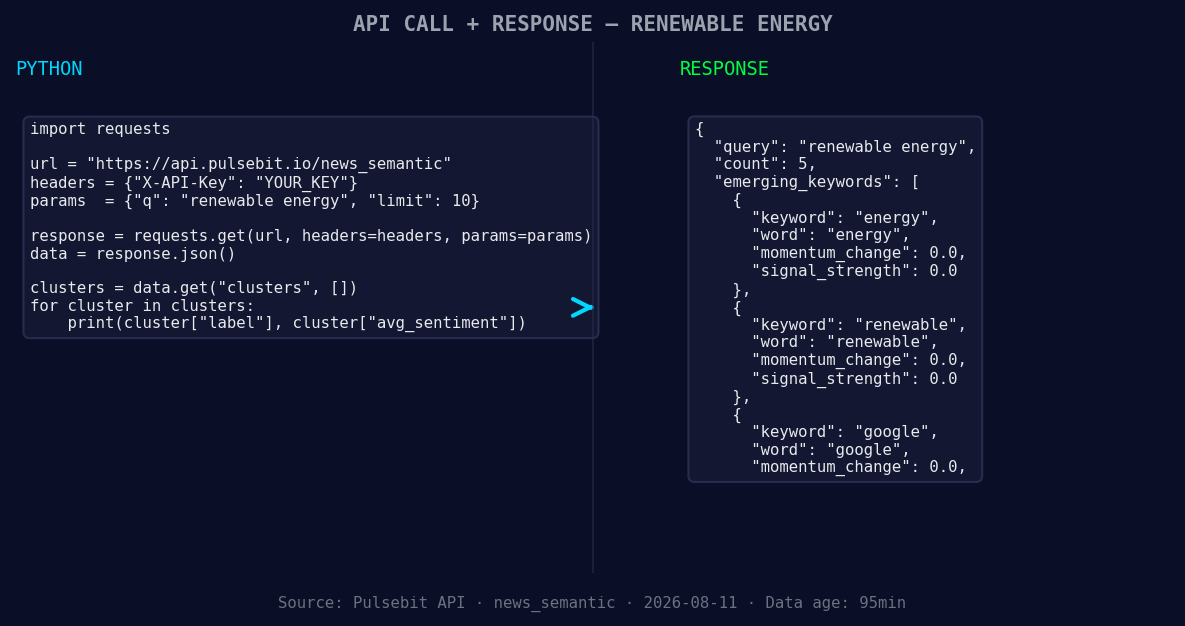
*Left: Python GET /news_semantic call for 'renewable energy'. Right: returned JSON response structure (clusters: 3). Source: Pulsebit /news_semantic.*
endpoint = "https://api.pulsebit.com/v1/articles"
params = {
"topic": "renewable energy",
"lang": "en",
"momentum": -0.461
}
response = requests.get(endpoint, params=params)
data = response.json()
Next, we want to analyze the sentiment of the narrative framing itself. We’ll take the cluster reason string, "Clustered by shared themes: solar, energy, new, haven, into," and run it through our sentiment analysis endpoint.
sentiment_endpoint = "https://api.pulsebit.com/v1/sentiment"
meta_sentiment_payload = {
    "text": "Clustered by shared themes: solar, energy, new, haven, into."
}

sentiment_response = requests.post(sentiment_endpoint, json=meta_sentiment_payload)
sentiment_data = sentiment_response.json()
By doing this, you can gauge how the framing of the narrative itself is influencing sentiment, providing deeper insights into the underlying themes.
Now, let's consider three specific builds you can implement with this momentum spike:
Real-time Monitoring with Geo Filter: Set a signal to trigger alerts when the sentiment for "renewable energy" in English-language articles drops below a threshold of +0.25. This will help you catch potential downward trends before they impact your strategy.
Meta-Sentiment Loop for Cluster Analysis: Create a scheduled job that automatically runs the meta-sentiment analysis every 24 hours on clustered topics. For instance, score themes like "solar," "energy," and "new" against each other to identify emerging narratives or shifts that could inform your decision-making.
Forming Gap Alerts: Build a notification system that alerts you when forming themes such as "energy" and "renewable" show a divergence from mainstream topics like "solar" and "new." For example, if "renewable" sentiment is stable while "solar" sentiment drops significantly, it could indicate a critical shift in public perception that warrants further investigation.
By leveraging these patterns and insights, you can stay ahead in understanding sentiment and narrative shifts.
Get started by checking out our documentation at pulsebit.lojenterprise.com/docs. You can copy-paste and run this code in under 10 minutes to start capturing real-time sentiment shifts.


Top comments (0)